

Joe Espinosa’s passion for teaching baseball players is contagious.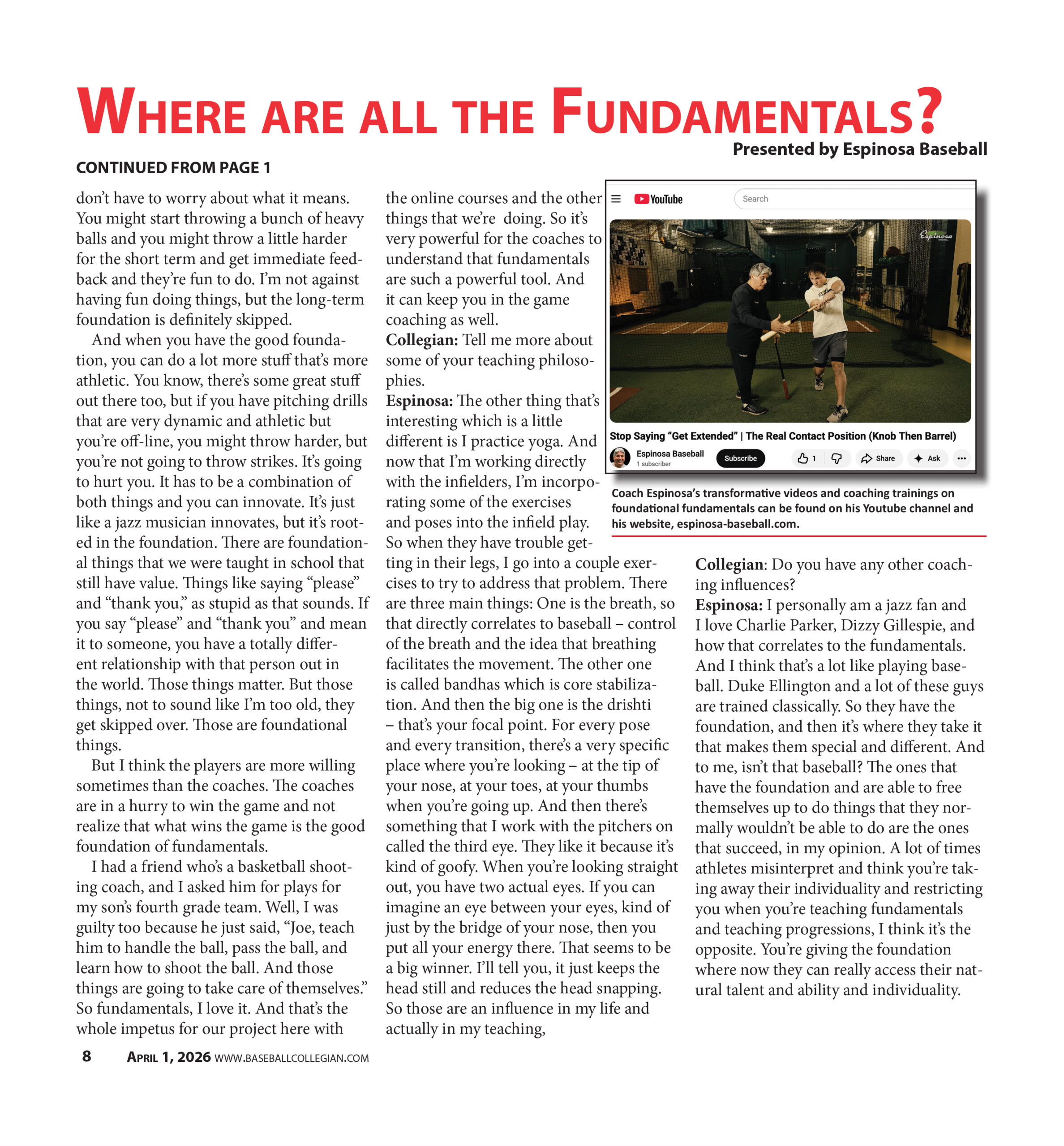
He has learned from everyone over a life in coaching. The information is great, but the positivity is amazing. You want to be coached by Joe Espinosa.
Espinosa has coached infielders at Yale University, Amherst College, and at Eastern Conn. St. where they won a DIII National championship with a 49-3 record. He has also coached thousands of players in private training over many decades.
At the foundation of his teaching is fundamentals. It is refreshing as it seems like they are not a part of the conversation enough. And no, this is not about old-school vs. new-school, this is about winning games and players doing great things. Because at the heart of great athletic success lies consistency, which is born out of strong fundamental technique.
In this wide-ranging conversation, we talk with Joe about his experiences and best practices as a coach.
Collegian: Fundamentals are so important. And while there’s so much information out there, it still feels like they’re getting skipped a lot. Why is that happening?
Espinosa: I think they take work. They take time and you have to invest time in learning them. And then you have to invest a lot of time in practicing them. And you may not get the immediate results. If you just take the newest thing off Instagram or something, or a drill that might look really cool, you don’t have to worry about what it means. You might start throwing a bunch of heavy balls and you might throw a little harder for the short term and get immediate feedback and they’re fun to do. I’m not against having fun doing things, but the long-term foundation is definitely skipped.
And when you have the good foundation, you can do a lot more stuff that’s more athletic. You know, there’s some great stuff out there too, but if you have pitching drills that are very dynamic and athletic but you’re off-line, you might throw harder, but you’re not going to throw strikes. It’s going to hurt you. It has to be a combination of both things and you can innovate. It’s just like a jazz musician innovates, but it’s rooted in the foundation. There are foundational things that we were taught in school that still have value. Things like saying “please” and “thank you,” as stupid as that sounds. If you say “please” and “thank you” and mean it to someone, you have a totally different relationship with that person out in the world. Those things matter. But those things, not to sound like I’m too old, they get skipped over. Those are foundational things.
But I think the players are more willing sometimes than the coaches. The coaches are in a hurry to win the game and not realize that what wins the game is the good foundation of fundamentals.
I had a friend who’s a basketball shooting coach, and I asked him for plays for my son’s fourth grade team. Well, I was guilty too because he just said, “Joe, teach him to handle the ball, pass the ball, and learn how to shoot the ball. And those things are going to take care of themselves.” So fundamentals, I love it. And that’s the whole impetus for our project here with the online courses and the other things that we’re doing. So it’s very powerful for the coaches to understand that fundamentals are such a powerful tool. And it can keep you in the game coaching as well.
Collegian: Tell me more about some of your teaching philosophies.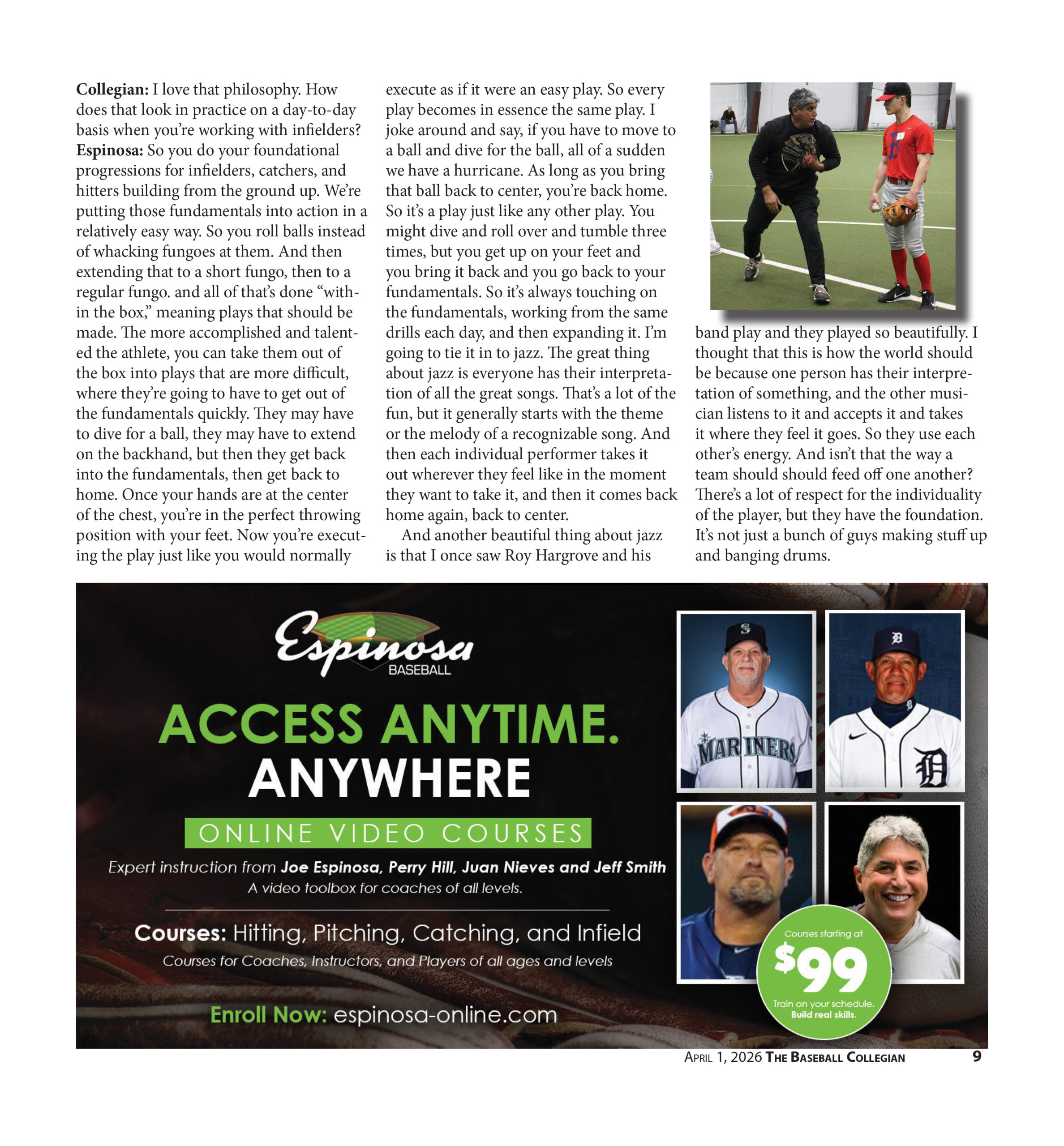
Espinosa: The other thing that’s interesting which is a little different is I practice yoga. And now that I’m working directly with the infielders, I’m incorporating some of the exercises and poses into the infield play. So when they have trouble getting in their legs, I go into a couple exercises to try to address that problem. There are three main things: One is the breath, so that directly correlates to baseball – control of the breath and the idea that breathing facilitates the movement. The other one is called bandhas which is core stabilization. And then the big one is the drishti – that’s your focal point. For every pose and every transition, there’s a very specific place where you’re looking – at the tip of your nose, at your toes, at your thumbs when you’re going up. And then there’s something that I work with the pitchers on called the third eye. They like it because it’s kind of goofy. When you’re looking straight out, you have two actual eyes. If you can imagine an eye between your eyes, kind of just by the bridge of your nose, then you put all your energy there. That seems to be a big winner. I’ll tell you, it just keeps the head still and reduces the head snapping. So those are an influence in my life and actually in my teaching,
Collegian: Do you have any other coaching influences?
Espinosa: I personally am a jazz fan and I love Charlie Parker, Dizzy Gillespie, and how that correlates to the fundamentals. And I think that’s a lot like playing baseball. Duke Ellington and a lot of these guys are trained classically. So they have the foundation, and then it’s where they take it that makes them special and different. And to me, isn’t that baseball? The ones that have the foundation and are able to free themselves up to do things that they normally wouldn’t be able to do are the ones that succeed, in my opinion. A lot of times athletes misinterpret and think you’re taking away their individuality and restricting you when you’re teaching fundamentals and teaching progressions, I think it’s the opposite. You’re giving the foundation where now they can really access their natural talent and ability and individuality.
Collegian: : I love that philosophy. How does that look in practice on a day-to-day basis when you’re working with infielders?
Espinosa: So you do your foundational progressions for infielders, catchers, and hitters building from the ground up. We’re putting those fundamentals into action in a relatively easy way. So you roll balls instead of whacking fungoes at them. And then extending that to a short fungo, then to a regular fungo. and all of that’s done “within the box,” meaning plays that should be made. The more accomplished and talented the athlete, you can take them out of the box into plays that are more difficult, where they’re going to have to get out of the fundamentals quickly. They may have to dive for a ball, they may have to extend on the backhand, but then they get back into the fundamentals, then get back to home. Once your hands are at the center of the chest, you’re in the perfect throwing position with your feet. Now you’re executing the play just like you would normally execute as if it were an easy play. So every play becomes in essence the same play. I joke around and say, if you have to move to a ball and dive for the ball, all of a sudden we have a hurricane. As long as you bring that ball back to center, you’re back home. So it’s a play just like any other play. You might dive and roll over and tumble three times, but you get up on your feet and you bring it back and you go back to your fundamentals. So it’s always touching on the fundamentals, working from the same drills each day, and then expanding it. I’m going to tie it in to jazz. The great thing about jazz is everyone has their interpretation of all the great songs. That’s a lot of the fun, but it generally starts with the theme or the melody of a recognizable song. And then each individual performer takes it out wherever they feel like in the moment they want to take it, and then it comes back home again, back to center.
And another beautiful thing about jazz is that I once saw Roy Hargrove and his band play and they played so beautifully. I thought that this is how the world should be because one person has their interpretation of something, and the other musician listens to it and accepts it and takes it where they feel it goes. So they use each other’s energy. And isn’t that the way a team should should feed off one another? There’s a lot of respect for the individuality of the player, but they have the foundation. It’s not just a bunch of guys making stuff up and banging drums.

Collegian: : So now for the coach that is all in on what you’re saying: You’re probably not talking about Coltrane at baseball practice, but you’re taking that essence. And with your college team, how long do you do that for every day?
Espinosa: About 20 minutes every day. One of my biggest influences as a baseball teacher is Perry Hill (see The Baseball Collegian Issue 7). We used his 6-F’s system at Amherst College originally, and then we took the same system and brought it to Eastern Conn. State and won a national championship. Every time you get your body moving in the right position, go back to the fundamentals. So if I see something, it may be that I ask the player to meet me 15 minutes before everybody gets there. Also, I’ve used video since way back and I think that really roots them in the fundamentals. And as Perry Hill talks about, players have their iPads and they love watching themselves over and over and over again. So take advantage of that.
We start everybody at the foundation, and then we can attend to the individual needs of each player. It’s really being a witness to each player on each rep then individualizing the exercises or routines based on their needs, I know the players really appreciate the individual attention. I have had really great conversations with the kids and I joke with them. I say, “I know I’m a pain in the butt, but I hope I’m helping.” And they’re like, “You’re really helping.” And well, isn’t that everything?
Collegian: : How do you handle a kid that has some hard-wired bad habits? While you’re running them through the drills, and foundational concepts, they keep going back to whatever they’ve done. How do you deal with that?
Espinosa: Yeah. I think the first thing that comes to mind is you have to be patient. Patience and understanding the consistency of working with them every day. They will all get it after a while. They’ll get it at different stages, but then it’s slowing it down and isolating. I think a little bit of video will help him see. Make him aware of it. And then not going on to the next progression until he’s proficient at wherever he is. I joke with the kids: I might say, “You have to field it and funnel.” And they field it, but they don’t funnel. I say, “I asked you for a glass of ice water, but you only gave me water. What are the ingredients? I said ice water. Well, you gave me only one. You didn’t give me the other.”
And this goes with hitting and pitching. A lot of times you take them forward and they’ll regress because their brains are going really fast. But then just bring them back to where they are comfortable and proficient. And usually in one or two reps, they’ll get it back. So if I’m teaching funnel then footwork, and when I add the footwork and he’s not funneling again, we go back to ice water – field & funnel, field & funnel. Okay, now let’s add to it and slow it down so that their body understands it. They may understand it in their brain, but they’re not getting their body to understand it and trust it and feel it.
Back when Dee Gordon went to the Marlins, I was at spring training a lot. And Dee is just coming up to the base and he’s catching the ball and he’s breaking thumbs down and he doesn’t throw. And this goes on for the whole 20-minute session. So I said to Perry Hill, “Hey, what’s up with Dee Gordon?” I thought something’s wrong with his arm. And Perry says, “He’s not up to that yet. I have three-and-a-half more weeks to get him ready.” The next week, he’s breaking, pausing and then throwing. And then three days later, he’s making the throw. And, you know, miracle of miracles, by the time the season starts, he’s making the play far better than any of the other guys. But he had to slow him down to teach him the fundamentals so his body would understand the fundamentals. And our bodies have their own timeline. They’re not necessarily lined up with the timeline that we have as coaches.
Collegian: : The bigger challenge is the one that really doesn’t want to try something and doesn’t want to change anything.
Espinosa: So that’s a difficult one. What I do there, I say, “Let me explain my reasoning.” Let them have their say and why they want to do it, and even give them some reps before saying, “Look, why don’t we do this as an experiment? Let’s do it really slowly and see how it feels.” If the fundamental is correct and the athlete can play a little, you know, usually the result is good. For example, the throw will be on target: “How did that feel?” Or I’ll ask the first baseman, “How was that throw?” When the first baseman says, “That was perfect,” there’s maybe the buy-in a little bit.
So that kind of goes back to the patience to get more out of players. I see it in yoga – when the teacher has an understanding of my limitations and where I am in this moment and accepts that and is willing to work with me. I don’t think I’ve ever met a kid who didn’t want to do well. And I’ve been in so many situations with kids who were “uncoachable” kids with, you know, sometimes problems at home, all different situations. I don’t think I’ve met a kid that when you start talking specifics and you don’t try to push them and you really look at them and really give them the attention and work with them, that doesn’t want to do well. I really mean that. For us as coaches, that’s really No. 1.
