
The trend is training.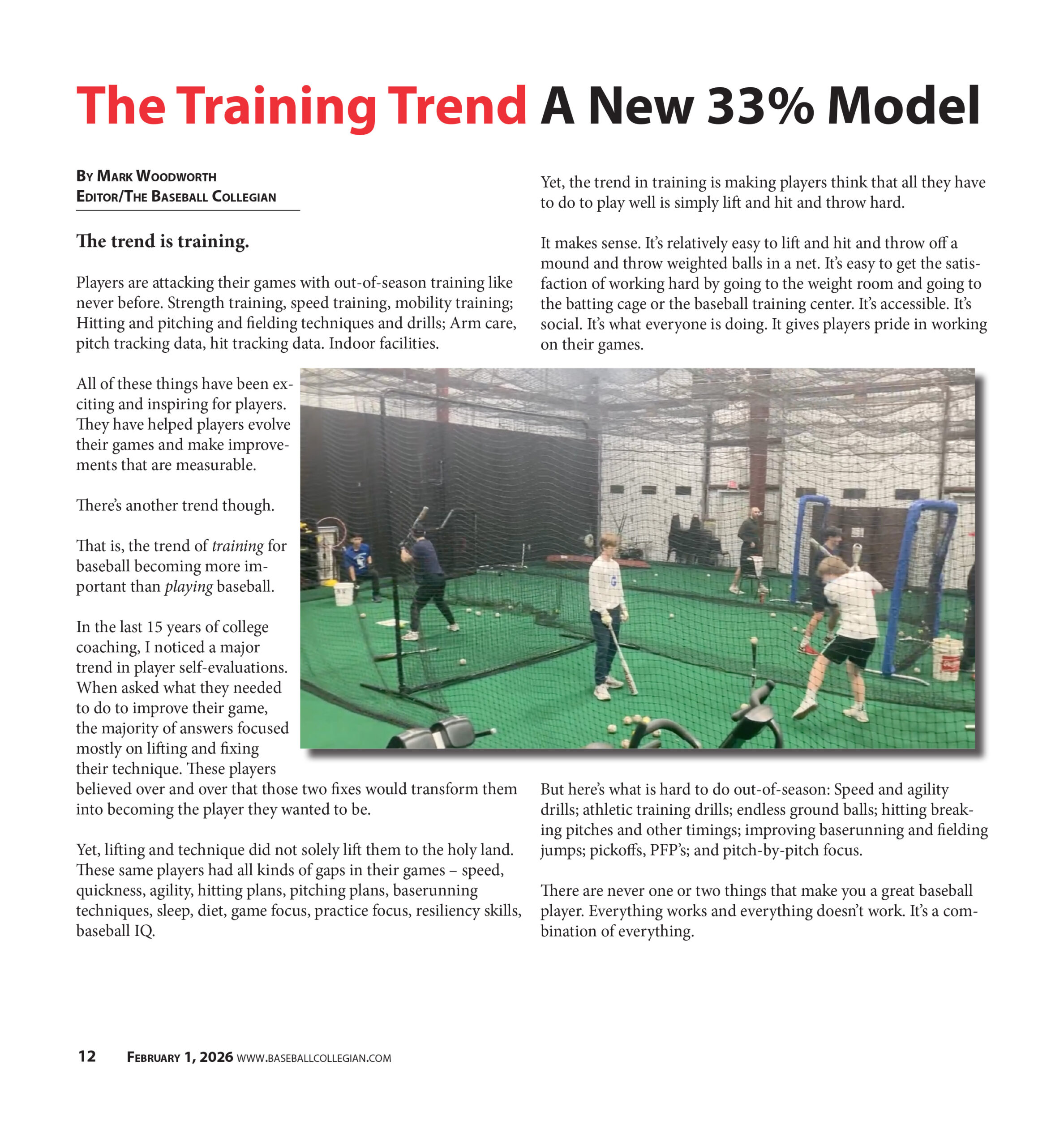
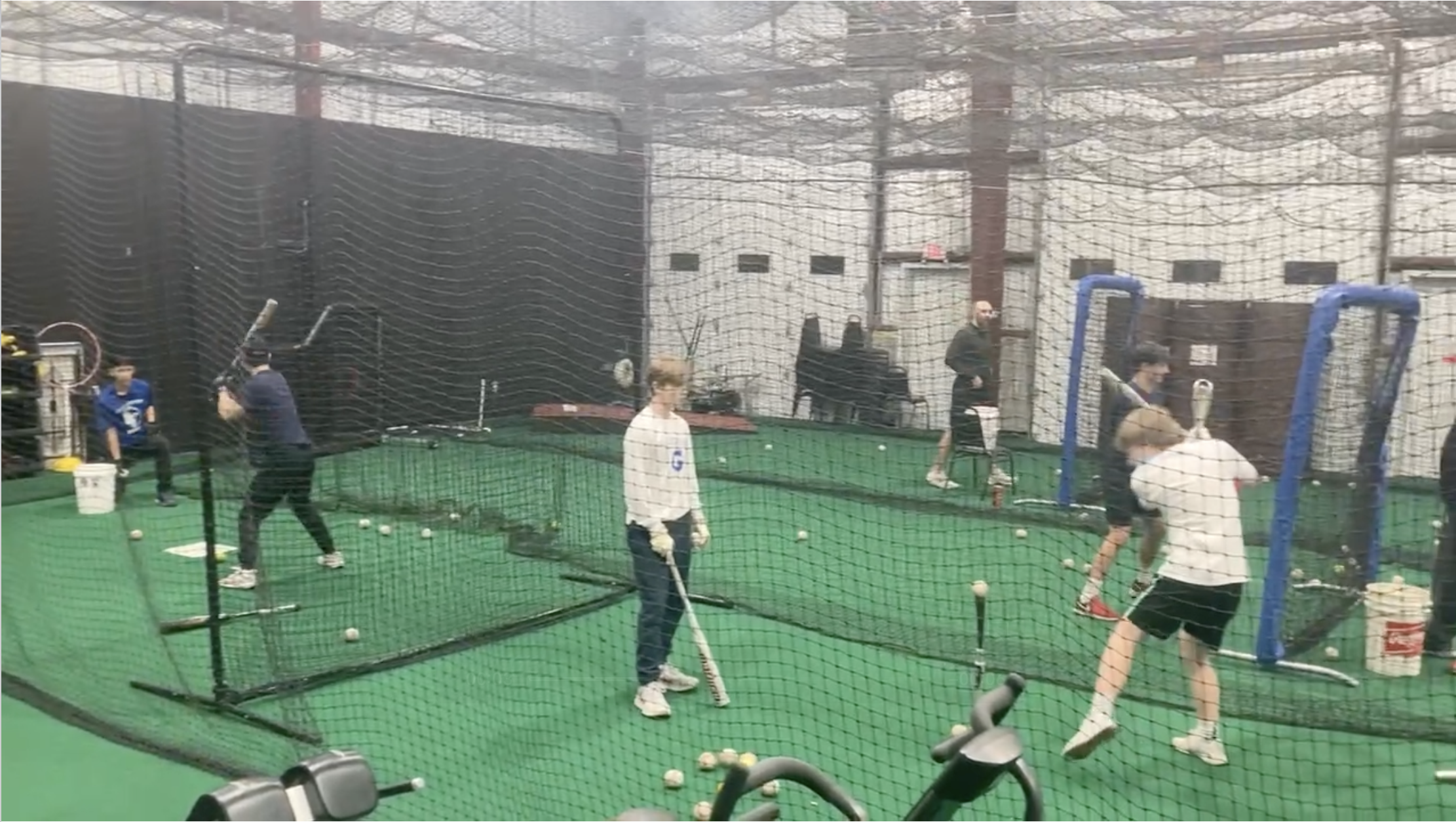
Players are attacking their games with out-of-season training like never before. Strength training, speed training, mobility training; Hitting and pitching and fielding techniques and drills; Arm care, pitch tracking data, hit tracking data. Indoor facilities.
All of these things have been exciting and inspiring for players. They have helped players evolve their games and make improvements that are measurable.
There’s another trend though.
That is, the trend of training for baseball becoming more important than playing baseball.
In the last 15 years of college coaching, I noticed a major trend in player self-evaluations. When asked what they needed to do to improve their game, the majority of answers focused mostly on lifting and fixing their technique. These players believed over and over that those two fixes would transform them into becoming the player they wanted to be.
Yet, lifting and technique did not solely lift them to the holy land. These same players had all kinds of gaps in their games – speed, quickness, agility, hitting plans, pitching plans, baserunning techniques, sleep, diet, game focus, practice focus, resiliency skills, baseball IQ.
Yet, the trend in training is making players think that all they have to do to play well is simply lift and hit and throw hard.
It makes sense. It’s relatively easy to lift and hit and throw off a mound and throw weighted balls in a net. It’s easy to get the satisfaction of working hard by going to the weight room and going to the batting cage or the baseball training center. It’s accessible. It’s social. It’s what everyone is doing. It gives players pride in working on their games.
But here’s what is hard to do out-of-season: Speed and agility drills; athletic training drills; endless ground balls; hitting breaking pitches and other timings; improving baserunning and fielding jumps; pickoffs, PFP’s; and pitch-by-pitch focus.
There are never one or two things that make you a great baseball player. Everything works and everything doesn’t work. It’s a combination of everything.
Yet, the issues in the trends of training need to be addressed. Part of the problem is the Covid shutdown: As one coach put it, “Training was the only thing players knew and could do.” That legacy is embedded in players. However, it seems imperative the things coaches talk about (and lament) – fielding, baserunning, IQ and feel for the game, battling, perseverance – be worked on in their training.
Thus, here’s a concept to training that will better prepare players for actually playing baseball, not just training for baseball.
The 33% Model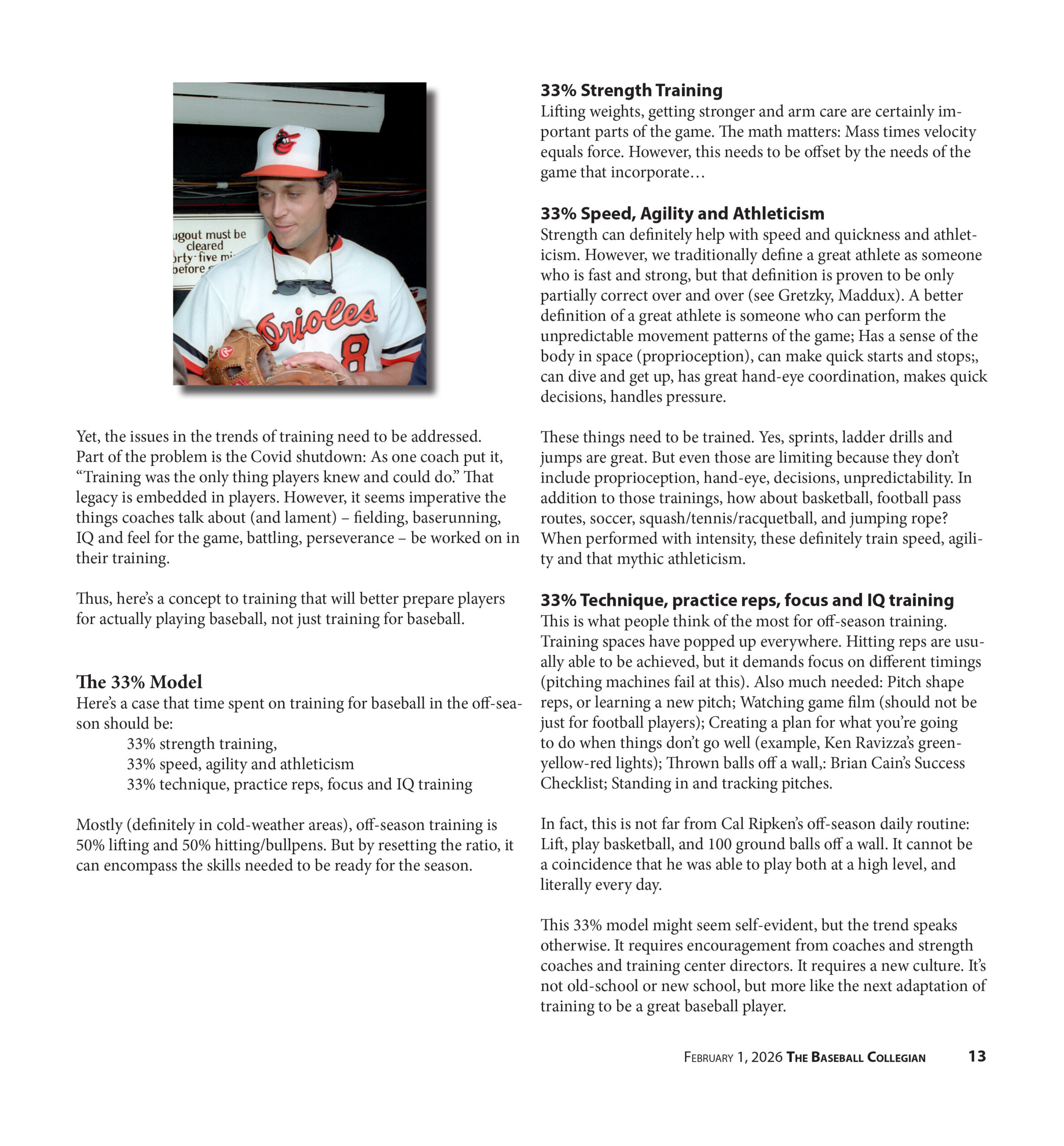
Here’s a case that time spent on training for baseball in the off-season should be:
33% strength training,
33% speed, agility and athleticism
33% technique, practice reps, focus and IQ training
Mostly (definitely in cold-weather areas), off-season training is 50% lifting and 50% hitting/bullpens. But by resetting the ratio, it can encompass the skills needed to be ready for the season.
33% Strength Training
Lifting weights, getting stronger and arm care are certainly important parts of the game. The math matters: Mass times velocity equals force. However, this needs to be offset by the needs of the game that incorporate…
33% Speed, Agility and Athleticism
Strength can definitely help with speed and quickness and athleticism. However, we traditionally define a great athlete as someone who is fast and strong, but that definition is proven to be only partially correct over and over (see Gretzky, Maddux). A better definition of a great athlete is someone who can perform the unpredictable movement patterns of the game; Has a sense of the body in space (proprioception), can make quick starts and stops;, can dive and get up, has great hand-eye coordination, makes quick decisions, handles pressure.
These things need to be trained. Yes, sprints, ladder drills and jumps are great. But even those are limiting because they don’t include proprioception, hand-eye, decisions, unpredictability. In addition to those trainings, how about basketball, football pass routes, soccer, squash/tennis/racquetball, and jumping rope? When performed with intensity, these definitely train speed, agility and that mythic athleticism.
This is what people think of the most for off-season training. Training spaces have popped up everywhere. Hitting reps are usually able to be achieved, but it demands focus on different timings (pitching machines fail at this). Also much needed: Pitch shape reps, or learning a new pitch; Watching game film (should not be just for football players); Creating a plan for what you’re going to do when things don’t go well (example, Ken Ravizza’s green-yellow-red lights); Thrown balls off a wall,: Brian Cain’s Success Checklist; Standing in and tracking pitches.
In fact, this is not far from Cal Ripken’s off-season daily routine: Lift, play basketball, and 100 ground balls off a wall. It cannot be a coincidence that he was able to play both at a high level, and literally every day.
This 33% model might seem self-evident, but the trend speaks otherwise. It requires encouragement from coaches and strength coaches and training center directors. It requires a new culture. It’s not old-school or new school, but more like the next adaptation of training to be a great baseball player.
