Pitching a baseball is not only a biomechanical act — it’s a battle of perception, intelligence, and will. Just as generals shape battlefields, pitchers shape at-bats. The great philosophers of war — Sun Tzu, Carl von Clausewitz, and Niccolò Machiavelli — provide a timeless framework for understanding how to dominate the mound strategically, psychologically, and tactically.
Introduction
1. Sun Tzu — The Art of Pitching through Deception and Awareness
Core Principles:
• Strategy, deception, timing, awareness of self and opponent.
Pitching Applications:
• Deception: Mix pitches and tunnel movements to disguise intent; every delivery must mask the next.
• Awareness: Study the hitter’s tendencies and body language — “Know your enemy and know yourself.”
• Tempo Control: Just as a General dictates when to attack, a pitcher controls pace and rhythm to unsettle the opponent.
• Terrain: The mound is your battlefield — own it with posture, energy, and confidence.
• Sun Tzu’s Pitching Mantra: Win before the battle begins. Prepare so thoroughly that the hitter’s defeat is inevitable.
2. Clausewitz—The Science of Pitching through Structure & Adaptation
Core Principles:
• Friction, fog of war, center of gravity, moral courage, adaptability.
Pitching Applications:
• Friction: Handle adversity — bad calls, errors, missed spots — with composure and persistence.
• Fog of War: Make decisions with incomplete information; rely on intuition built from preparation.
• Center of Gravity: Find each hitter’s weakness — their “source of strength” — and attack it relentlessly.
Adaptability:
• Change your plan in real-time; a rigid pitcher loses to fluid circumstances.
Moral Courage:
• Command presence on the mound; project confidence even when uncertain.
Clausewitz’s Pitching Mantra:
• Victory belongs to the pitcher who adjusts faster than the hitter.
3. Machiavelli — The Politics of Pitching through Control and Cunning
Core Principles:
• Power, manipulation, pragmatism, perception management.
Pitching Applications:
• Psychological Warfare: Command the strike zone and the hitter’s mind — induce fear, hesitation, and doubt.
Calculated Risk:
• Walks or brush-back pitches, used wisely, can shift psychological power.
Reputation:
• Build the image of dominance; your presence influences outcomes before the first pitch.
Pragmatism:
• Throw not the “perfect” pitch, but the necessary one for the situation.
Machiavelli’s Pitching Mantra:
• Control perception; power follows presence.
4. The Unified Philosophy — The Complete Strategist on the Mound
The Integrated Model:
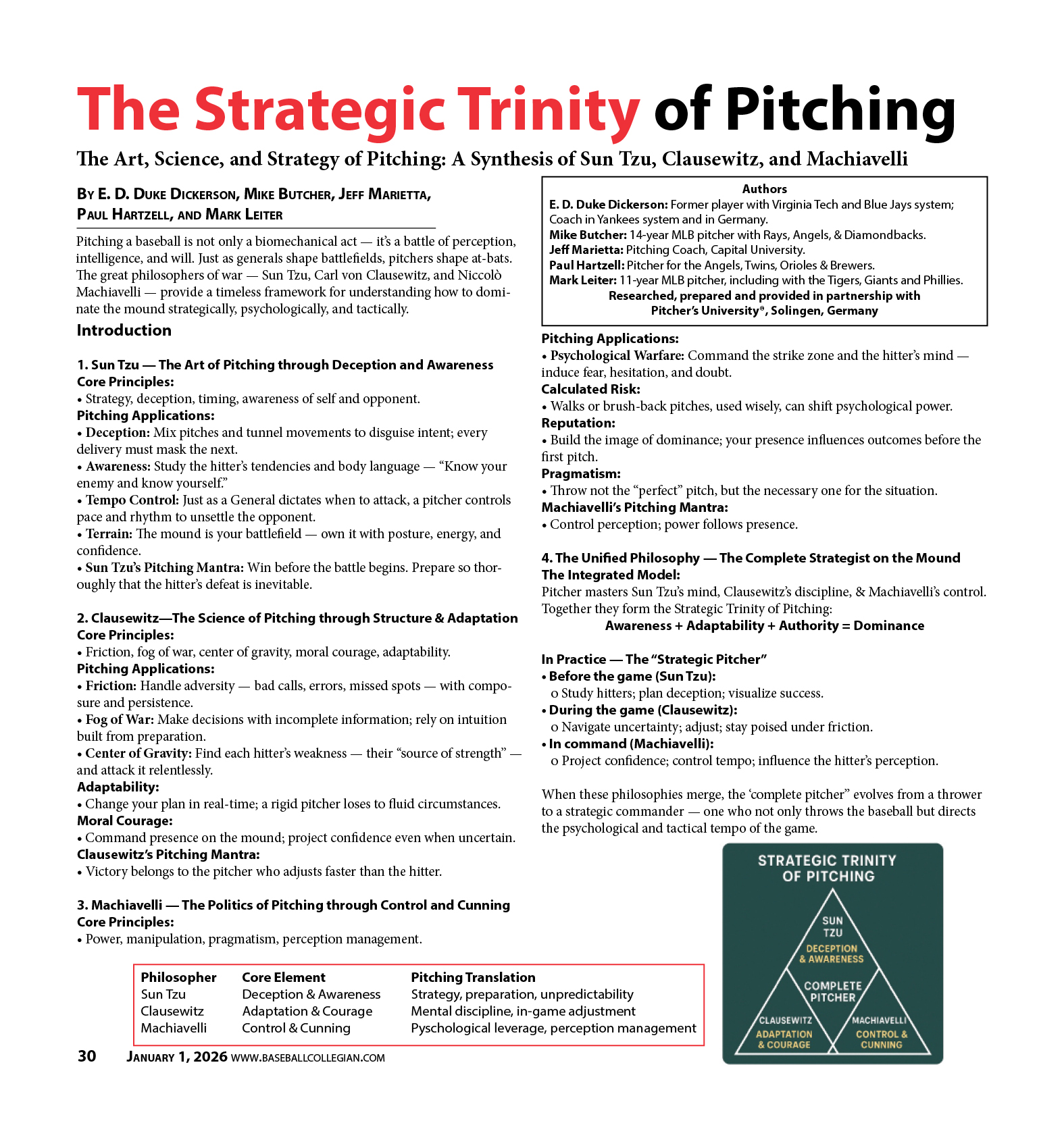
Pitcher masters Sun Tzu’s mind, Clausewitz’s discipline, & Machiavelli’s control.
Together they form the Strategic Trinity of Pitching:
Awareness + Adaptability + Authority = Dominance
In Practice — The “Strategic Pitcher”
• Before the game (Sun Tzu):
o Study hitters; plan deception; visualize success.
• During the game (Clausewitz):
o Navigate uncertainty; adjust; stay poised under friction.
• In command (Machiavelli):
o Project confidence; control tempo; influence the hitter’s perception.
When these philosophies merge, the ‘complete pitcher” evolves from a thrower to a strategic commander — one who not only throws the baseball but directs the psychological and tactical tempo of the game.
Authors
E. D. Duke Dickerson: Former player with Virginia Tech and Blue Jays system; Coach in Yankees system and in Germany.
Mike Butcher: 14-year MLB pitcher with Rays, Angels, & Diamondbacks.
Jeff Marietta: Pitching Coach, Capital University.
Paul Hartzell: Pitcher for the Angels, Twins, Orioles & Brewers.
Mark Leiter: 11-year MLB pitcher, including with the Tigers, Giants and Phillies.
Researched, prepared and provided in partnership with Pitcher’s University®, Solingen, Germany