What does the mental game of baseball mean? It infers that players think the right thoughts so they can play well. That sounds fine.
So then the inverse must be true: When a player doesn’t play well, it is because they are thinking the wrong thoughts.
But isn’t that a cynical way to look at the game? If you are not playing well, it’s because you are not smart enough. This sounds like grade school bullying stuff.
What if you know everything about baseball, but cannot feel subtle distinctions in your swing? What if your physiology only allows certain strengths or speeds? Couldn’t these be problems?
A common response is that the mental game is the difference when all physical things are equal. That sounds good, but when is that ever really the case? Everyone brings different skills to the table in various combinations.
Here’s a thought exercise: If the mental game was so overhwlelmingly important, shouldn’t Einstein have been the best baseball player ever? And why aren’t there 70-year-old genius managers currently playing at a Hall-of-Fame level?
The mental game is absolute important. The physical game is well. So what are we talking about?
The mental game and the physical game are treated as separate things to master. In reality, there is a bridge connecting the two, and it is essential to understand this in order to improve your game.
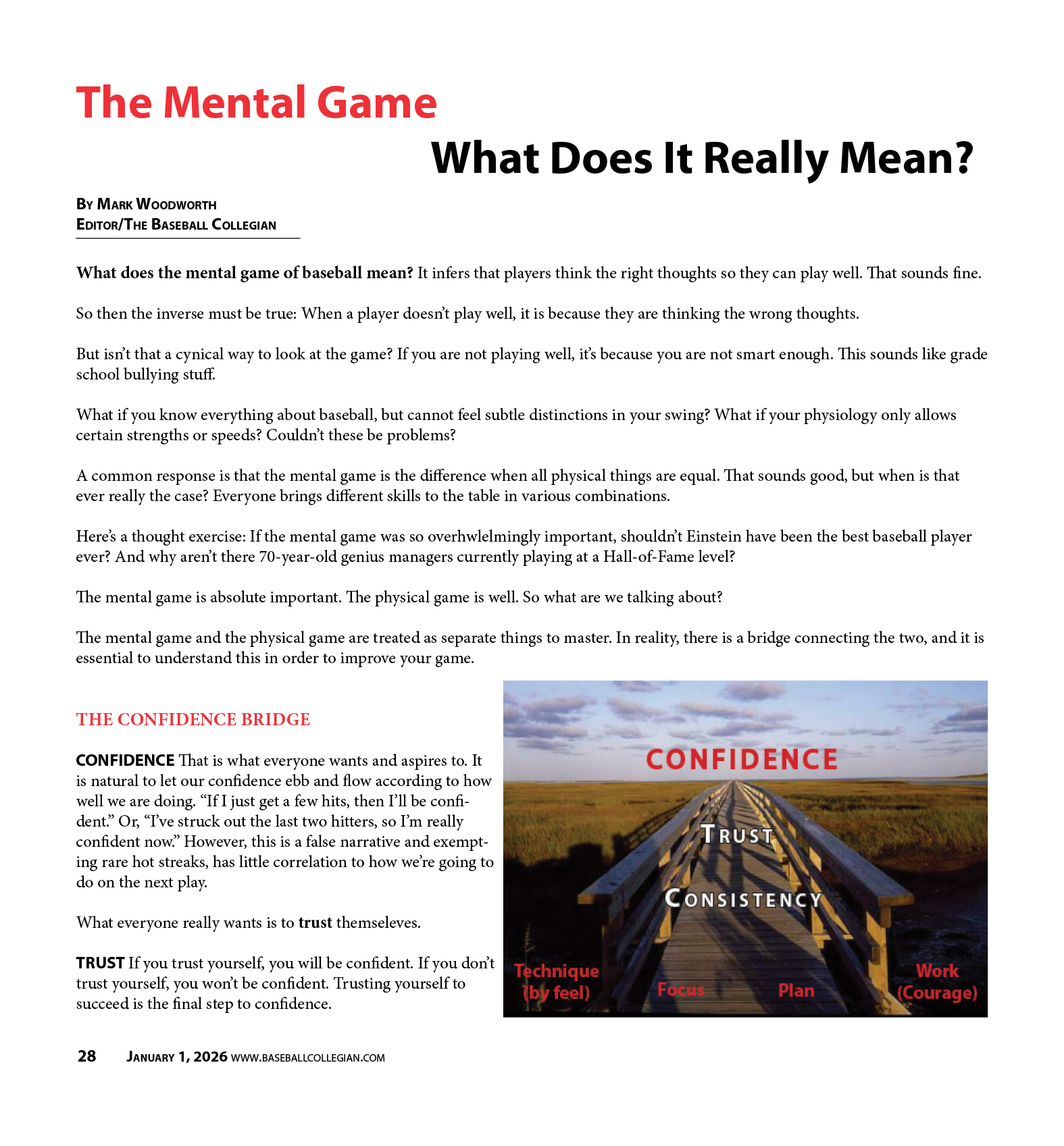
The Confidence BRIDGE
CONFIDENCE That is what everyone wants and aspires to. It is natural to let our confidence ebb and flow according to how well we are doing. “If I just get a few hits, then I’ll be confident.” Or, “I’ve struck out the last two hitters, so I’m really confident now.” However, this is a false narrative and exempting rare hot streaks, has little correlation to how we’re going to do on the next play.
What everyone really wants is to trust themseleves.
TRUST If you trust yourself, you will be confident. If you don’t trust yourself, you won’t be confident. Trusting yourself to succeed is the final step to confidence.
However, what is the source of trust (and in turn, confidence)? Consistency.
CONSISTENCY If you consistently succeed, you will trust yourself to come through when the time comes. If you are inconsistent, then you won’t trust yourself, and in turn, won’t be confident. We will be confident if we are consistent.
What is the source of consistency? This is where the bridge to the physical world takes place. In essence, there are four elements that contribute to consistency:
1) Technique. If you have good technique, you might not make every play, but you’ll be consistent, and therefore trust yourself, and therefore be confident. If you don’t have good technique, you might have some success, but you will be inconsistent, and thus, not confident. Good technique is best acquired and implemented by feel.
2) Focus. If you focus (i.e. pay attention to) what is important (the ball, the bat, the glove, your body, the field), that will help your consistency. If you are focusing on the fans cheering when the pitch is coming, you won’t be focused, and it will lead to inconsistency, and thus, lack of trust and lack of confidence.
3) Plan. You must have a good plan that will allow you to consistently succeed. If your plan is to swing at curveballs and he only throws fastballs, your plan is getting in the way of success. Similarly, if you practice pitching fastballs all the time, but never work on your offspeed pitches, then you won’t be consistent on the mound, and thus won’t have trust, nor confidence.
4) Work Ethic. If you don’t have the courage to work hard at your craft, be it practicing your technique, creating a plan, or cultivating the skill of focus, then you won’t be consistent. And thus, you won’t trust yourself, and thus, you won’t be confident.
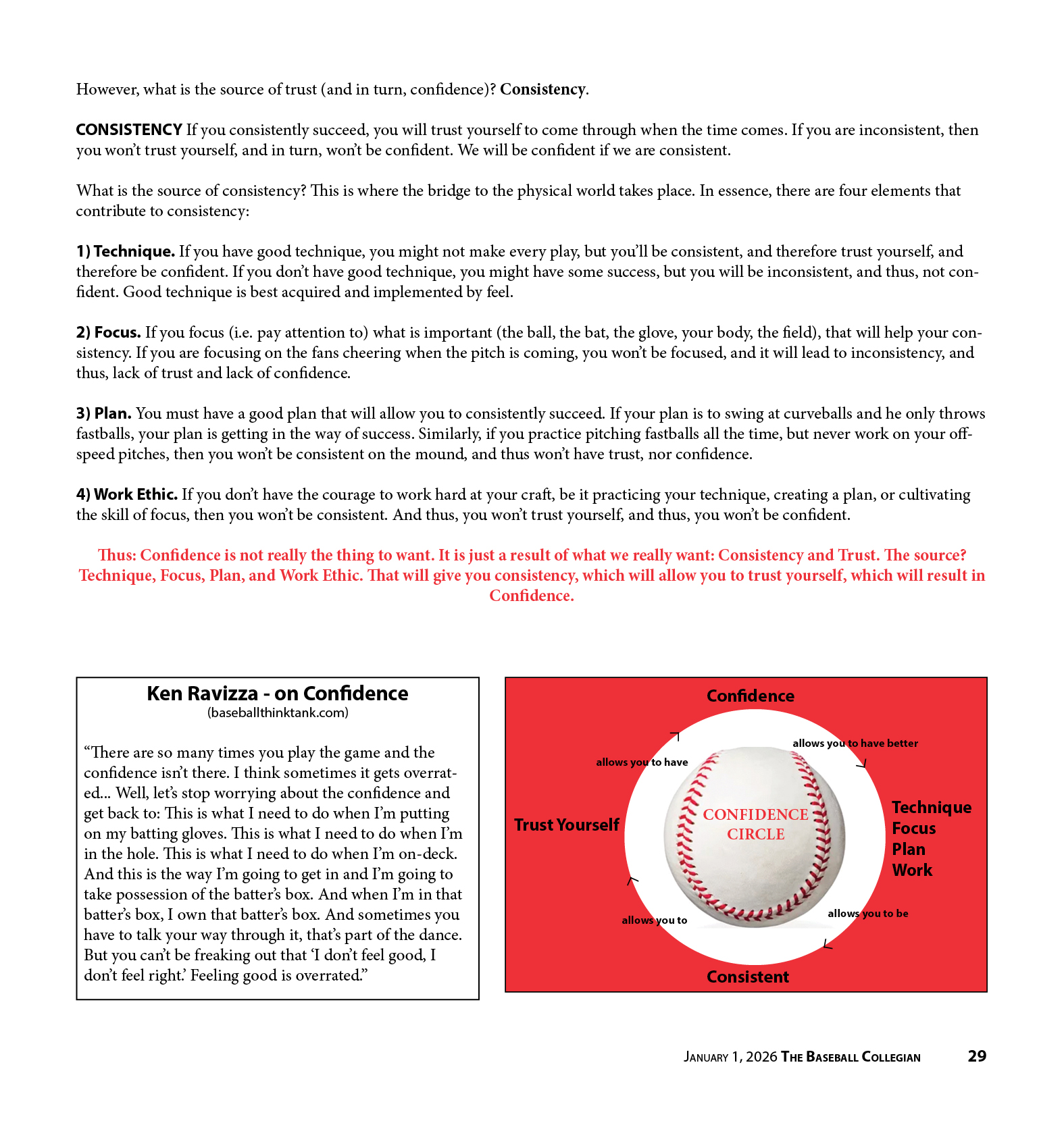
Thus: Confidence is not really the thing to want. It is just a result of what we really want: Consistency and Trust. The source? Technique, Focus, Plan, and Work Ethic. That will give you consistency, which will allow you to trust yourself, which will result in Confidence.