

“New paradigms change the game, and maybe the V-Flex training is the next wave of baseball as we get tired of computer data when we have our own computer in our brains.” – Martin Rubinoff, Masters of Sport Science
Baseball coaches are chasing all kinds of innovations: technique tips, exit velocity, pitch break, strength training, sleep, nutrition. Lots of 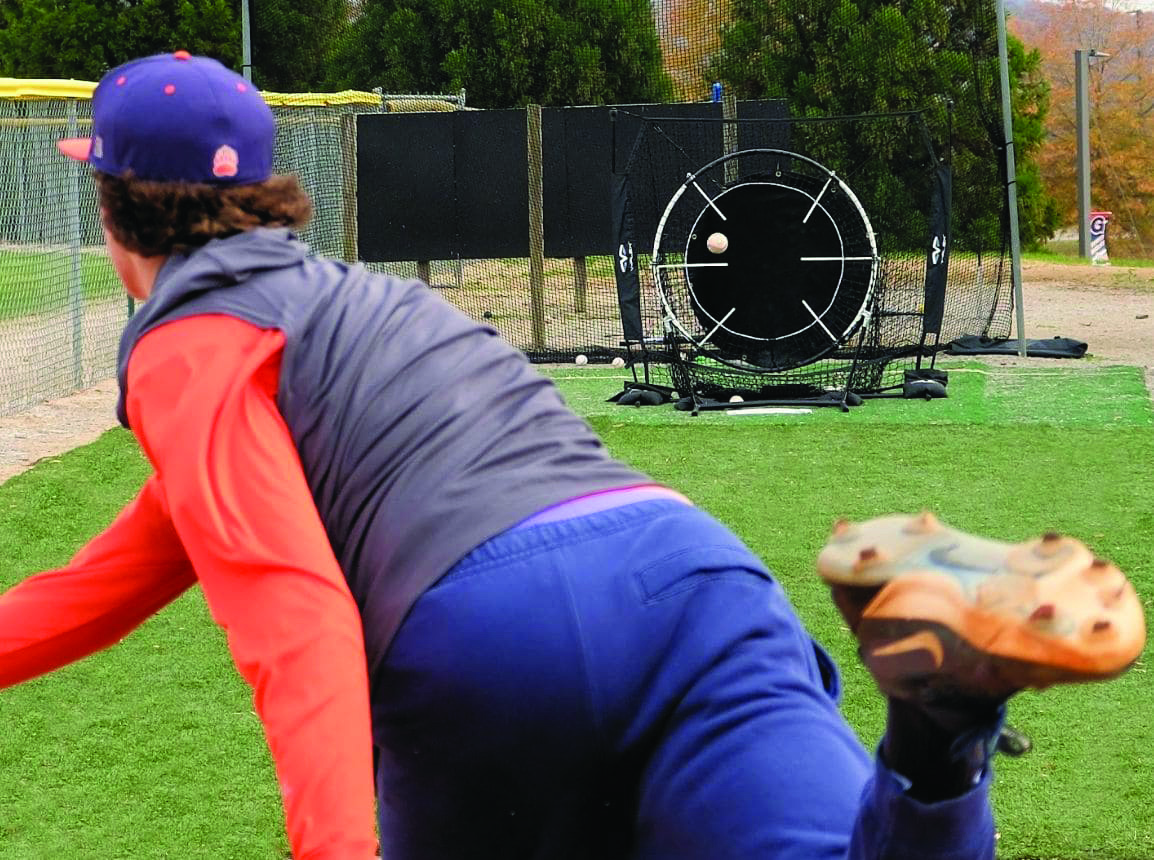 ideas and gadgets, and lots of promises out there to save our players from failure. Is there some holy grail technique or mental game philosophy? Maybe, maybe not, but regardless, it is imperative – almost a duty of coaches – to explore the possibility that there is something greater for our players.
We’re in a period of a great sorting-out of what really brings value. Lasting innovation comes from seeing possibilities in the future first, and the V-Flex screen system is one of those possibilities.
Why do certain hitters consistently synchronize with elite velocity while others fail despite comparable physical tools? – Martin Rubinoff
You might have seen V-Flex nets here and there, but besides the space age-looking nets, does anyone really know what they’re all about?
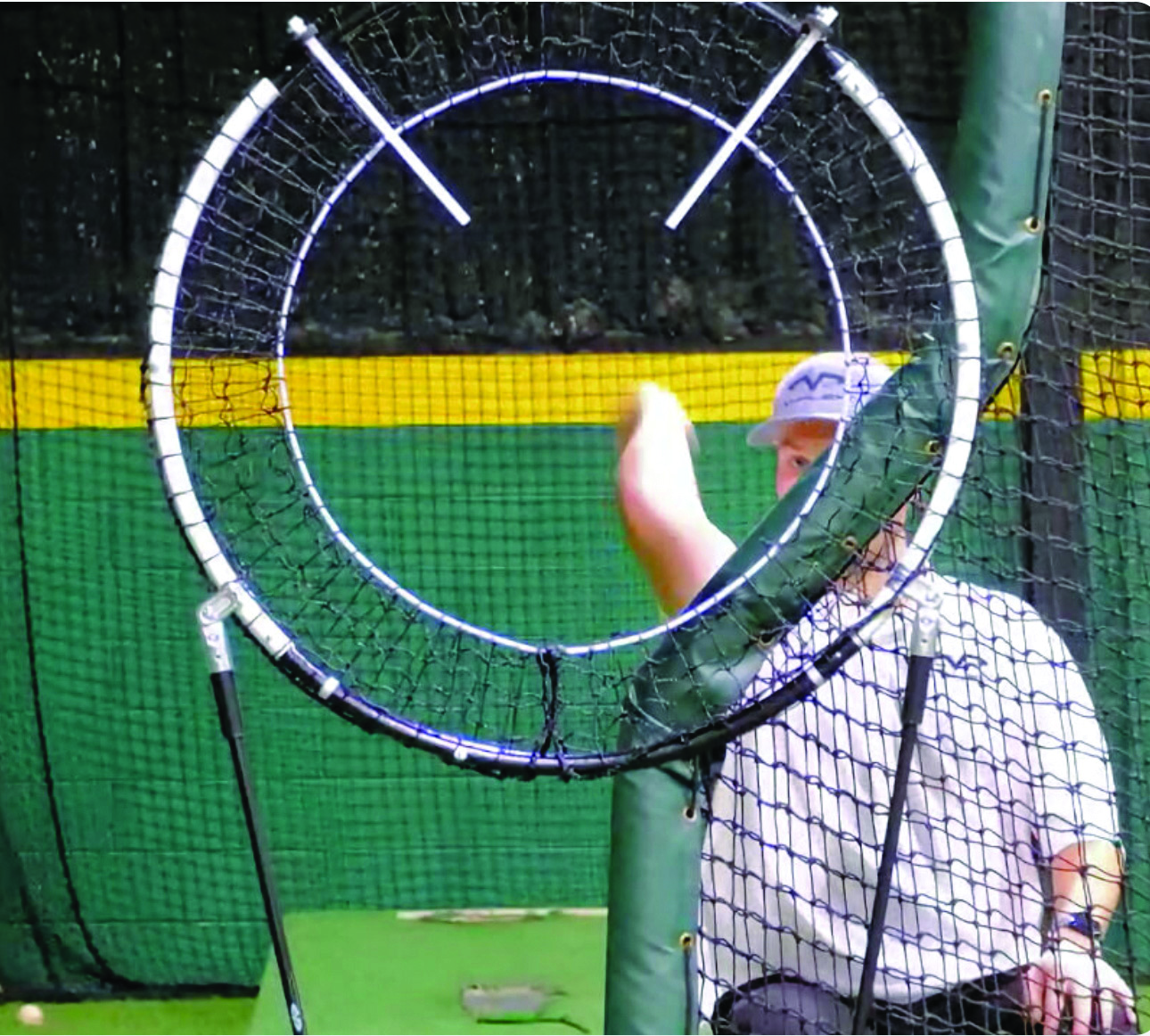
“Primarily, the objective of V-Flex training is to improve strike recognition for hitters and pitch command for hitters,” says V-Flex creator Tim Nicely. “You’re bringing space: the thing that surrounds the objects that make the object appear more dimensional, more vivid, more vibrant. In order to do that, you have to make the space around it stand out.”
 We are talking about improving pitch selection and pitch location. But we’re really talking about space. But what does this mean? One analogy is to think of the FedEx Logo. If you look at it the right way, you can see the white space between the E and X forms an arrow. It’s just white space, but we can see it because of the context of the letters around it.
In baseball, space gives us way more clues than we ever know. Tracking pitches is simply seeing the ball in space. Throwing to a target is really throwing through space. For hitters, they are making distinctions between pitches a little low, a little high, a little out. For pitchers, they are making similar fine distinctions with their release point. Anything to train this is at the source of baseball success.
The V-Flex nets train the context to better make distinctions in space so the body can react better.
“Natural human space is low resolution,” says Nicely. “If you want to see in high resolution, put a V-Flex net in front of you as a picture, and you’re uploading high resolution imagery. Focus and attention will automatically go up because the brain’s perceptual system is being invited to a space where the probability of a strike appearing is extremely high.”
The Science
All right. Let’s get the science out of the way. In physics, there is classical perception (the physical world) and also pre-perception (the brain). The brain clearly has some sort of role, but do we really know how to use it? Is it possible that the study of pre-perception physics can train the neurons in our brain to hit and pitch better?
 Nicely: “You’ve heard a lot of scientists say it’s physically impossible to hit a baseball. You should not be able to do it because of the math: three hundred millionths of a second to make a choice and swing a bat. That’s just unbelievable.
“This concept aligns with multiple neuroscience theories. Under this framework, hitters do not merely react to pitches. Rather, they use visual information, anticipatory timing, and motor synchronization.
“Because these are attractors, their brain is being pulled to those locations. So over about a two-to-three week period, their complete kinetic chain of physicality changes without any coaching really. That’s because the body is adjusting to these electrical constraints that the V-Flex is placing inside their brain, with the electromagnetic field, the imagery that goes to the eyes.
“See, the brain is picking up everything. It has feeds of information. It notices the pitcher’s shoulders, the pitchers hips, the pitchers legs. It’s actually reading the waves that are coming off of the pitcher’s body.”
Sensing and the Body
The relationship between sensing (including seeing the ball) and your body, is immense. We make intricate subconscious physical decisions all the time: walking, eating, driving, talking. In baseball, the high-speed actions demand even more.
“You know, what happens upstream will eventually make it downstream, says Nicely. “If you want to affect the muscles firing to generate either a pitch or a swing, you actually have to affect the upstream information. There are a lot of people trying to fix things downstream, by fixing the swing and the mechanical features of the body.
“But we’re trying to provide the brain upstream information – a better interpretation of where it is in space. Where my body is, where my hands are, where my hips are is all related to the feeling of: where am I in space? Making the spatial component of the brain a better processor. Then you’re going to be better at what you do.”
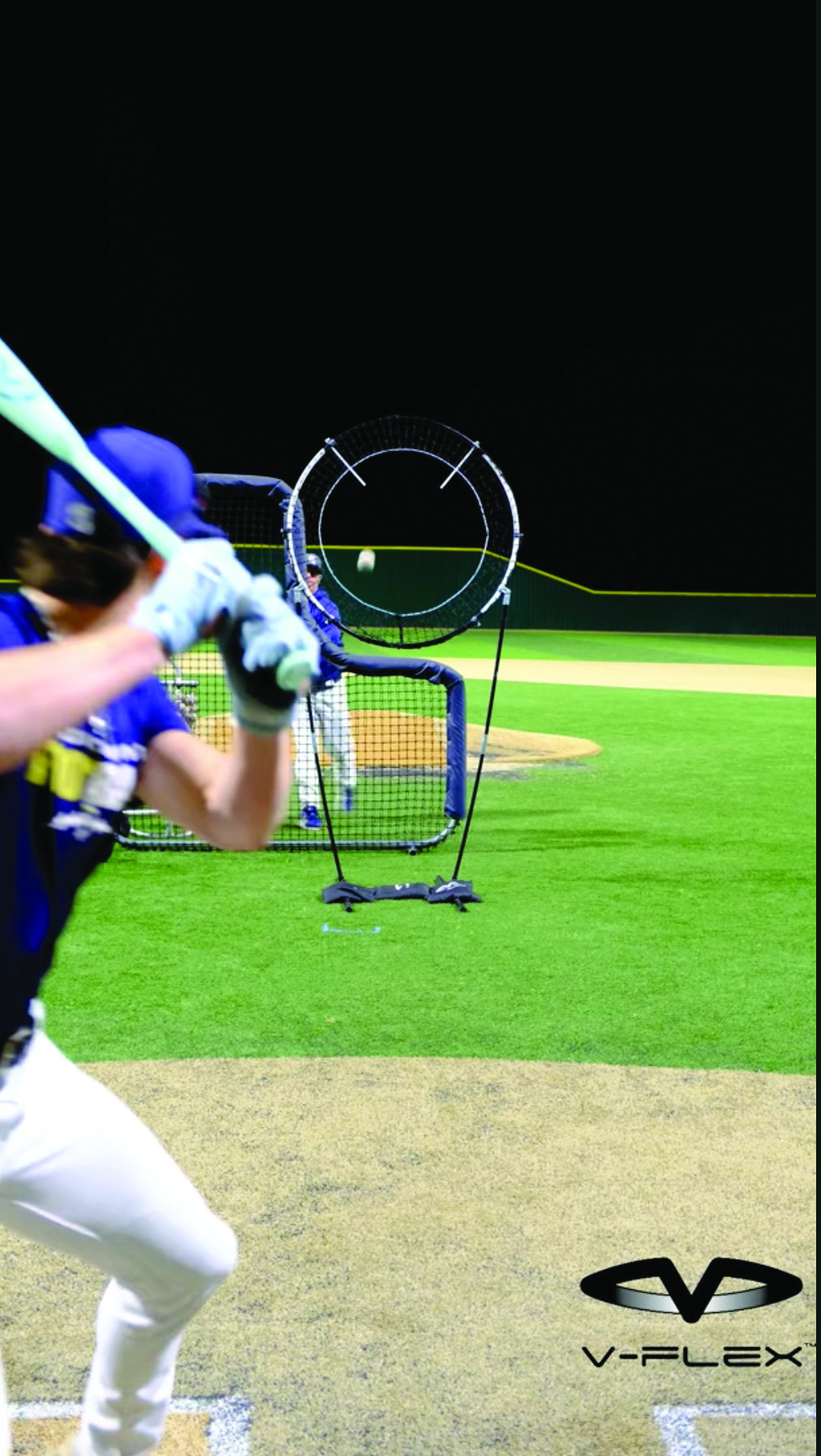 “I mean, yes, we’re going for higher batting averages and things like that. But do they feel their swing, does their swing feel better?
“They feel like they have more time to process the ball, even though that’s not the case. The time is the same, but the brain is doing a better job of basically predicting where the ball is going to be because the information around the ball is better than not having anything at all. We get comments from them that, ‘Hey, it seems like I can wait longer. I see the ball farther.’
“On the pitching side, the same thing holds true. You’ll hear the same thing: ‘I feel more comfortable throwing my pitches now, I feel like I have more control of the zone.’”
The concept is that the information that we are receiving directly informs our actions without even knowing it. You don’t need to have a PhD in physics.
Nicely: “I want for the coaches to see the value in this. They don’t have to understand the physics, but they have to understand they want their players to get better.
“There has to be a new way of looking at the information they’re receiving from Trackman or Synergy. Put a V-Flex out there, you will see strike zone tendencies change within that data set. But if you don’t put a V-Flex there, your zones will never change because you didn’t do anything to change the electromagnetic field, the interpretation within that field of that brain. You do these drills three days a week on your field, then you will see these numbers start to move.”
Coaches
One of the interesting aspects for coaches is that while they are spending all this money on data and pitch communication systems, the game is in the physical world. The V-Flex nets are inexpensive and simple to use – the pitcher or BP pitcher simply throws the ball through the opening in the screen. The training does the work.
“Now the coach is asking himself, how do I use this to help my players?,” says Nicely. “No matter if you’re the pitcher, the hitter, or if you’re the coach, everybody sees this thing in a new light. They know that change has come.”
East Carolina, Maryland, Dallas Baptist are prime adopters of the system, while schools like World Series champion Oklahoma, Georgia, San Diego State and Stanford also have it. In softball, 55 of the 64 NCAA teams use it, including every SEC team. In baseball, 10 of the 64 NCAA teams use it and 17 MLB organizations as well.
Nicely: “You will gain value much faster. That’s what we’ve seen in the data we’ve collected – you gain nearly a complete year on people that do not train on V-Flex, because you’re putting a quarter in your pocket every time you swing, not a penny. And that value shows up on the field really fast, maybe within two weeks. You start to see a true change in behavior. And by the third week, you’ve got a really solid person at the plate and on the mound because they’ve built value faster. Not because they lifted more weights in the weight room, but because their brain was exposed to more spatial information, more visual clues, more firing in the receptive field. And that receptive field becomes faster and quicker and better at processing visual information because you’re not asking it to do it cognitively. You are providing that brain its environment for learning. And that’s why it’s such a paradigm shift. It’s like, ‘Man, is this really happening?’ Yeah it is.”
