
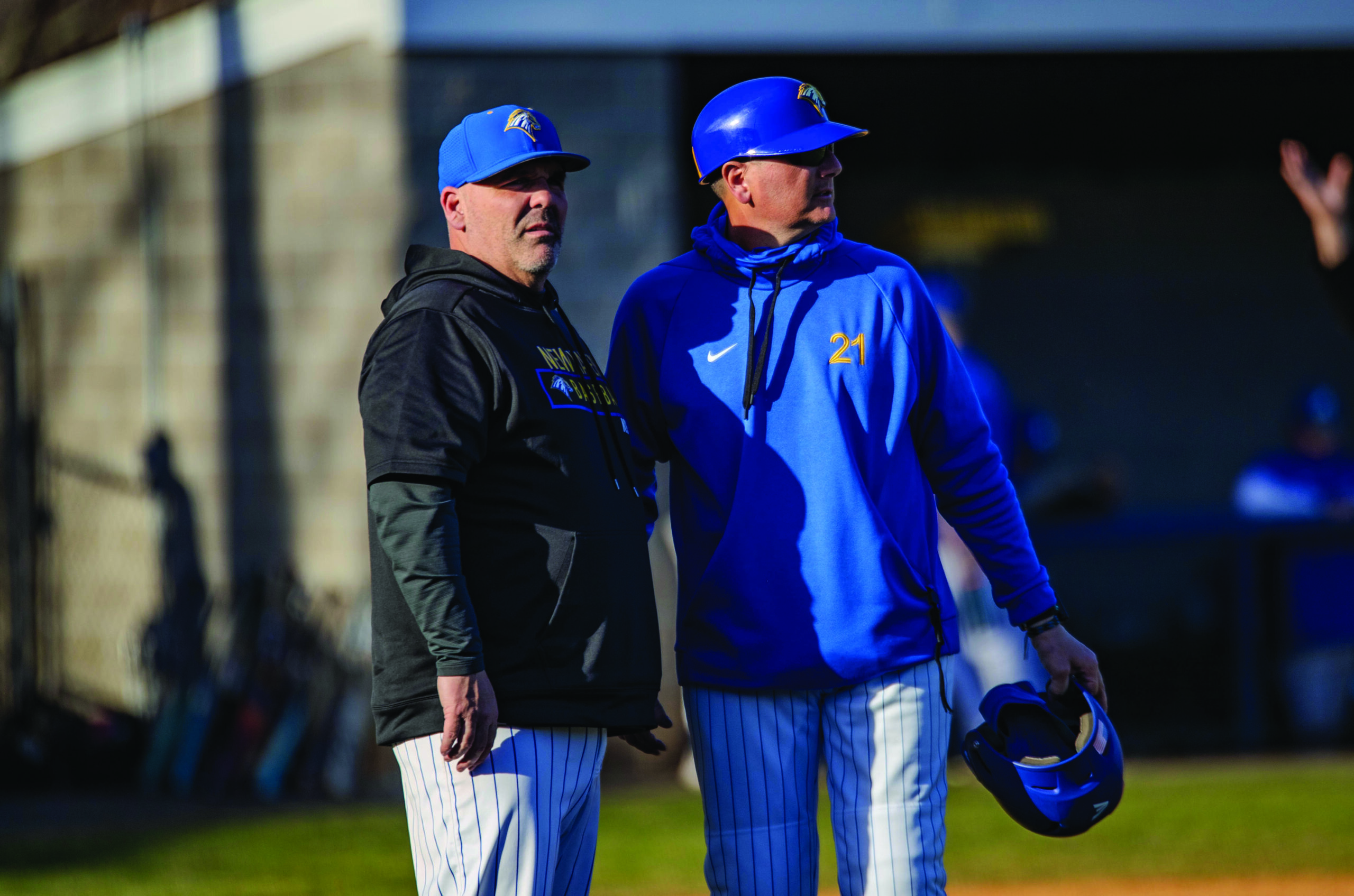
The University of New Haven baseball program features two outstanding coaches who have been incredibly impactful in so many lives. This spring, head coach Chris Celano began his 12 season at the school, after achieving great Div. II success at both New Haven and previously at his alma mater, Dowling College. Ray Guarino has been a beloved assistant coach for many years at Yale, Bridgeport, and now at New Haven.
New Haven began its first year as a Division I program in the spring of 2026. However, as big of a task as it is to usher their team into the highest level of college baseball, these two outstanding leaders also found themselves battling a common opponent much different than what they expected.
In a wide-ranging conversation, they shared their powerful story of resilience and community.
BASEBALL COLLEGIAN: What are some things you would like to share about your journey?
CHRIS CELANO: In January, I had appendicitis. I went to the ER, had the standard appendix removal surgery, and roughly seven days later, I got a pathology report that found a tumor in my appendix. I didn’t even know that appendix cancer existed. What I found out is it’s one of the rarest forms that you can get. And it just went 100 miles an hour from there. My first appointment was three hours and I met six different people who were part of my team. After, my wife Michelle and I looked at each other and we’re like, “Well, it sounds like we’re in good hands here.” This is the luckiest piece: the Smilow Cancer Center [in New Haven] had an appendix cancer specialist. And there’s probably less than 10 in the country.
I had put my trust in Dr. Turaga. He walks into the room and basically told me, “I’m going to handle this for you. I got you.” I never met him before that.
They did a follow-up colon surgery and then recommended the chemotherapy that I did this summer. Basically, that gives it an even greater chance that it doesn’t come back. I did four rounds. Each cycle was three weeks.
It was a very unique experience in a lot of ways, not just physically, but being in that environment of not only the care you get, but the other patients, and you’re in a whole new world of people dealing with this. One of the biggest things for me in the experience was getting in that community. The people at Smilow and how they treat these people – it’s above and beyond. They’re really doing God’s work.
So, that was my entire January, up to basically two weeks ago.
RAY GUARINO: When I was coaching at Yale, we were at Florida playing the Gators, and I went for a run, and I come back, and somethig just didn’t feel right.
Then I’m hitting infield/outfield against Quinnipiac and in the first swing, I think I pull my oblique. It turns out, those were my ribs breaking. The cancer just ate the bone from inside out, and from there, it was downhill. Broken ribs, broken clavicles, four fractured vertebrae, back, shoulders, up and down my spine, my rib cage. You know, it was a nightmare. It was awful.
A saving grace for me is that my wife Jackie is an oncology nurse at Smilow. She was like, “All right, this is who we’re going to go see.” And I followed Jackie’s lead. And she got the best of the best for this particular diagnosis of multiple myeloma, which is blood cancer. I was diagnosed Memorial Day weekend of 2019. And then that summer, I coached American Legion in Hamden. I got out of the hospital June 13th, and I was in uniform June 14th, with Jackie and Stoop [former Yale head coach John Stuper] yelling at me for 20 minutes.
I’m coaching third, and I’m sending guys, and I could hear the IV’s clicking as I’m wheeling somebody around third. That was right in the middle of it.
And to think that was seven years ago now. I mean, from where I was in 2019, I mean, it’s night and day.
BASEBALL COLLEGIAN: How have your two experiences compared?
CHRIS CELANO: I’m the sprinter, he’s the marathon runner. Mine was laid out to me as short term treatment because I only did four rounds. So I was going through a sprint, in a sense. I don’t want to speak for Ray, but I view him as more of the marathon runner. I think we were different in that regard. But here’s the unique part. I have a sounding board with someone who has not only become a really good friend of mine, but my co-worker to talk about everything that’s involved when you get diagnosed. Not that many people have someone that close, that is currently going through it, that knows where your mind could be on a certain day. He pushes the smoke away and says, “I get it, this is what’s going on,” because he has experience in it. And also watching him, before I was diagnosed, deal the way he does with everything, which blows my mind. It’s amplified even more what he’s done – not me, him – because I’ve watched him do it for years. It actually helped me because I saw someone up close be able to grind this out and get through it. It prepared me by thinking, “All right, I get it. I’ve seen this in action.” I guess that’s the moral of this whole story: We’re both in this world.
RAY GUARINO: Shelley [Chris’s wife] and Vito {Chris’s son], and with Jackie and my life, without them giving us the support that we need and to help at home, I don’t think any of it’s possible. Imagine getting two people that are used to handling everything themselves. And then all of a sudden, you get into a situation where you just physically can’t.
CHRIS CELANO: Ray and I are a lot alike. No matter what, at least once in your life, things start to look like they’re going south. The way I looked at it when I got diagnosed was you have a choice: You can figure out how to take this thing head on. Or you can go the other way and retreat.
I think you are the person that makes that decision. And you really can’t tell who you are until it happens, You have to really be faced with it to find out who you are. And you have a decision to make. I think Ray and I both made a similar decision – We’re just going to lean into this thing and take it head on.
But there was a true test, because for me, I could sit here and think, “Oh, I would do this under these circumstances,” but when you’re confronted with it in reality, you find out exactly what type of person you are.
BASEBALL COLLEGIAN: Talk about baseball’s role in in going through this experience.
RAY GUARINO: It is part of the healing process. Other than Jackie and my family, being able to go to the field and be with the guys was the best medicine that you could ever ask for. The mental side of it, just being outside, being with guys that you care about, guys that care about you. That summer, that’s something that I’ll never forget.
I’m coaching that summer at 141 pounds. Jackie drove me from the door to the dugout, and I get in the dugout, and Kevin Huber [fellow coach at Yale at the time] is in the dugout in uniform. And I’m like, “What are you doing?” He goes, “We’re coaching together today.” I’m like, “Where’d you get that uniform?” And he says, “Don’t worry about it.”
It seems like a lifetime ago. It’s been seven years, even though there’s no remission. They call it maintained right now. I mean, it could rear its ugly head and bring me back to day one at any moment. So, I’ve been on chemo, IV chemo, since then every two weeks.
BASEBALL COLLEGIAN: How have you talked to your players about it?
CHRIS CELANO: From the jump, my thoughts were that as soon as I get all the facts, the team’s going to know. I think our program is set up, and our culture here is set up to be able to do that. I had parents tell me that they were really impressed that I was that open with the team. I didn’t do it for any other reason other than they deserve to know. Quite frankly, it’s clearly nothing that I’m ashamed of. It’s nothing to hide from anyone, in my opinion.
Our athletes, especially these days, want information. They want details. They want relationships with their coaches. That’s what they strive for now, which is a big change from however many years ago, right? So, to me, it was important to get them the right information. And let them know that, yeah, your head coach is probably not going to be around after our second weekend.
I was in uniform our first two conference weekends, and then we played a midweek game at Rhode Island. I had to drive myself to URI because I had a doctor’s appointment in the morning. I coached that game, and that was it.
You know, it’s the first baseball season I’ve missed since I’ve been four years old. So that was so bizarre. My body clock and my brain are wired to be completely engulfed in that. But I will say it was a good outlet for those three hours to be able to watch us online, as frustrating sometimes as it is. But you realize after doing this as a coach, you don’t have as much control as you think anyway, right? So at the end of the day, I knew I had Ray and even our GA [Bobby Zmarzlak] and our seniors all stepping up and doing a fantastic job of keeping things together. So I was never concerned about that, which was the biggest relief.
I did make it to Senior Day, and I remember the day vividly. I put my uniform on and it was renewed gratefulness, and being so grateful that you can do that again. You take things for granted, it’s human nature when you’re doing it every day. But I also remember after that ceremony, I was probably on the field and around the guys for roughly an hour, then walking to my car after the ceremony and wanting to pass out. I was still in that state in terms of fatigue and physically.
BASEBALL COLLEGIAN: Have you passed any lessons from your experience to your team?
CHRIS CELANO: I would always push myself, no matter what, even throughout treatment. On the days that I could work out and do things physically, I would do it. Even though sometimes I wouldn’t feel like it. If I’d work out for an hour, I’d need 12 hours of recovery. But my attitude was, “Every day I don’t do it, this thing wins.” My mindset now is, “I’m just refusing to let it win.”
It’s been the truest test in my life to show my character. It’s not about being overly alpha or macho or anything like that. For me, it’s about who I truly am and how I react to adversity. I tell our athletes all the time, “How are we going to react when there’s adversity? I think Ray and I are a really good example to these players and these athletes of dealing with adversity. Because in life, it’s going to come in whatever form. And we’re living it every day. There are a lot of athletes that don’t get to see it in practice every day. So we’re always talking about adversity with our players, and how you handle it.
I think we both have the ability to not let them know exactly what we’re feeling on any given day. But those guys know that they’re still going to get our best on any given day. And to know that we’re showing up because we care about them as people, then in turn, they’re giving us their best as well. And that’s one of the things that we always preach. Life is about showing up. After your time at UNH, if you become a father, or an employee, life is about showing up, right? And to me, it’s really important that we talk about it. They’re seeing it play out live.
And if you ask them about Ray’s time here, they wouldn’t know what he’s dealing with. Based on his energy level here, what we do here, you wouldn’t know. If you didn’t know, he looks like anybody else that’s a crazy college baseball coach that’s pouring his life into what we’re doing.
BASEBALL COLLEGIAN: How did the Ray Guarino Baseball Series, an annual rivalry game between your alma mater West Haven High and Hamden High, happen?
RAY GUARINO: What the town of Hamden and the town of West Haven did for me that summer is second to none. It was a special summer with a real special group of guys. It was [West Haven HS coach] Ron Luneau and [Hamden HS coach] Chris Borelli’s idea. To have a game named after me is bizarre to even think about. I don’t think anyone is really deserving of that, and certainly not me, but those guys took it upon themselves.
The baseball community in this area [greater New Haven] is where you step on the field and you want to beat the crap out of each other. When the game’s over, at the end of the day, we’re all friends, and we all look out for each other.
BASEBALL COLLEGIAN: What was it like on the field with New Haven this spring?
RAY GUARINO: It was a lot. Not having him and even forget about making the jump to Division I. Being the guy to make sure that this still ran the way that he wanted it to. The on-field stuff was the easy stuff. It was the academics and travel and meals and who didn’t go to class and who’s missing this assignment. That stuff wears on you over the course of a week. And then on top of it, going to treatment and then coming to practice and getting in the office and starting the day. On those days, you’re not feeling 100%, but if I’m 75%, you’re going to get 100% of that 75%.
The whole season was a complete blur. You open against Missouri and the next thing you know, there’s a blizzard here, and we can’t get back. And we’re stuck in Florida, and we go right to TCU from there, and then we get back here, and we’re playing at UConn. And it’s just like, “All right, let’s go.”
But that is what keeps the fire in the belly. It keeps that intensity and drive to keep doing it because there are 35 men out there that are relying on you, and there are 35 families that are entrusting you with their son. And that’s something that we take seriously. To know that when they drop their kid off, they’re going be taken care of.
BASEBALL COLLEGIAN: Has this perspective changed you as a coach and changed your relationship with winning and losing?
CHRIS CELANO: Even before I started dealing with this, my view on the wins and losses after doing this as a head coach for 20+ years, has changed over time. Just the fact that winning and losing, for me, is defined by a lot of things. The scoreboard clearly is one of them, right? But it’s also for our athletes: What are we doing to prepare them for life after here? We can win at that. How do they perform academically? We can win there.
After handling what I’ve handled and getting through it, I have more of a desire to want to win. Because at the end of the day, it’s almost like, “Well, if I can conquer this, then why can’t we win all 55 games?” However, I think there is a part of it where it’s taking the lessons out of each time we don’t win and letting go of it quicker.
My mortality has never been in question for myself until, quite frankly, the past five, six months. I think that’s changed my thinking to “How am I going to spend these next five minutes? I don’t want to waste those.” So I think it’ll help me really get more value out of the time after those games we lose to just take what I need from it, turn the page, and let’s move forward.
I remember my wife would see how I would be after a loss, and she would be like, “Wow, this is a lot.” And I’m like, “Yeah, it’s not life and death. It’s actually worse.” That’s what I used to feel. And now I don’t think that’s true for me anymore. But what is important to me is not wasting the time, and making sure that our athletes are getting the experience they deserve, and we’re getting the most out of them. And for me, it’s about maximizing every second we have to do that. And it just magnifies the 24 hours of each day. I’m gifted this day again, this brand new day. And, you know, if I have a dozen problems before lunch time, so what? Great. It’s living life.
RAY GUARINO: It changed how I go about everything. It changed how you interact with everybody, how you handle big situations, small situations. And you realize quickly that the little things really don’t matter. In the whole scheme of things, there’s things that you really need to worry about, and things that are just a nuisance that are going to pass quickly. It just puts everything into perspective. Every decision that I make for me and Jackie, or every decision that Jackie makes for her and I, is circled around my diagnosis, and it has for the last seven years. And luckily enough for me, my numbers have been okay.
Every time I’m putting a uniform on, I want to win. I think back to that Memorial Day, the weekend of 2019 when they tell you the diagnosis. My mentality was “I’m going to win.” That was my mentality. There was no quit.
BASEBALL COLLEGIAN: How is it coaching together with this shared experience now?
CHRIS CELANO: We know what each other is dealing with, which is crazy. It’s very unique. We know exactly how it feels. So any of that stuff where you’re like, “Man, I’m letting everyone down” or that guilt that gets into your head when you want to be there. Ray’s like, “I get it. I get it.” And when to shut it down? Ray’s very good at that with me, because I won’t until I literally just fall down. That’s one of my faults. It’s also probably a strength in a lot of ways, but he’s good at reminding me, “I know what you’re dealing with. It’s time for you to just shut down for a little bit.’
The thing I’m most proud about this entire spring is literally, obviously, the way that the rest of the coaching staff held this thing together, and how our athletes went out there and competed. Every single inning. Watching them go out and want to win every single inning was motivation to me to recover and keep going and it was pretty cool and inspirational to me.
I also want to raise some type of awareness for what I have, or hopefully what I had, because it’s so rare. Any type of exposure and awareness for cancer in general, but specifically for the appendix cancer I had, which is one of the rarest forms you can get. If I can give as much information to people and it helps one other person, it’s worth it.
In the same breath, if our guys can see us deal with this and be at our lowest, and know that life still goes on, and there are still good days ahead, and things are going to pass, and that if you really push yourself and work hard and be disciplined, you can do whatever you want. It’s the definition of showing up, which is what we preach to them.
RAY GUARINO: I think in this profession, in order to build relationships, you have to be an open book anyway. And the more honest and up front you are with guys, the better connection that you make with them. Our guys are mature beyond their years, and they get it. They know we may not show it or say it, but they know if we’re not at our best on that particular day. And the culture that Chris has created here allows for them to become leaders because they take over.
BASEBALL COLLEGIAN: Not only is coaching baseball hard enough, but it was New Haven’s first year at Division I, and yet, you had these other battles to face.
CHRIS CELANO: I lost my mother-in-law and my father this year. My father’s funeral was two days before my appendix inflamed. So it was real life. I’ve learned that there’s nothing I can’t tackle. You just gut it out. Life comes at you.
That’s the famous line: “No one cares.” They do, but in general, no one cares. Because life’s still going to happen. You get bad news on Monday but you can get more bad news on Tuesday. But you still got to play nine innings. It ebbs and flows. There are good days and bad days and you could be losing in the ninth, but you can still win.
I’m ready to get back on the field. That was one of those things, too, where I thought to myself, “You’re going to find out how bad you still want to do this.”
And, yeah, I’m chomping at the bit to get on the grass. I want to be out there with these guys.
