

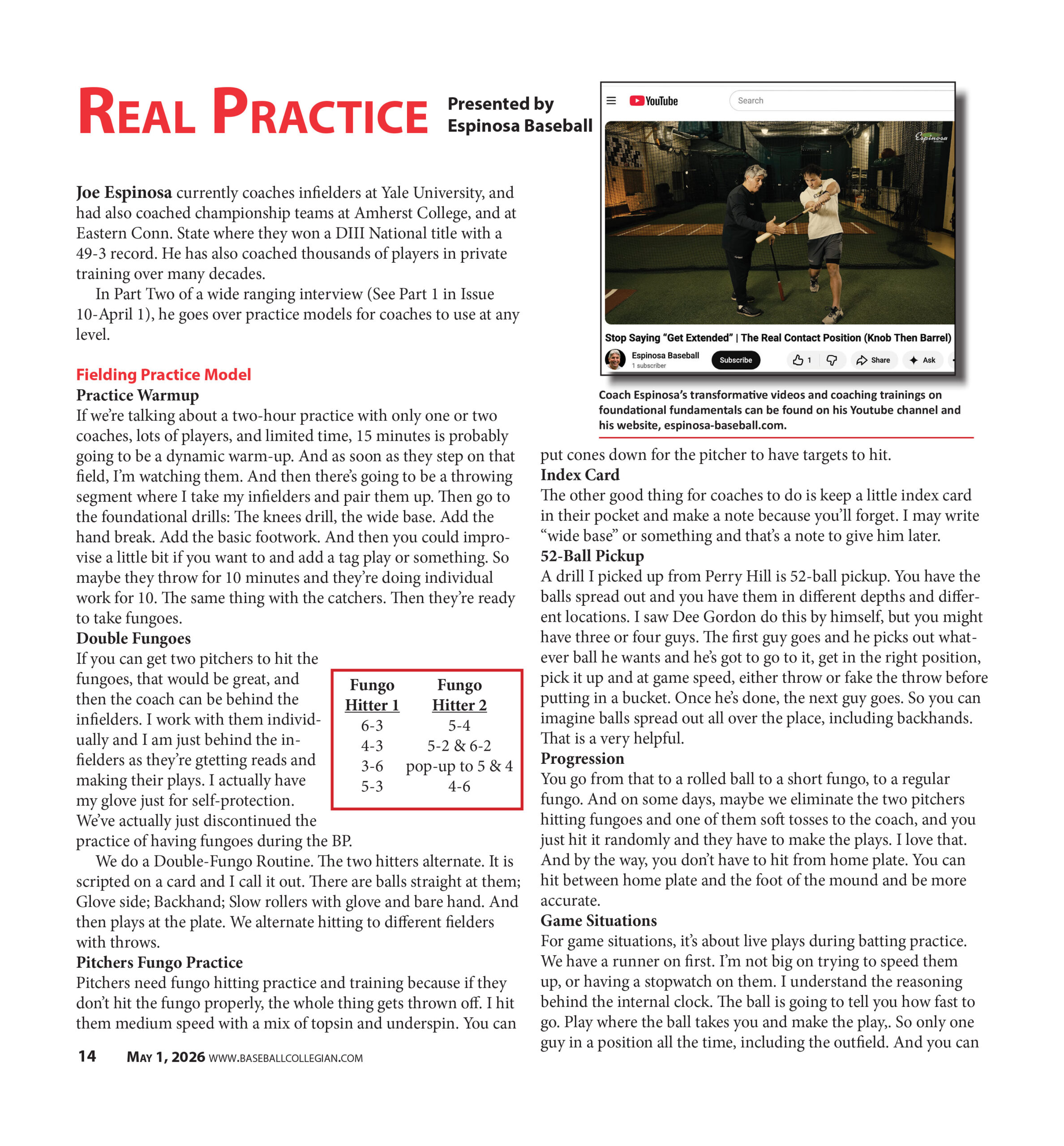
Joe Espinosa currently coaches infielders at Yale University, and had also coached championship teams at Amherst College, and at Eastern Conn. State where they won a DIII National title with a 49-3 record. He has also coached thousands of players in private training over many decades.
In Part Two of a wide ranging interview (See Part 1 in Issue 10-April 1), he goes over practice models for coaches to use at any level.
 Fielding Practice Model
Practice Warmup
If we’re talking about a two-hour practice with only one or two coaches, lots of players, and limited time, 15 minutes is probably going to be a dynamic warm-up. And as soon as they step on that field, I’m watching them. And then there’s going to be a throwing segment where I take my infielders and pair them up. Then go to the foundational drills: The knees drill, the wide base. Add the hand break. Add the basic footwork. And then you could improvise a little bit if you want to and add a tag play or something. So maybe they throw for 10 minutes and they’re doing individual work for 10. The same thing with the catchers. Then they’re ready to take fungoes.
Double Fungoes
If you can get two pitchers to hit the fungoes, that would be great, and then the coach can be behind the infielders. I work with them individually and I am just behind the infielders as they’re gtetting reads and making their plays. I actually have my glove just for self-protection. We’ve actually just discontinued the practice of having fungoes during the BP.
We do a Double-Fungo Routine. The two hitters alternate. It is scripted on a card and I call it out. There are balls straight at them; Glove side; Backhand; Slow rollers with glove and bare hand. And then plays at the plate. We alternate hitting to different fielders with throws.
Pitchers Fungo Practice
Pitchers need fungo hitting practice and training because if they don’t hit the fungo properly, the whole thing gets thrown off. I hit them medium speed with a mix of topsin and underspin. You can put cones down for the pitcher to have targets to hit.
Index Card
The other good thing for coaches to do is keep a little index card in their pocket and make a note because you’ll forget. I may write “wide base” or something and that’s a note to give him later.
52-Ball Pickup
A drill I picked up from Perry Hill is 52-ball pickup. You have the balls spread out and you have them in different depths and different locations. I saw Dee Gordon do this by himself, but you might have three or four guys. The first guy goes and he picks out whatever ball he wants and he’s got to go to it, get in the right position, pick it up and at game speed, either throw or fake the throw before putting in a bucket. Once he’s done, the next guy goes. So you can imagine balls spread out all over the place, including backhands. That is a very helpful.
Progression
You go from that to a rolled ball to a short fungo, to a regular fungo. And on some days, maybe we eliminate the two pitchers hitting fungoes and one of them soft tosses to the coach, and you just hit it randomly and they have to make the plays. I love that. And by the way, you don’t have to hit from home plate. You can hit between home plate and the foot of the mound and be more accurate.
Game Situations
For game situations, it’s about live plays during batting practice. We have a runner on first. I’m not big on trying to speed them up, or having a stopwatch on them. I understand the reasoning behind the internal clock. The ball is going to tell you how fast to go. Play where the ball takes you and make the play,. So only one guy in a position all the time, including the outfield. And you can have a guy in foul territory and after the other guy gets a rep, they switch. But as soon as you start over-populating the field, you get zero results like that.
Hitting
Non-BP Hitting Warmup
For the others, there are a lot of things to do. Very rarely do I use the tee, because I think it teaches the hitter to look down. I’m a big fan of dry swings. It makes it easy and they start swinging efficiently so they’re not over-swinging. I use the torque drill, which is both toes facing the same direction and I like to stop them at contact. And then go full. I have something I call modified torque where the back foot is parallel to the back line of the batter’s box and they go from there. That’s really good. Then I go to no-stride swings so they can feel the heel drop and the back hip rotation, that connection. And then I may add the stride phase without the swing.
BP Concepts
We then go into game swings or batting practice swings because I find guys take batting practice and if they’re not destroying balls, they’re not happy. And that’s really the time where you’re grooving the swing. Those are not actual game swings – you’re not facing game pitching that’s designed to get you out because they over-swing and get frustrated. And that destroys the whole kinetic chain. They start using their upper body – I call it the caveman swing, as we all know what happens when the upper body goes.
Pepper
They should also learn how to play pepper. The coaches put us on the side of the field. We didn’t want to stop playing the pepper games. We played hot pepper. We played all kinds of stuff.
Fun Drill
Here’s a great one that Mike Epstein told me about when he coached his son’s team. He wanted to teach the swing plane, so he tied a rope between two trees. And all he did was have them hit. Not even baseballs, but, like, softies or wiffle balls. And their whole goal was it couldn’t be a fly ball. They had to hit line drives over that rope. And he said they had been grounding out all the time, and then they started hitting great. The parents were going, “What are you teaching them? This is great.” He says, “I’m not teaching them anything. They wanted responsibility more than we know, and we just gave them a target to shoot for.”
