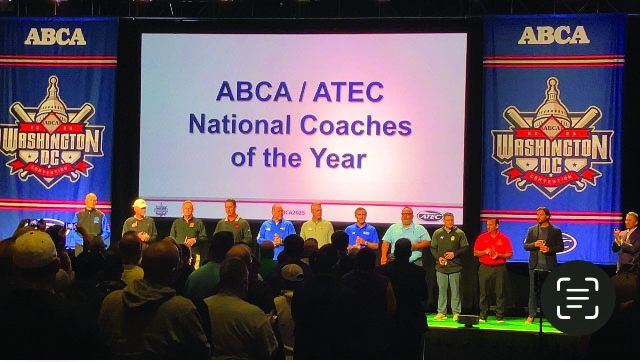
Winning a National Championship is certainly amazing, as is becoming an All-American or Coach-of-the-Year. However, there is certainly currency in being on a team that leads the nation in a statistical category. Not only does it help your team win, but it signifies coaching excellence.
Here’s to the coaches who shepherded their players to be better than everyone else at a certain part of the game. To celebrate them, a full list of national statistical champs is on pages 10-12, while here are some coaching insights from coaches who helped their teams become the best of the best.
Larry Lee – Cal Poly (Most Hits in NCAA DI)
When I teach hitting, I try to teach what I think will withstand the test of time. The ability to hit all pitch locations, all pitch types, and hit to the majority of the field. When you spend a lot of time working with all types of hitters over many years, you have to be creative with your teaching, due to the body awareness of each individual hitter. You have to understand the cause and effects of how the body works, and have many fixes to see which one might work the best for that individual person. I try to get to a point to what I call the “domino,” where a hitter thinks about one specific thing and everything falls into place.
We do a combination of tee drills, flip or toss drills, machine swings, and live arm swings at a close distance. Eventually, we need to figure out which drills should be done for each individual on a daily basis. We use a combination of machines, using both regular baseballs and Heater balls (a lighter foam ball that accentuates the movement of a particular pitch). We try to have our hitters face a live arm from a short distance as much as possible during the week to get the them to work on their timing and vision.
The impact of a specific drill usually works for specific hitters, and sometimes can be counter productive for other hitters. Without naming and explaining every drill, I can list some of the areas that I think can help a hitter become more fundamentally sound.
Back foot pivoting properly, hitting to the opposite field properly, pulling the ball properly, properly transferring the lower half from the backside to the front side, bottom arm set up and movement, hitting the elevated pitch, tempo and timing of swing, hand load, initial hand movement at beginning of swing, using the top hand properly, lower body rhythm, target hitting, hitting the low pitch, hitting through the baseball, and barrel control.
Kevin Brooks – Angelo State (Top BA in NCAA DII)
Our hitting philosophy is about doing anything we can to score runs in whatever way the game allows us to do. We do believe in a line-drive ground ball approach and feel being able to hit the ball the other way at a high rate is an absolute must for a good college hitter. We believe every player needs to be able to bunt at a high level and use that as a weapon. We don’t like strikeouts and feel the chances to get on base really increase if you put the ball in play. Lastly, we think that being able to direct the baseball is an important skill that can be developed and can help lead to some vast improvements.
We feel if a hitter has a good bat path where they can stay through the ball for a longer amount of time, they have a great chance of success on a regular basis.
One drill that seems to be almost a magic pill for our hitters is the 45 Degree angle drill on the Field. We basically just change the angle of the pitch to ½ way between the mound and foul line on the 1st and 3rd base sides and take BP from those angle to simulate pitches on the inner and outer half of the plate. Another one we use early in the fall is the Bat Throw Drill where we work on staying through the ball by throwing our bats in the direction of where we are trying to hit the ball.
I think we are working on timing every day as well as rhythm, etc. Most of the time just trying to work on letting the ball travel and get deep.
We work on pitch selection all the time. In our opinion, it’s much more important than the mechanics of the swing and the biggest factor in being a good hitter. Pretty much every hitter handles about ½ or more of the zone well. When we introduce pitch selection, pretty much every player takes a pretty big step backwards. I think due to fact that they are actually thinking about it and not just reacting. But after some time, it becomes just something they do and they just react. When that happen, results really take off.
In general, our game plan is for the hitter to control the strike zone and when he gets his pitch, swing and hit it well.
Team-wise, we generally spend an hour of practice on hitting with generally 4-5 stations with one being hitting on the field. We also do a quite of bit of situational game BP scrimmages at the end of practice.
We try to start the day hitting the ball the other way, then start working our way around the field, hitting the ball where it is pitched. We try to hit line drives and not lift the ball. We also take our situational rounds very seriously when it comes to bunting.
Ryne Romick – Pitching Coach – Denison
(Least Hits per 9 in NCAA DIII)
When trying to determine how to become a successful pitcher, players must understand it’s about the defensive group in its entirety. How can you not stress another system (defensive system or offensive system)? Getting weaker contact reduces defensive stress. Limiting free bases reduces defensive stress. Striking hitters out reduces defensive stress. Knowing that we are working on the mound to be a big part of the entire system is key.
We try to boil our focus down to limiting runs and helping the team win. The 3 main components of that for us are competing in the strike zone, managing a running game, and fielding the position in the team defense.
Every time our guys pick up a ball we want to be mindful of what we are trying to accomplish. For each guy, those goals and tasks will vary but simply attacking something would be the first step to continuous improvement. We vary catch play routines quite a bit. Changing the platform and remaining athletic allows room for young pitchers to explore themselves.
Jared Noonan-Santa Rosa JC Pitching Coach
(Least Hits per 9-Calif JC)
By being able to land multiple pitches for a strike and locate in and out of the zone, pitchers can take control of the physical side by controlling the bathead speed and forcing the hitter into more difficult swing decisions.
Location wins and should always be a focus. First pitch strike with at least two pitches: Starting an at bat 0-1 shifts the at-bat greatly into the pitcher’s favor, and being able to steal a strike with an offspeed pitch when most hitters are sitting dead red fastball makes our job a lot easier.
Be a machine: Stay in control of your emotions, we all miss – even the hack attacks and jugs miss sometimes. The machine never reacts, never throws its hands up or puts its head in its glove. Another ball shoots right back out, and that’s our job as a pitcher, to throw the next pitch – not be thinking about the last one.
“T Line” drill. It can be done on any line – foul line, turf break, anything. We start by marking our front foot strike with a hat, ball, or whatever’s available. The drill is done in two dry reps. The first is an 80% stride length, where we’re focusing on staying on the line, keeping hips and shoulders closed to the target and making sure everything is in control and on line. We should also see the ball flip up above the shoulder (or close to it – slot dependent) right in this area. This drill is especially effective when guys are “stuck” or flipping the ball up late and struggling with command, a common flaw at higher levels where we are chasing velocity. After the first dry rep, a second, full pitching motion is executed where we get to full stride length, release, and follow through. The first step should inform us of the proper timing here so we can ensure a quality dry rep. It’s simple, cheap and boring (if you ask the players), but it works.
I prefer to stay away from guys while they warm up for a start. I get a feel from what they have that day from a distance and from the catcher, as
I don’t like standing right over guys’ shoulders as they warm up. They’re gonna be out there alone, and I think it’s important to get comfortable with that reality.
While we have several “checkpoints” throughout the week – team flatgrounds, bullpen days, team lifts, and the like, I really preach that each guy develop their own routine.
I believe collaboration is one of the most powerful tools we have. By fostering an environment in the bullpen that promotes self- discovery and communication, I’ve seen greatness. While we as coaches spend all day thinking and talking pitching, we no longer do it. Some of the most monumental improvements that I’ve seen – pitch grips, mechanical cues, all of it – have come player to player. The seed of the idea may come from me or another coach, but there’s a certain level of confidence and trust that develops when it comes from another player. Additionally, self-discovery is huge in pitcher development. We can promote this as coaches by ensuring players have the tools, time, and motivation to work on their own. I rarely step in when I see guys trying things out on their own. It’s easy to discard someone else’s idea once you hit the mound and it doesn’t work or feel the way you want it to, but when it comes from within, it seems to really stick. Pitching is a lonely venture, and allotting time for guys to self explore has helped them become more confident in themselves.
Adrian Santiago – Milwaukee School of Engineering
(Most Stolen Bases in NCAA DIII)
You, as a runner, have two main things to focus on, what distance your lead should be (8,10,12,15 feet), and having the confidence in the timing we have on the pitcher to go.
In all of our scrimmages, our players have one free attempt to steal a base. If they get caught, they go back, but they have to vary their leads and what kind of steal they are doing. We have cones/tape marking out each distance they can be at as well. We also video all of our scrimmages and practices so they can go back and watch their steals, and how their technique is.
I have seen fast guys be bad at stealing bases, and slower guys be great at it. Technique matters, IQ and knowing the situation at-hand matters, and being confident and aggressive is just as important as technique. Practice does indeed make perfect.