
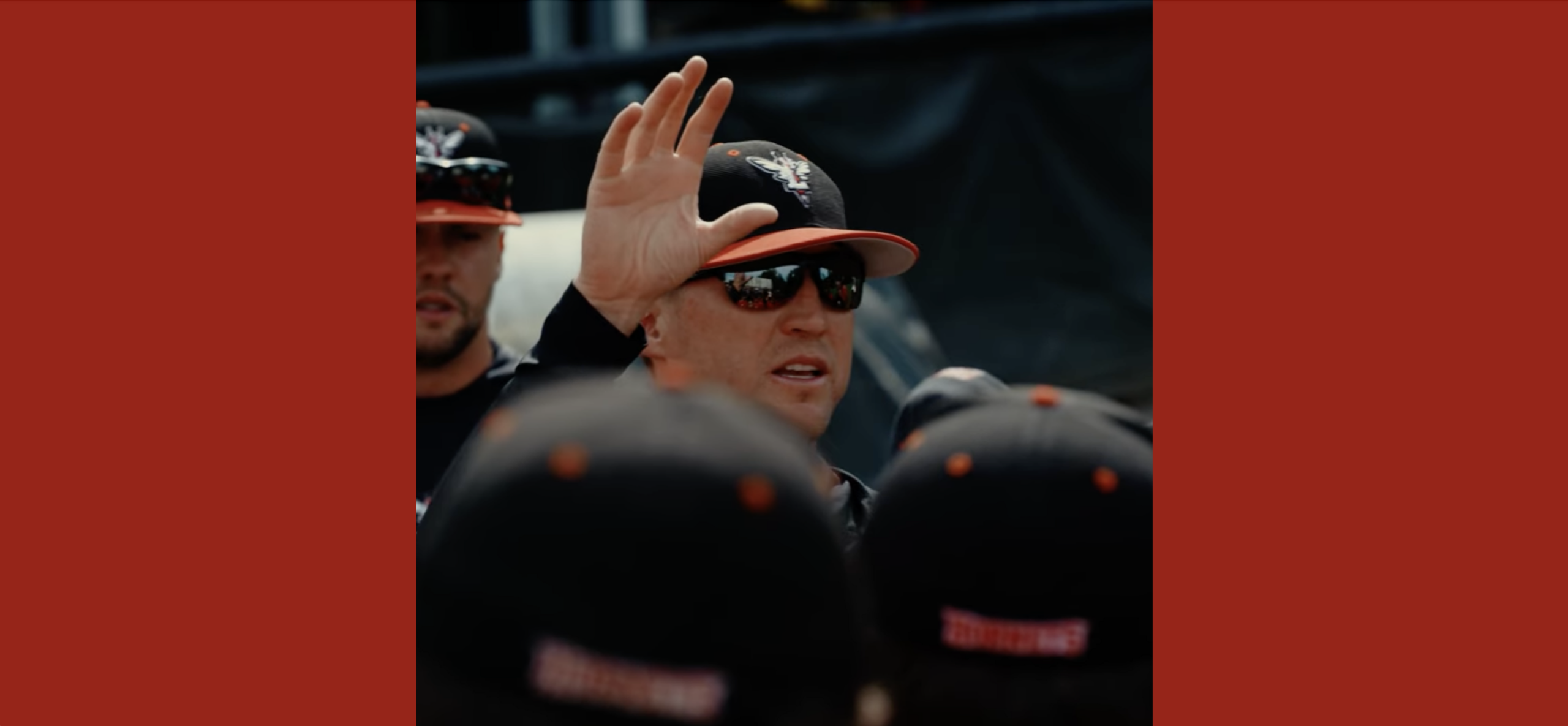
Travis Beazley is entering his fourth year as head coach at the University of Lynchburg in Virginia and his reputation as an outstanding pitching coach is spreading around the country. Now in his 10th year at the school, his pitching staffs are routinely in the top five in the nation in ERA and WHIP, and in turn, his teams are having great success. As an assistant, he helped lead Lymchburg to an NCAA Division III national title in 2023, and now as head coach, he has an 118-34-1 record and gone to two Super Regionals and a World Series.
He has a clear passion for pitching and a well thought-out care and insight into the details of coaching pitchers. In this interview, he lays out an exceptional guide on how to run a pitching staff from beginning to end.
PHILOSOPHY

BASEBALL COLLEGIAN: How would you describe your overall pitching philosophy?
BEAZLEY: We’re trying to blend the old school and the new school. I graduated from Randolph-Macon in 2006 and was drafted as a pitcher by the Red Sox. We have another assistant, Mike Solbach, who was here when I got here with Lucas Jones [the Lynchburg Head Coach until 2023] in the summer of 2017. Mike pitched at Liberty and in the Yankees and Rockies organizations. We both were exiting our careers as a lot of this technology was coming in like weighted balls, video, Trackman and Rapsodo. So we kind of learned old school but as coaches, obviously we’re learning the new school. So our experiences as players is a little bit more old school where it’s competing and feel. Now we’re learning and coaching in a completely different world.
These guys are overwhelmed with so much data all the time. So I think it’s really important that we try to blend the two. We’re not a pitching academy. There are great places that do great things with guys that help them develop arm strength and velocity stuff. And obviously we’re doing some of that here. But we’re in the business of trying to build pitchers and guys that can get outs. We have technology, we have Rapsodo, but our guys can be overwhelmed with the data. I think we’re just trying to use the data that we do have to connect the dots of what we’re seeing, what’s playing out, and give our guys a very simple plan that they can go execute every day. It’s really trying to build guys that can stay healthy, can carry big workloads, and that get better while they’re here, with the mindset that you’re going to get better faster if you’re pitching rather than training.
The guys that have been really good in our program are guys that have logged a good amount of innings and their velocity and stuff obviously has gotten better over time. The guys that pitch for us throw strikes. So we’re obviously developing stuff, but that probably is not the No. 1 priority for us. You’ve got to be able to pitch, you got to be able to throw strikes.
TECHNIQUE

BASEBALL COLLEGIAN: So let’s start to break down what that entails. How much do you do with technique? Are there any specific things that you look for in pitchers?
BEAZLEY: First of all, we’re trying to recruit guys that are athletic. I think that’s the No. 1 thing. We’re trying to recruit guys that move well and get down the mound. Probably more than anything, we’re looking at arm action. We’re not really getting lost in the minutia of short or long arm action, but more so, are they in sync? And then the longer I do this, the more I’m fixated on their head. Can they stabilize and rotate around their trunk, and can their head be relatively stable working through the catcher? Or is their head everywhere? When guys are not able to create energy down the mound, they’re just not flexible or strong enough. They try to make up for it with just aggression. Sometimes it’s intent and they’re just trying to do a little bit more. I think a lot of times it’s lack of strength in the lower body and they just can’t stabilize. When we watch video of elite throwers in the big leagues, the vast majority are able to land, stick, rotate around their head and eyes, and relatively stay on the target as they gain extension and gain ground down the mound. Those guys tend to repeat the delivery. And if you repeat your delivery, you tend to throw more strikes.
Outside of that, we’re doing a good amount of work. We have four turf mounds and we’ve got water bags, med balls, and plyo balls where they can do that stuff every single day and focus on the kind of teaching points that we focused on them. They can do it at the field as well.
This is stolen from Butch Thompson [Auburn head coach] and I love it: When we throw our bullpens, we have the mindset of “over the rubber” or “at the plate.” You can’t be both places at the same time. With the mindset of “over the rubber”, we’re working on moving down the mound and mechanics. When we are thinking “at the plate,” it’s more about what we’re going to have to do on game day, whether it’s executing pitches, movement of a pitch, or sequencing.
We try to spend the majority of our bullpens and mound work “at the plate,” not “over the rubber.” If you’re working on something “over the rubber,” like a new grip or a change in your delivery, it’s oftentimes not fair to judge where the ball ends up, because you’ve changed the goal of the pitch. And “at the plate,” I don’t want you thinking about delivery mechanics or grip when you’re pitching. I want you to just think about executing the pitch and get the guy out.
BASEBALL COLLEGIAN: When working with a guy on stabilizing his head, how does a coach do that?
BEAZLEY: The first thing I’ll do is walk down the mound and stand a couple feet next to where they land. The mindset is to visualize throwing a bullpen down a very narrow hallway. It kind of forces you to stay in there a little longer and not jerk your head off target or pull off. You see if they’re not stable with their glove foot as they land, or if they are on the outside of their foot or rotating on that foot and falling glove-side off the mound as they release the ball.
Guys do so much training now, but a lot of these guys are doing a lot of their throws to something that’s roughly 10 to 20 feet in front of them, like nets or plyo mats. If you’re throwing a fastball 60 feet, 6 inches, your catcher is behind the plate. We want them to actually think about throwing that same pitch 10 feet further back. Can we throw it through the target, through the zone, rather than to the target. That sometimes helps them.
Then a lot of non-bullpen training. I really like the core velocity belt that trains how our lower half works. A lot of med ball, water bag stuff, things like that. More than anything, it’s showing them video because a lot of times they don’t realize where their eyes are at release. There are a few guys that can get away with it, where they’re pulling off or maybe their eyes aren’t on target, but when the ball comes out of your hand, typically guys that are on target with their eyes tend to throw the ball more accurately than other guys.
We’re just trying to make guys a little bit more efficient. Sometimes it’s small adjustments and they pick it up pretty quick. Sometimes guys need a little bit of time and just need a year with a structured program or structured weight training. Sometimes it’s not even mechanical, but they need a year to let their body catch up to what they’re trying to do.
This is a Lucas Jones quote: “We’re either working while we’re playing, or you’re waiting while you’re working.” For some guys, you’re getting innings, you’re playing, you’re in the rotation, you have a role in the pen. You’re getting better while you’re doing that. For others, it’s working and waiting. I think that when you coach pitchers, you learn there is no easy fix. There’s no fairy dust we can sprinkle on you. I think it just is the hard work like changes in your delivery or cleaning things up or trying to gain another pitch or velo. You can’t really control the timeline of that. And I think that’s where sometimes guys have a hard time where they’re feeling like they’re putting in the work, but they’re not seeing the results. But ultimately you have to stay the course.
It’s consistent that you need guys who like to work, like to throw, like to long toss, like the craft. If you don’t like those things, it’s hard to be good.
I was very fortunate in 2007 in Greenville [Single-A] and Jon Lester was there. He’d already been in the bigs. We were on the same schedule every day for basically a month. We lifted together, we threw together, we threw bullpens together. And you learn that this is what a professional looks like. And that’s what we try to instill in our guys. There’s work and then there’s professional work. Even though we’re not professionals, even though it’s not your job and you’re not making money, you can still approach it that way. Because if you learn how to work and do it that way and it’s something you love, then whatever you do when you get out of baseball, whatever industry, that professionalism is still going to be there.
PITCH CALLING & SEQUENCING

BASEBALL COLLEGIAN: What do you do for pitch calling and sequencing in games?
BEAZLEY: The first six years I was the pitching coach. For 10 years now, Mike Solbach and I have watched every bullpen together. The last three seasons I’ve transitioned to head coach, so he’s carried a much larger load and calls the pitches. We game plan together – we’re just trying to identify the hitter’s tendencies: What do they hit hard? Where is their zone? What do they struggle with? Are they aggressive early, late? And then try to develop a plan that fits the strengths of our pitchers. Mike does a really good job of this. We try to simplify it for them. It’s more about, “Hey, this is what you do well – go do that. It’s a good matchup for you.” Or, “Hey, this is the one thing you just need to be aware of.”
We’ve always called pitches, but our guys always have the freedom to shake. I’ve always been a big believer that it’s the execution of the pitch, as opposed to the selection of the pitch. There are probably better pitches to throw in certain counts, but it’s way more about whether you can throw a pitch that you actually believe in and execute. We definitely sequence. We’re going to try to find a weakness and we’re going to make you prove that you can adjust. And once you adjust, we’ll adjust.
I think every coach, at some point in their career should have to call pitches for a season. You don’t know until you do it because it’s not a video game. You learn about your guys and you learn who can actually do what. It’s not a vacuum. You’re calling pitches and there’s a lot of factors that go into every pitch you throw. You have to know your guys.
A PITCHER’S CALENDAR
BASEBALL COLLEGIAN: What are you doing with your guys daily from the fall all the way into the spring.
BEAZLEY: With every pitching staff, you’re probably going to have three pockets of pitchers. Some guys have thrown a decent amount of innings and we feel like their workload is high. We’re going to have those guys not throw in intrasquads, and we’re going to try to target specific things that we think we can clean up and work on for two or three months, For the two pockets who didn’t throw a lot in the spring and summer, it’s way more about competing and getting innings. They’re throwing a bullpen once a week and pitching once a week. We’re trying to give them opportunities to learn more about who they are, how they’re going to get batters out, how to compete. There’s a lot of learning going on.
For the fall, we intrasquad Friday, Saturday, and Sunday. In Division III, a lot of days are not coach days, so they work on their own. When we do practice, we’ll stagger groups. I try to structure our practices more of like what you might find at spring training early on. We have hitting groups from 10:30 to 3:30 in hour blocks. Other days, we might have defensive groups. For pitchers, we have two guys at a time and stagger them over 20-30 minutes. We give them 40 minutes to do their pre-throw: J-bands, wrist weights, plyos, hip mobility. Then at 1:30, the first group takes the mound, then every 20-30 minutes, another group of two come down for mound work. And that just gives us the ability to work with one or two guys at a time and stay on track. I used to hate when you would have to wait 30 minutes to throw your bullpen.
There’s going to be a couple drills at the beginning specific to them. Rockers, rolling step-backs, focusing on glove side, stabilizing lower half, more rhythm in their delivery. And then 20-30 minute long toss – it’s the Jaeger long toss where we’re putting some arc underneath the ball, stretching it out, listening to our arm, no pre-set distance. Then when they come in, changeups from 65-75 feet, stepping behind trying to throw them hard, then sliders stepping behind at 65. For curveballs, we’re throwing those 50-55 feet.
The longer I’ve done it, the more I’ve gotten away from flat grounds and the more we try to just touch the mound when we can. It might be a controlled effort level, but we’re going to touch the slope and work on the slope. Five to 15 throws at the end of the throwing program.
BASEBALL COLLEGIAN: What do you do in November and December after fall ball?
BEAZLEY: We’ll give them a break. When I played, you got a month to two months off, no throwing, So we’ve kind of adopted that. We still try to get our guys a minimum four to eight weeks over the course of 12 months of no throwing. But we try to break it up, whether it’s a break between the spring and summer, and still give them a chance to ramp up summer into the fall. We definitely want to give them a chance to recover, rest, give their arm a little bit of a break, but we work really hard not to go much longer than two, maybe three weeks, where they’re not putting the ball in their hand and doing some sort of throwing. It’s more about keeping that feel. It’s not so much long tossing or a lot of throwing.
At the end of the fall, we’ll meet with each guy and try to give them a good idea of where they’re at. If you’re going to start game one the second week of February, you have to do the work because either you’re going to not be good, you’re going to lose that role, or worse, you’re going to get hurt.
So we build out a Google calendar for them from the day our fall season ends to the very first game of the spring season. And we basically work backwards. For example, for the game one starter, you’re going to have four intrasquad starts before that first weekend. We’ll go 25 pitches, then 50, then 75, then 80 to build up their pitch count. So then they decide how many bullpens they need to be able to throw 25 pitches in the first intrasquad. Then, how many weeks to build to that first bullpen – usually we like at least three to four weeks. It’s usually in between December and January.
So each pitcher has to plug those into the calendar. It gives him autonomy to think about what he needs and plan out for what works for him. When I first got into it, I built out these really nice schedules, and it looked nice and planned out. But what I learned is that it’s useless because it’s not tailored to them. It’s not built out on days where they can actually get in a facility and throw the bullpens. Some need more bullpens, some need less. And then we go over it with them including making sure they have enough ramp-up phase.
BASEBALL COLLEGIAN:What is your daily routine in the spring?
BEAZLEY: We’ve always been in the mode of giving them at least one day off per week, but it might be two days off – it depends on the arm. Obviously the younger guys don’t know what they don’t know yet. Day 1 after they pitch, it might be off, or it’s very, very light. Obviously no breaking balls, 60 feet, maybe 90. Some guys want that day off and go light on Day 2.
On the Third Day, we call it a hybrid day, with long toss but more about stretching it out than high intent, but not taxing ourselves for the bullpen the next day.
On the Fourth Day, that’s going to be our heavier day with long toss and stretching it out. They’ll throw a bullpen of 35-40 pitches.
Our second day off is going to be either Day Five or Six. It just depends on the guy and the arm. Either way, it will be a little bit lighter. The universal thing that I’ve noticed with the guys that I’ve coached including a couple of big leaguers in my time at VMI, All Americans, pitchers-of-the-year, stuff like that, is that more times than not, you’re pulling those guys back, then you’re having to push them. And what I mean by that is they like to long toss – they would do it every day. I think if you want to be healthy and you want to throw a lot of innings, you have to throw, but we’re also making sure that they’re not doing stuff that’s going to be detrimental to them. And then we have arm care, and a heavier lift – I like them to lift with the team if it works out depending on when they pitch.
BASEBALL COLLEGIAN: How do you handle bullpens for relievers who don’t get in games, and for midweek away games?
BEAZLEY: That’s tricky. Our catchers always hit in the second of four BP groups, so when they’re done, the pitchers are finishing their throwing program, and they gear up and we’re starting our bullpens.
We’ve done things where we’re throwing bullpens before we get on the bus. We’ve had some rare occasions when we’ve done it when we’ve gotten back. And there’s times when they stay back and just grab a catcher while we’re gone. I don’t love it because you’re losing a day where you can work with them. At our level, it’s hard to justify putting a guy on a bus and having them miss a couple classes if they’re not going to play. They’ve got to go to class.
If we’re playing on a Tuesday or Wednesday and they didn’t pitch, we’re going to give them live AB’s on that Thursday. We do it during early work between 1:00 and 3:30 before we start team practice. It might be three or four hitters. it might be with the turtle out there. Maybe 15 pitches – not this super lengthy thing, and as long as they have a day to recover. If all you’ve done is throw bullpens the last month, it’s not fair.
You need to get innings. That’s the only way to get better.
