
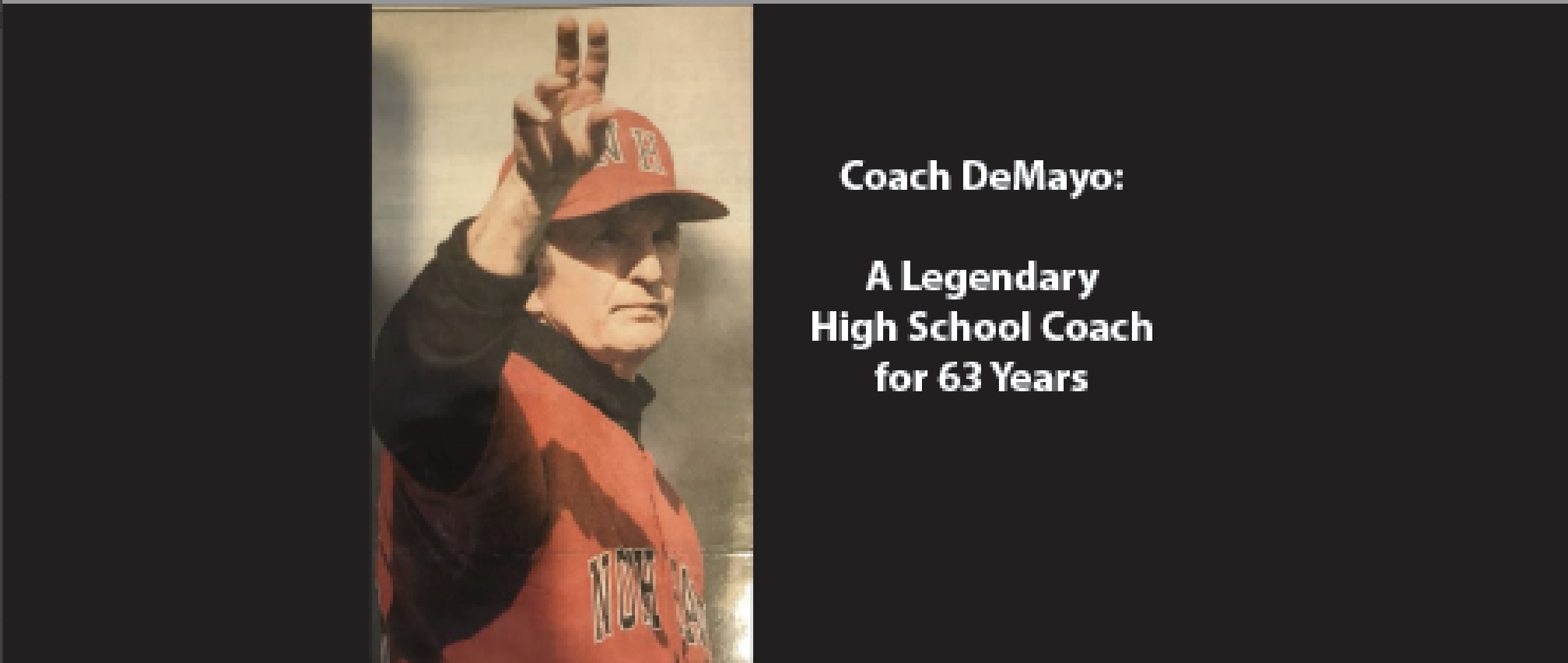
Bob DeMayo was the North Haven (Conn.) High School baseball coach for 63 years and recorded 937 wins and five state titles. One of his former players, Frank LaMonaca ‘75, reports on some of his strategies:
There is much debate in the game today on the value of bunting. While Coach DeMayo understood that debate, he also argued there is a huge skill gap between the professional game vs. the high school and college game. It was his contention that because pro pitchers, catchers and infielders are such great athletes now, and because they do it every day for a living, it is more difficult to execute a successful bunt at the pro level. But at the high school level, there is a much greater variation in talent, and less defensive practice, and therefore less skill in the infield overall. Thus, Coach preached that if we put the ball in play, we’d put pressure on the opposing team’s defense, and good things would happen. Therefore, he believed bunting remained an effective offensive weapon at the high school, and to some extent, the college level.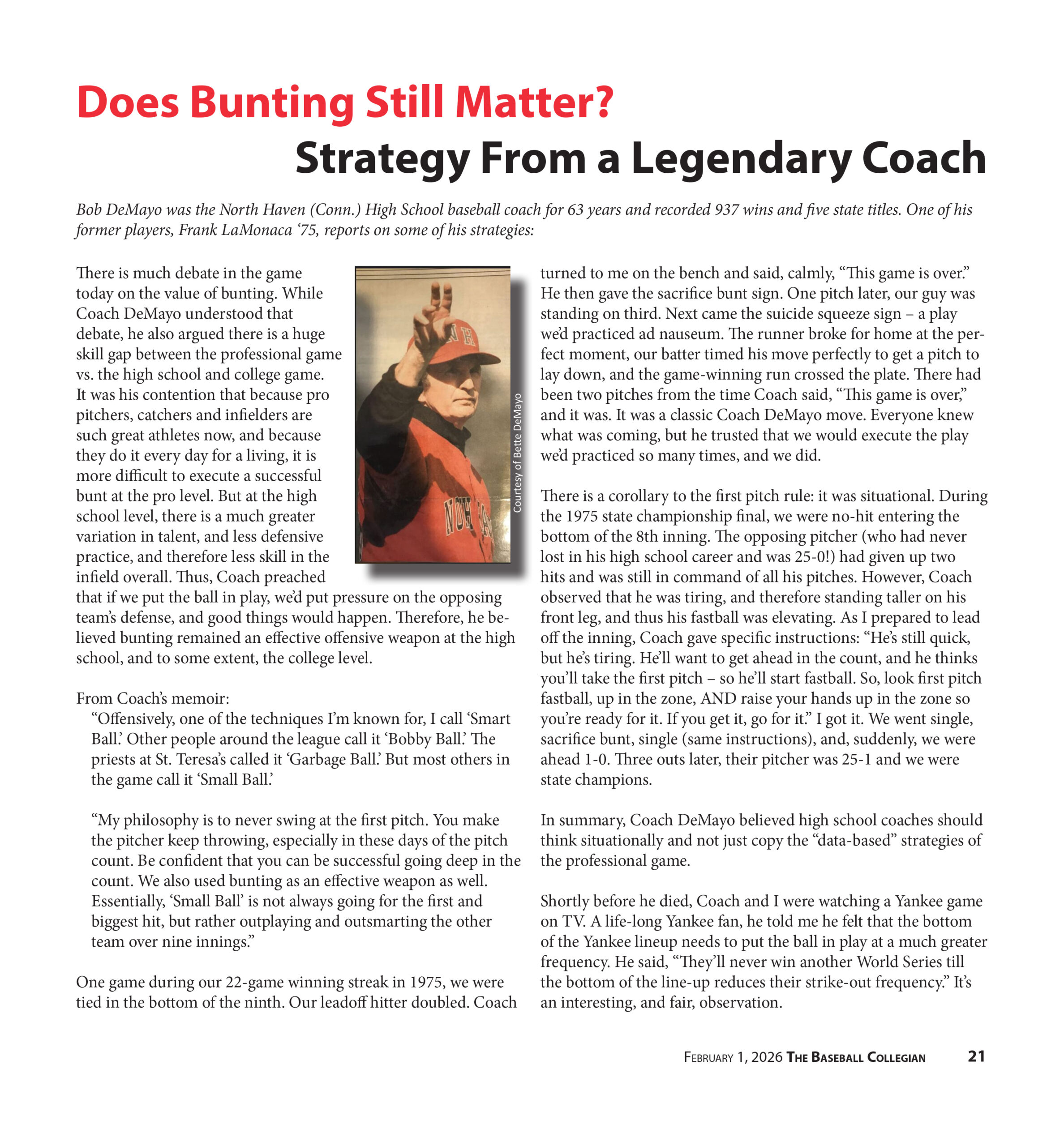
From Coach’s memoir:
“Offensively, one of the techniques I’m known for, I call ‘Smart
Ball.’ Other people around the league call it ‘Bobby Ball.’ The
priests at St. Teresa’s called it ‘Garbage Ball.’ But most others in
the game call it ‘Small Ball.’
“My philosophy is to never swing at the first pitch. You make
the pitcher keep throwing, especially in these days of the pitch
count. Be confident that you can be successful going deep in the
count. We also used bunting as an effective weapon as well.
Essentially, ‘Small Ball’ is not always going for the first and
biggest hit, but rather outplaying and outsmarting the other
team over nine innings.”
One game during our 22-game winning streak in 1975, we were tied in the bottom of the ninth. Our leadoff hitter doubled. Coach turned to me on the bench and said, calmly, “This game is over.” He then gave the sacrifice bunt sign. One pitch later, our guy was standing on third. Next came the suicide squeeze sign – a play we’d practiced ad nauseum. The runner broke for home at the perfect moment, our batter timed his move perfectly to get a pitch to lay down, and the game-winning run crossed the plate. There had been two pitches from the time Coach said, “This game is over,” and it was. It was a classic Coach DeMayo move. Everyone knew what was coming, but he trusted that we would execute the play we’d practiced so many times, and we did.
There is a corollary to the first pitch rule: it was situational. During the 1975 state championship final, we were no-hit entering the bottom of the 8th inning. The opposing pitcher (who had never lost in his high school career and was 25-0!) had given up two hits and was still in command of all his pitches. However, Coach observed that he was tiring, and therefore standing taller on his front leg, and thus his fastball was elevating. As I prepared to lead off the inning, Coach gave specific instructions: “He’s still quick, but he’s tiring. He’ll want to get ahead in the count, and he thinks you’ll take the first pitch – so he’ll start fastball. So, look first pitch fastball, up in the zone, AND raise your hands up in the zone so you’re ready for it. If you get it, go for it.” I got it. We went single, sacrifice bunt, single (same instructions), and, suddenly, we were ahead 1-0. Three outs later, their pitcher was 25-1 and we were state champions.
In summary, Coach DeMayo believed high school coaches should think situationally and not just copy the “data-based” strategies of the professional game.
Shortly before he died, Coach and I were watching a Yankee game on TV. A life-long Yankee fan, he told me he felt that the bottom of the Yankee lineup needs to put the ball in play at a much greater frequency. He said, “They’ll never win another World Series till the bottom of the line-up reduces their strike-out frequency.” It’s an interesting, and fair, observation.
