
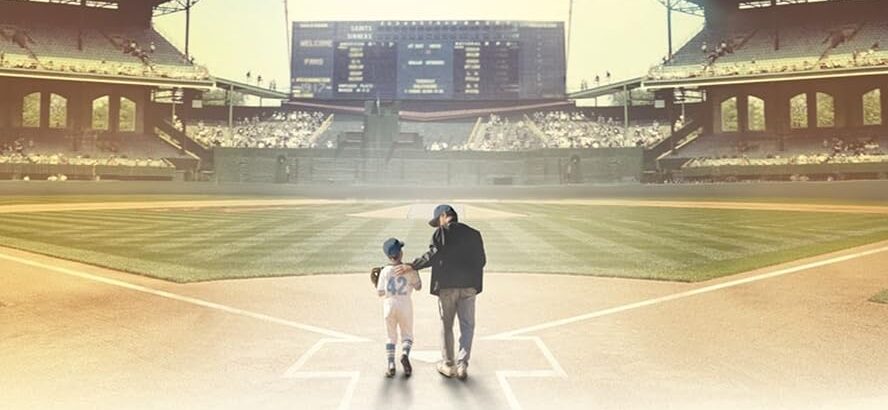
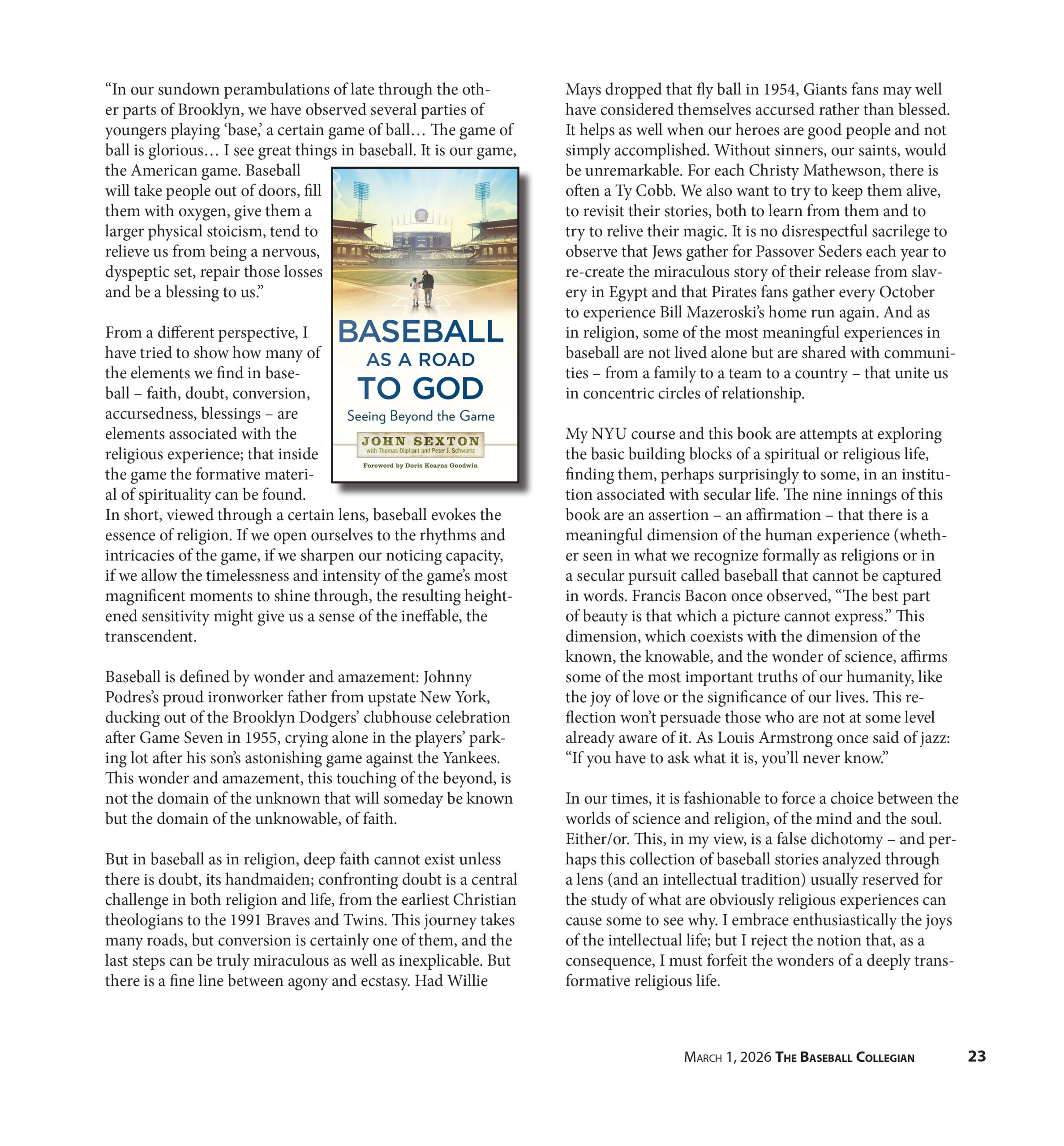
John Sexton served as the President of New York University from 2002 to 2015. He still teaches the class he created, Baseball as a Road to God, culminating in the NY Times best-selling book of the same name.
A new movie based on his book and his lectures, titled Baseball: Beyond Belief, is about how baseball, community and religion intersect in our lives. It will be released in the spring of 2026.
 No one has described the profound dimensions of baseball better, or with more eloquence and insight, than the late Bart Giamatti – Renaissance man, scholar, university president (at Yale) devoted family man (his son is the actor Paul Giamatti), and final commissioner of baseball, the one time we’ve had a commissioner who loved the game more than the business, who emphasized stewardship rather than ownership. After his premature death in 1989 at age fifty-one, friends put together a collection of his baseball writings, and speeches and called it A Great and Glorious Game.
It is a great glorious volume, beginning with a keen observation about baseball’s almost casually cruel arithmetic: “It breaks your heart. It is designed to break your heart. The game begins in the spring, when everything else begins again, and it blossoms in the summer, filling the afternoons and evenings, and then as soon as the chill rains come, it stops and leaves you to face the fall alone.” Giamatti wrote that it “keeps time fat and slow and lazy.” As he noted correctly, “In 1839, the rule became fixed that one runs [the bases] counterclockwise. Time does not matter in baseball.”
Giamatti was writing after his beloved Red Sox had just missed in another pennant race, but his wistful words mask an abiding hope for the next spring, and the profound optimism it will bring. “I was counting on the game’s deep patterns, three strikes, three outs, three times three innings, and its deepest impulse, to go out and back, to leave and to return home, to set the order of the day and to organize the daylight.” A continual theme in Giamatti’s prose concerns the importance of the concept of home in baseball, especially in a nation as peripatetically bustling as America. He summed up his inspiring worldview in an essay about the Sox-Yankees playoff game in 1978, which featured a wonderful analogy. Each batter, for him is Odysseus.
Baseball is about homecoming. It is a journey by theft and strength, guile and speed, out around first to the far island of second, where foes lurk in the reefs and the green sea suddenly grows deeper, then to turn sharply, skimming the shallows, making for a shore that will show a friendly face, a color, a familiar language and, at third, to proceed, no longer by paths indirect, but straight, to home.
Baseball is about going home, and how hard it is to get there and how driven is our need. It tells us how good home is. Its wisdom says you can go home again but that you cannot stay. The journey must always start once more, the bat an oar over the shoulder, until there is an end to all journeying. Nostos; the going home; the game of nostalgia, so apt an image for our hunger that it hurts.
 Giamatti’s writings about baseball fit in a long line of writing about the elevating capacity of the game that can be traced back at least to Walt Whitman. In 1846, as the rules of baseball and the nation’s love for it still were evolving, the great poet’s observations were recorded at least twice:
“In our sundown perambulations of late through the other parts of Brooklyn, we have observed several parties of youngers playing ‘base,’ a certain game of ball… The game of ball is glorious… I see great things in baseball. It is our game, the American game. Baseball will take people out of doors, fill them with oxygen, give them a larger physical stoicism, tend to relieve us from being a nervous, dyspeptic set, repair those losses and be a blessing to us.”
From a different perspective, I have tried to show how many of the elements we find in baseball – faith, doubt, conversion, accursedness, blessings – are elements associated with the religious experience; that inside the game the formative material of spirituality can be found. In short, viewed through a certain lens, baseball evokes the essence of religion. If we open ourselves to the rhythms and intricacies of the game, if we sharpen our noticing capacity, if we allow the timelessness and intensity of the game’s most magnificent moments to shine through, the resulting heightened sensitivity might give us a sense of the ineffable, the transcendent.
Baseball is defined by wonder and amazement: Johnny Podres’s proud ironworker father from upstate New York, ducking out of the Brooklyn Dodgers’ clubhouse celebration after Game Seven in 1955, crying alone in the players’ parking lot after his son’s astonishing game against the Yankees. This wonder and amazement, this touching of the beyond, is not the domain of the unknown that will someday be known but the domain of the unknowable, of faith.
But in baseball as in religion, deep faith cannot exist unless there is doubt, its handmaiden; confronting doubt is a central challenge in both religion and life, from the earliest Christian theologians to the 1991 Braves and Twins. This journey takes many roads, but conversion is certainly one of them, and the last steps can be truly miraculous as well as inexplicable. But there is a fine line between agony and ecstasy. Had Willie Mays dropped that fly ball in 1954, Giants fans may well have considered themselves accursed rather than blessed. It helps as well when our heroes are good people and not simply accomplished. Without sinners, our saints, would be unremarkable. For each Christy Mathewson, there is often a Ty Cobb. We also want to try to keep them alive, to revisit their stories, both to learn from them and to try to relive their magic. It is no disrespectful sacrilege to observe that Jews gather for Passover Seders each year to re-create the miraculous story of their release from slavery in Egypt and that Pirates fans gather every October to experience Bill Mazeroski’s home run again. And as in religion, some of the most meaningful experiences in baseball are not lived alone but are shared with communities – from a family to a team to a country – that unite us in concentric circles of relationship.
 My NYU course and this book are attempts at exploring the basic building blocks of a spiritual or religious life, finding them, perhaps surprisingly to some, in an institution associated with secular life. The nine innings of this book are an assertion – an affirmation – that there is a meaningful dimension of the human experience (whether seen in what we recognize formally as religions or in a secular pursuit called baseball that cannot be captured in words. Francis Bacon once observed, “The best part of beauty is that which a picture cannot express.” This dimension, which coexists with the dimension of the known, the knowable, and the wonder of science, affirms some of the most important truths of our humanity, like the joy of love or the significance of our lives. This reflection won’t persuade those who are not at some level already aware of it. As Louis Armstrong once said of jazz: “If you have to ask what it is, you’ll never know.”
In our times, it is fashionable to force a choice between the worlds of science and religion, of the mind and the soul. Either/or. This, in my view, is a false dichotomy – and perhaps this collection of baseball stories analyzed through a lens (and an intellectual tradition) usually reserved for the study of what are obviously religious experiences can cause some to see why. I embrace enthusiastically the joys of the intellectual life; but I reject the notion that, as a consequence, I must forfeit the wonders of a deeply transformative religious life.
Baseball calls us to live slow and notice. This alone may be enough – if it causes some to perceive the world differently and more intensely. The game answers the call issued by my late teacher, the Passionate (referring to the Catholic order) present and cultural historian Thomas Berry, when he wrote that “when we see a flower, a butterfly, a tree, when we feel the evening breeze flow over us or wade in a stream of clear water, our natural response is immediate, intuitive, transforming, ecstatic. Everywhere we find ourselves invaded by the world of the sacred.”
Father Berry’s words struck a chord with me years ago. I grew up in New York’s Rockaways, with a great beach and the beautiful Atlantic as backdrop to all we did. It was not a neighborhood for the economic upper class, but all of us were enriched beyond measure by the beautiful infinitude that stretched before us at the beach wall. As the physicist Richard Feynman, who also grew up in the Rockaways, put it: “If we stand on the shore and look at the sea, we see the water, the waves breaking, the foam, the sloshing motion of the water, the sound, the air, the winds and the clouds, the sun and the blue sky, and light; there is sand and there are rocks of various hardness and permanence, color and texture. There are animals and seaward, hunger and disease, and the observer on the beach; there may be even happiness and thought.”
Such meditations prepare us to probe the ineffable wonders of life – through science and religion, in concert not in conflict.
In encouraging my students to see the world in this way, I have sought to provoke, not to preach. For some of my students, an exploration of baseball and the experiences, impulses, and feelings it provokes has prompted a way of looking at the world that makes them more capable of embracing ineffable joys, even as they develop the life of the mind.
Beyond this, studying the game as we do reveals how structural elements we associate with religion often are present in the apparently mundane. In this way, baseball illustrates the nature of the religious experience. This may cause some to investigate further. And that would be good.
 Unrestrained by time, baseball encourages, almost requires in its most meaningful moments, an appreciation of living slowly and in the moment; the kind of differentiated experience that separates the sacred in life from the profane. This experience is where religion begins. As Rabbi Heschel wrote, it “is not a feeling for the mystery of living, or a sense of awe, wonder, or fear, which is the root of religion; but rather the question what to do with the feeling for the mystery of living, what to do with awe, wonder, or fear.” In a way, baseball’s window into the nature of religious experience is more revelatory, frankly, than the window offered by much of organized religion.
There are difficulties, of course, associated with the word religion – and much evil has come from attempting to take the religious experience and “explain” it – that is, to codify it in dogma. Wars have erupted over that dogma. A lust for power and greed has allowed the sanctification of the material world in God’s name: How high is one’s example? How much gold is in one’s chalice? All this for the greater glorification of something that is quite profane – something that can be labeled God but is anything but God in the sense that the greatest thinkers and lovers of religion use the word.
As beloved, sanctified even, as are Hall of Fame ballplayers, championship teams and revered figures of the game, there has always existed a matter of perspective in baseball. Arguments sometimes are heated. Thankfully, however, nobody ever had to go to war over the Babe.
But this book in the end is simply a vehicle to tell some stories that reveal a love of baseball – and (in some of the stories) display the joy of spiritual life. And maybe it shows that it is possible, even for a committed intellectual, to embrace both. It is, to repeat Tillich’s words, “to convince some readers of the hidden power of faith within themselves and of the infinite significance of that to which faith is related.”
Baseball can reveal something about the world and our ways of living in it that goes beyond what we see on the field. It can teach us to notice and embrace the ineffable beyond, to find the sacred amidst the profane. Just ask yourself: Do you, as you read these stories of baseball, see or recognize elements you associate with religion and the spiritual life? Do you see things here that resonate with you in some dimension of your being, which might add value to your life? Do you see a way of looking at the world that might be useful? If so, baseball perhaps is a guide to viewing religion and the spiritual life differently, to living differently, to being in the world in a different way and seeing more in it.
Okay. Baseball, for most us anyways, is not the road to God – indeed it is not even a road to God. But, if given sensitive attention, it can awaken us to a dimension of life often missing in our contemporary world of hard facts and hard science. We can learn, through baseball, to experience life more deeply. By embracing the ineffable joys of the “green fields of the mind,” we can enlarge our capacity to embrace the ineffable more generally. Baseball can teach us that living simultaneously the life of faith and the life of the mind is possible, even fun.
And each winter, as we long for the possibilities of spring with its awakening, and as we ponder the depths of mystical moments past in baseball and in life, we proclaim our creed:
Wait’ll Next Year!
John Sexton is the President Emeritus of New York University, after previously serving as the Dean of the NYU Law School. He received a PhD in History of American Religion from Fordham, a JD from Harvard, and has received 24 honorary degrees.
Thomas Oliphant was a columnist for The Boston Globe for 40 years, and has been a part of the Baseball as a Road to God seminar for years.
Peter J. Schwartz is a sports attorney at Skadden, Arps, Slate, Meagher and Flom and formerly was a reporter for Forbes. He was the first student ever enrolled in the Baseball as a Road to God seminar.
