

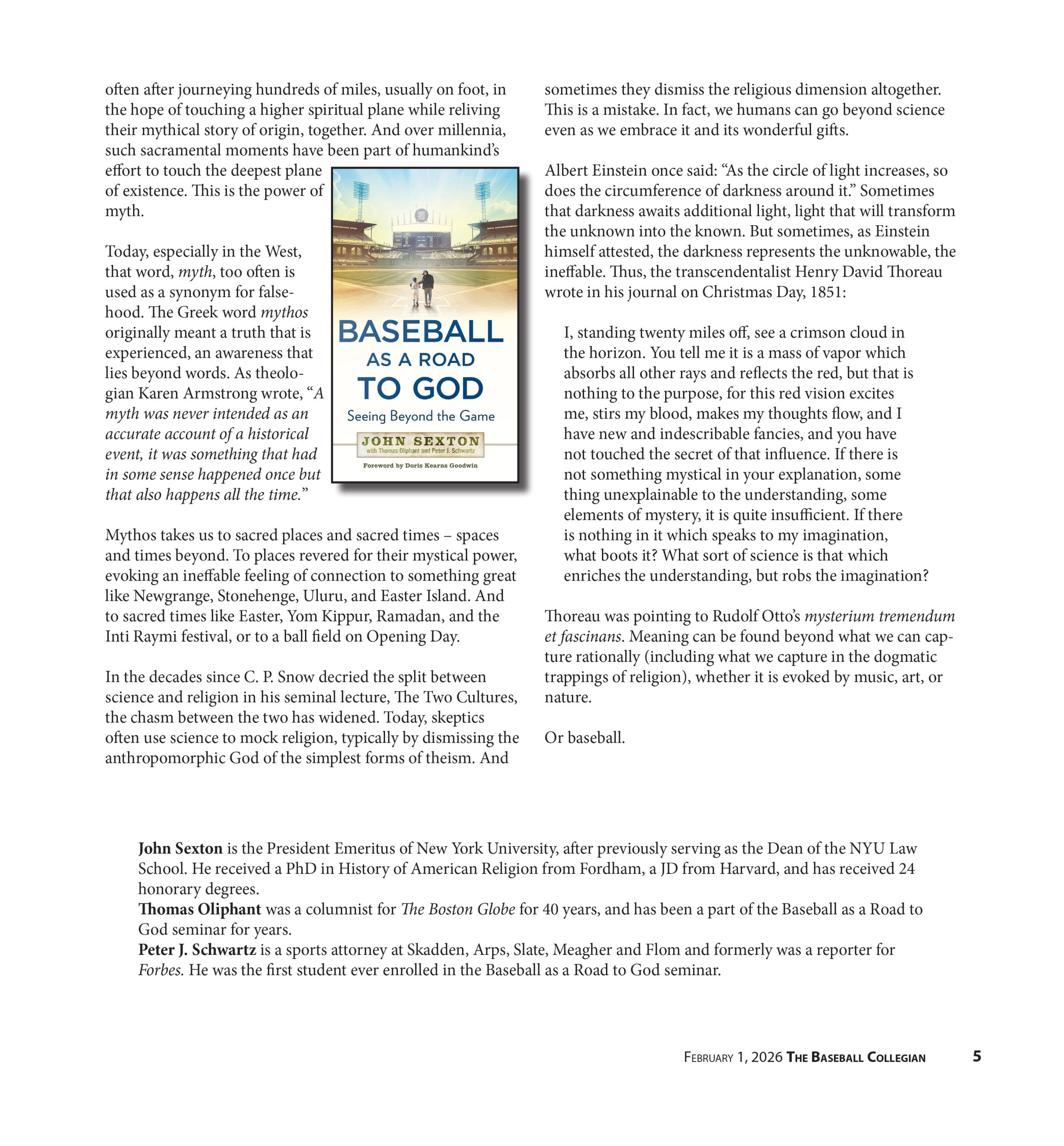
John Sexton served as the President of New York University from 2002 to 2015. He still teaches the class he created, Baseball as a Road to God, culminating in the NY Times best-selling book of the same name.
A new movie based on his book and his lectures, titled Baseball: Beyond Belief, is about how baseball, community and religion intersect in our lives. It will be released in the spring of 2026.
Sacred Space and Time
Some sacred moments occur when “time is out” and the game is halted. So it was on September 6, 1995, when the crowd inside Baltimore’s Oriole Park at Camden Yards erupted into a twenty-two minute ovation in honor of Cal Ripken Jr. after the fifth inning in a game against the California Angels.
The game had just then become “official,” and it therefore was official that Ripken had played in his 2,131st consecutive game, breaking what was once thought to be baseball’s most unassailable record. As the cheering crowd rose in awe, Ripken circled not the bases, but the entire ballpark, stopping frequently to shake hands with fans along the rails. The effect was as magical as it was celebratory. In their book All Things Shining, philosophers Hubert Dreyfus and Sean Dorrance Kelly describe how, in such moments, “something overwhelming occurs.” As they put it, the cheering crowd “wells up and carries you along as on a powerful wave. The wave metaphor is crucial here. Where a wave is at its most powerful, it is a solid foundation that can support as many riders as will fit upon it. It can even sweep up more as it runs along. But when the wave passes, nothing but its memory survives. Try to stand upon the still water and you’ll find that the supporting foundation is gone. Those moments of sport are like that. When you are in the midst of them, riding the wave, they carry you along and give meaning to life.”
The outpouring of emotion for Ripken was simultaneously a nod to the quiet dignity of Lou Gehrig, the previous record holder – an example of baseball’s intertwining of past and present. The sanctity of Gehrig and his record formed a halo upon Ripken as he broke it, the two were united as one.
It had been almost six decades since Gehrig uttered legendary words in his farewell address at Yankee Stadium, a farewell forced by the terminal illness that eventually bore his name: “Today I consider myself the luckiest man on the face of the earth… I might have been given a bad break, but I’ve got an awful lot to live for.” To this day, Gehrig is celebrated on the anniversary of the speech – the Fourth of July – by the Yankees each year they are home (making an already sacred time that much more meaningful), and on one occasion (2009, the seventieth anniversary) by all of baseball, as the speech was recited, word for word, by representatives of every home team in the major leagues. In this and many other ways, baseball creates and lives the cyclical, repetitive liturgy and sacramental time of religion.
Inti Raymi, the Incan Festival of the Sun, celebrates the winter solstice by honoring the god Inti, with hopes of a good harvest in the coming year. In recent years, the ceremony (their Opening Day) has gained a measure of renown through a historical reconstruction, held in Cusco, Peru, as a weeklong ode to its heritage. But before it was suppressed by the Catholic Church in the sixteenth century, the Inti Raymi was a deeply pious affair and is said to have been marked by precise execution of rituals (some gruesome) in the same manner and location each year. Thousands of Inca convened, often after journeying hundreds of miles, usually on foot, in the hope of touching a higher spiritual plane while reliving their mythical story of origin, together. And over millennia, such sacramental moments have been part of humankind’s effort to touch the deepest plane of existence. This is the power of myth.
 Today, especially in the West, that word, myth, too often is used as a synonym for falsehood. The Greek word mythos originally meant a truth that is experienced, an awareness that lies beyond words. As theologian Karen Armstrong wrote, “A myth was never intended as an accurate account of a historical event, it was something that had in some sense happened once but that also happens all the time.”
Mythos takes us to sacred places and sacred times – spaces and times beyond. To places revered for their mystical power, evoking an ineffable feeling of connection to something great like Newgrange, Stonehenge, Uluru, and Easter Island. And to sacred times like Easter, Yom Kippur, Ramadan, and the Inti Raymi festival, or to a ball field on Opening Day.
In the decades since C. P. Snow decried the split between science and religion in his seminal lecture, The Two Cultures, the chasm between the two has widened. Today, skeptics often use science to mock religion, typically by dismissing the anthropomorphic God of the simplest forms of theism. And sometimes they dismiss the religious dimension altogether. This is a mistake. In fact, we humans can go beyond science even as we embrace it and its wonderful gifts.
Albert Einstein once said: “As the circle of light increases, so does the circumference of darkness around it.” Sometimes that darkness awaits additional light, light that will transform the unknown into the known. But sometimes, as Einstein himself attested, the darkness represents the unknowable, the ineffable. Thus, the transcendentalist Henry David Thoreau wrote in his journal on Christmas Day, 1851:
I, standing twenty miles off, see a crimson cloud in the horizon. You tell me it is a mass of vapor which absorbs all other rays and reflects the
red, but that is nothing to the purpose, for this red vision excites me, stirs my blood, makes my thoughts flow, and I have new and
indescribable ancies, and you have not touched the secret of that influence. If there is not something mystical in your explanation, something
unexplainable to the understanding, some elements of mystery, it is quite insufficient. If there is nothing in it which speaks to my
imagination, what boots it? What sort of science is that which enriches the understanding, but robs the imagination?
Thoreau was pointing to Rudolf Otto’s mysterium tremendum et fascinans. Meaning can be found beyond what we can capture rationally (including what we capture in the dogmatic trappings of religion), whether it is evoked by music, art, or nature.
Or baseball.
John Sexton is the President Emeritus of New York University, after previously serving as the Dean of the NYU Law School. He received a PhD in History of American Religion from Fordham, a JD from Harvard, and has received 24 honorary degrees.
Thomas Oliphant was a columnist for The Boston Globe for 40 years, and has been a part of the Baseball as a Road to God seminar for years.
Peter J. Schwartz is a sports attorney at Skadden, Arps, Slate, Meagher and Flom and formerly was a reporter for Forbes. He was the first student ever enrolled in the Baseball as a Road to God seminar.
