

The intent of the Baseball Collegian Pitching Project is to inform coaches and players and parents of some of the many theories on being a successful pitcher.
Most every concept has advocates with very strong opinions on either side of the argument. Too often, a theory is chosen based on popularity, conventional wisdom, or because someone famous does it that way, as opposed to one’s own analysis. With so many contradicting theories, it is essential to have an understanding of all of the possible options before deciding which one to commit to.
These pitching theories are presented without judgment, without confirmation bias, with no preconceptions, and without dogma or commercialism. In turn, the strong hope is that people are inspired to do the work to make up their own mind based on as much information as possible – and in turn, do what makes most sense to them.
Last month, the discussion was about pitch calling and pitch sequencing. This month, the discussion turns to the front leg.
Q. Should your front leg be extended at release or bent?
 General Belief:
• Bent or Locked out, but Firm Josh Boggs
This is not to say that the leg should land completely straight, or even that it has to straighten as the throw occurs.
There are great pitchers whose front leg is bent throughout the throw, like Roy Oswalt. There are also a lot of pitchers whose leg completely straightens into a bracing position, like Justin Verlander or Zack Greinke. Both are fine, as long as the knee doesn’t go forward after foot plant. This is an extremely common reason why a lot of kids have postural issues in the middle and at the end of the motion, don’t follow through effectively, and don’t throw as hard as they should. It’s all related to lack of stability on landing.
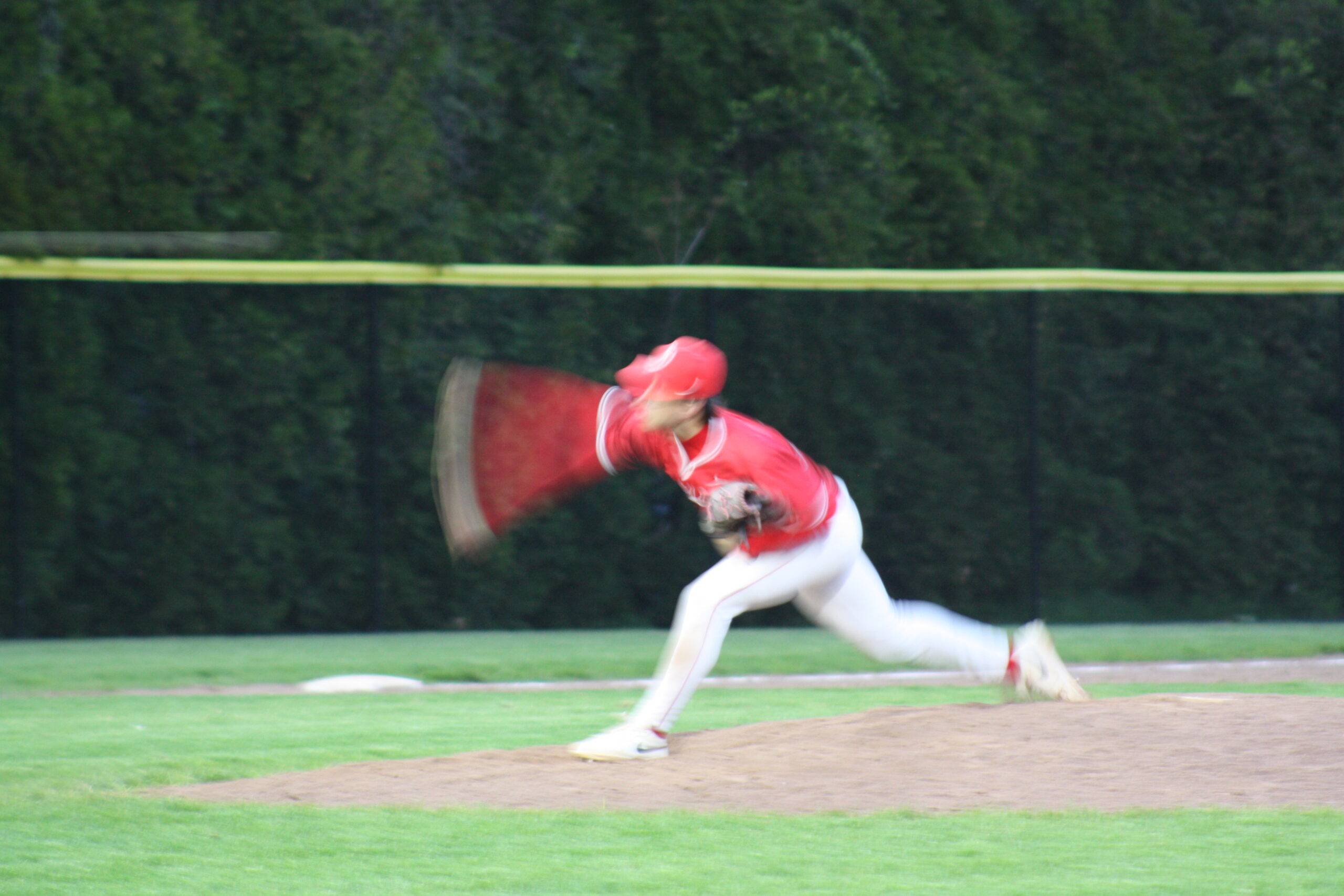 The second way a front leg can thwart success, is if it moves left or right on foot plant. This is more common in young pitchers, as their muscles are not fully capable of supporting as much weight as is needed for explosive pitching. To see this, it’s best to watch (or video) from behind. If the knee moves inward (uncommon) or outward (more common), then the pitcher’s accuracy will be very hard to maintain. Accuracy is largely about release point and there’s nothing easy about consistent release point if the knee is steering the body left or right as the throw is happening. This is one of the most common factors in a youth pitcher missing left and right in the zone that I have ever found. (pitchmechanics101.com)
Other Philosophies:
• Bent, into extended Bill Thurston
Upon firm stride foot placement, the lead leg is flexed at the knee at about a 135 degree angle.
– As the trunk is rotated to a squared off throwing position, the lead leg starts to brace-up (extend) so there is a firm base, a firm front side to rotate up against.
– The bracing action of the lead leg stops the body from continuing to move forward, allowing the hips, trunk and shoulders to generate tremendous horizontal rotation and centrifugal forces which produce great arm and hand speed, resulting in greater velocity.
– Many young pitchers, after foot contact, allow their lead knee to stay flexed and actually continue to drift forward. This prevents good rotational forces and causes a loss of power and velocity. (The Fine Art of Pitching, by Bill Thurston)
• Bent, into extended Phil Rosengren
When talking about good front knee action and extension, I’m specifically talking about what you want to be happening at ball release. I am NOT advising that you should land with a stiff or locked out front knee. This would be very jarring, increasing the stress on the arm and hurting your control. You want to land flexed and firm with that front leg, and then brace up into ball release.
To help understand how this works, imagine you’re riding a bicycle at full speed and suddenly slam on the front brake. What happens? The front wheel will stop and inertia will launch the back of the bike up in the air sending you over the handlebars. Well the same thing is happening in your pitching delivery. (betterpitching.com)
• Lock Out Graeme Lehman
This supports the data presented by Escamilla et al (1998) which reported that collegiate pitchers demonstrated knee extension just prior to maximum external rotation of the glenohurmeral joint during a fastball pitch.
High velocity cricket bowlers have also been shown to exhibit similar front knee movement patterns. Wormgoor et al. (2010) demonstrated that greater front knee extension at ball release was the biomechanical factor that correlated the highest with throwing velocity. (lehmansbaseball.wordpress.com)
• Lock Out/Claw backwards Kyle Boddy
While back leg “drive” did NOT significantly correlate with increased ball velocity, lead leg posterior force did. This can best be viewed by the following clip of Shohei Otani from the Nippon Professional Baseball (NPB) league in Japan, their version of MLB. Otani has thrown 101 MPH in a game and regularly sits mid-high 90’s! Watch how the lead leg not only compresses vertically downwards, but claws backwards in a direction opposite of the throw before it rotates over due to residual momentum of the trunk and hips following through (www.drivelinebaseball.com)
• Don’t Lock Out Chris O’Leary
I teach pitchers to firm up but not lock out the GS knee because locking it out, while it WILL give you a velocity boost, can definitely lead to hip and knee problems and maybe arm problems. (www.baseball-fever.com)
