

Duke Dickerson was a former record-setting pitcher at Virginia Tech who helped guide the Hokies to two NCAA Division 1 Super Regionals. He signed with and played in the Toronto Blue Jays organization, then served as field staff with the New York Yankees organization. He is currently pitching coordinator at Capital University (Columbus, OH), Special Advisor to the Solingen Alligators Baseball Club of the German Bundesliga, and an American Baseball Coaches Association (ABCA) Ambassador.
1. Overview
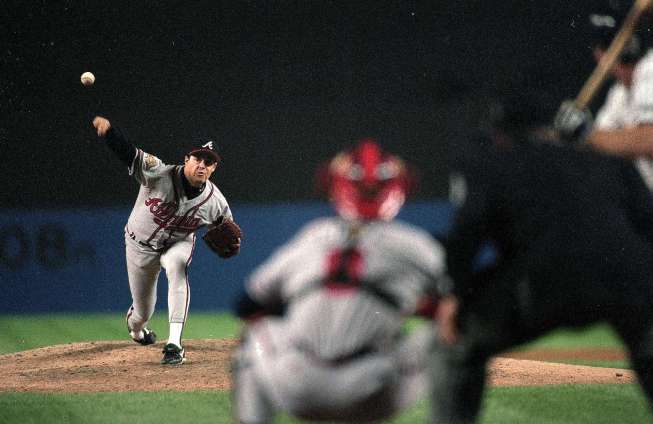
• Greg Maddux (MLB 1986–2008) is one of the most intelligent and efficient pitchers in baseball history. Though he never possessed overpowering velocity, his career—355 wins, 3,371 strikeouts, and a 3.16 ERA—was built on precision, anticipation, and advanced understanding of hitters and physics.
• Nicknamed “The Professor,” Maddux transformed pitching from brute competition into a form of strategic chess — every pitch designed not just to get an out, but to set up the next.
2. Philosophy: “Less Force, More Thought”
Maddux’s philosophy was grounded in control, deception, and efficiency rather than velocity.
He once said: “The key isn’t to throw harder; it’s to throw smarter.”
Key Tenets:
• Efficiency over power: Focus on minimizing wasted energy – physically and mentally.
• Movement over speed: A well-placed, moving 86-mph fastball beats a flat 96-mph fastball.
• Perception over reaction: He aimed to make hitters see something they expected and then deliver something subtly different.
• Maddux approached pitching as an information game: the more he knew about the batter’s tendencies, body language, and reactions, the greater his advantage.
3. Strategy: The Maddux Matrix
A. Commanding the Quadrants
• Maddux divided the strike zone into four quadrants and sought to own each corner.
• His ability to paint edges—especially down and away to right-handers—forced hitters into defensive swings.
• He exploited the perception of the strike zone:
• Early in games, he’d establish one side of the plate.
• Later, he’d expand the opposite edge — hitters would chase because he’d subtly shifted their visual reference point.
B. Changing Eye Levels and Speeds
• Maddux manipulated vertical and horizontal planes masterfully:
• A sinking fastball down and away set up a rising fastball up and in.
• A slow changeup after a two-seamer caused perceived “hop” in the next fastball.
• By altering time perception (Einstein would approve), he controlled hitters’ rhythm and timing — the core of his dominance.
C. Movement Mastery
Maddux’s pitches—especially his two-seam fastball and change-up—shared identical arm action but had late, differential movement. He created “late life” by perfecting:
• Spin efficiency (seam orientation for maximum movement)
• Seam-shifted airflow (akin to a real-world Navier–Stokes effect)
• Grip pressure variance (micro-adjustments that altered movement subtly)
This wasn’t accidental; it was physics in action. He intuitively understood the Magnus effect, Bernoulli pressure differentials, and drag coefficients long before those terms became common in baseball analytics.
4. The Maddux Mindset
A. Observation
• Maddux was famous for noticing the smallest cues — a batter’s weight shift, grip change, or breathing pattern.
• He often said he could tell what pitch a hitter wanted just by how they stood in the box.
B. Anticipation
Rather than react, Maddux anticipated:
• “You don’t throw where the hitter is — you throw where he’s going to be.”
• This anticipation allowed him to pitch ahead of time — strategically controlling not just the pitch, but the hitter’s mental state.
C. Efficiency
He valued finishing games quickly — with minimal pitches and maximum precision.
• A “Maddux” (a complete game shutout in fewer than 100 pitches) is now an official term in baseball statistics — a testament to his mastery of conservation and control.
5. Mechanics: Simplicity and Repeatability
• Maddux’s delivery was compact, balanced, and easily repeatable:
• Minimal moving parts = consistent release point.
• Front-side stability = precise control over movement.
• Efficient kinetic chain = reduced stress and maximum command.
• His motion exemplified Newtonian efficiency — every action produced a controlled, proportional reaction.
• He didn’t overpower the ball; he guided it through geometry and timing.
6. The Legacy: The Scientist on the Mound
In Maddux’s Own Words:
• “The art of pitching is upsetting timing.”
• “Movement, not velocity, gets people out.”
• “You learn more from watching hitters than watching film.”
7. Summary: The Maddux Equation
Pitching Mastery =
(Intelligence × Efficiency) + (Movement ÷ Effort)
Greg Maddux turned pitching into a living equation – a harmony of observation, physics, and psychology. His career proves that the ultimate weapon isn’t velocity; it’s understanding the geometry and aerodynamics of the game, and using them to outthink the opponent.
