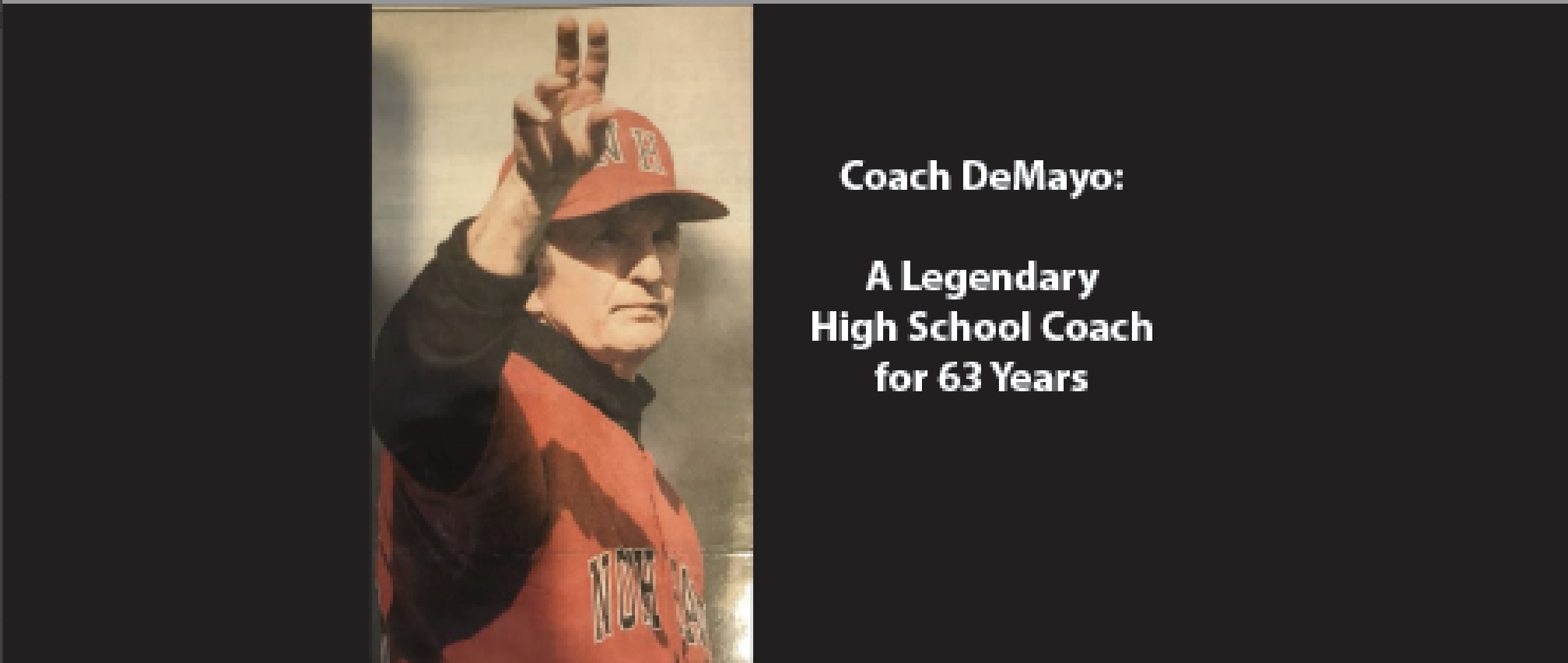
“I think the heart of my coaching style was the way I thought things out and encouraged my players to do the same. In practice, I’d put forth hypothetical fielding situations and say, “What would you do in this situation? Then change the number of outs – what about now?” I’d keep my players on the field until it got dark, practicing the same plays over and over, with their teammates running the bases, until their assignments became second nature.”
Coach DeMayo, from Bob DeMayo: Coach for a Season, Teacher for Life.
Playing for Bob DeMayo at North Haven High School (Conn.) came with commitments: to yourself, to the team, to the work:
First lesson: You earn your spot every day – no resting on your laurels.
Second lesson: What you practice, you will do – game-situation work was a key part of every practice.
Third lesson: Talent gets you on the field – Baseball IQ keeps you there.
Building on recent pieces in The Baseball Collegian on Situational Practice Guidelines and Baseball IQ, I’m reminded of what his players say was the “secret sauce” to Coach DeMayo’s process: every defensive practice had runners on the base paths, dodging around you, sliding into you – always movement, always pressure.
My teammates and I well remember those “live” game-situation practices. Those were the fun days – teammates challenging you under real game-time pressure. All nine positions were on defense, fielding Coach’s well-placed fungoes, while our teammates ran the bases. The goal: make the right choices, on time.
For example, every outfield cut-off demanded situational awareness. Coach would call out the score, inning, and number of outs, then position the baserunners. Our job was to execute the right relay for the moment. Sometimes that meant conceding a run to prevent other runners from advancing; other times that meant going all out to gun down the lead runner at home. In time, we knew the difference instinctively.
Likewise, every double-play drill had a runner “cheating” from home to first, and another bearing down on you at second. The rapid pace of the action sharpened our reflexes and polished our execution…and somehow, we still turned the double-plays.
We also rehearsed set plays for pickoffs and bunt defenses, syncing our timing with the pitchers, while all four infielders moved in unison and the outfielders shifted to their backup assignments. Every defensive player had to be in position for every possibility.
Finally, the runners were encouraged to do unexpected things on the bases, testing our reactions. Runners would take off at odd times, baiting us into madcap rundowns. The rule was simple: get the ball to the fielder who could best drive the lead runner back to the base he came from. We’d sprint at the runner full tilt, ball held high, give one hard fake, and if he didn’t bite, one throw to the base. One sprint, one fake, one throw — play over. On rundowns, Coach was firm: “There’ll be no ‘hotbox,’ no ‘backyard baseball,’ on my team!”
One key to winning is eliminating the “big inning” on defense. As noted in a previous article, that meant limiting consecutive walks and errors. For Coach DeMayo, that also included never giving opponents extra bases by making smart relay choices, using sound catch-and-throw techniques, and executing clean rundowns.
Most practices teach skills; Bob DeMayo’s built Baseball IQ. At a recent reunion, one former teammate captured it perfectly: “There is one lasting impression from my days playing for Coach DeMayo: that after all the conditioning, and all the drills, and all the grueling game-situation practice, you could walk off the field every evening, with the sun low in the sky, knowing you had earned your keep. In the end, it’s the work that we remember – and it made the winning that much sweeter.”
Bob DeMayo was the North Haven (Conn.) High School baseball coach for 63 years and recorded 937 wins and five state titles. One of his former players, Frank LaMonaca ’75, continues to spread the teachings he learned.