

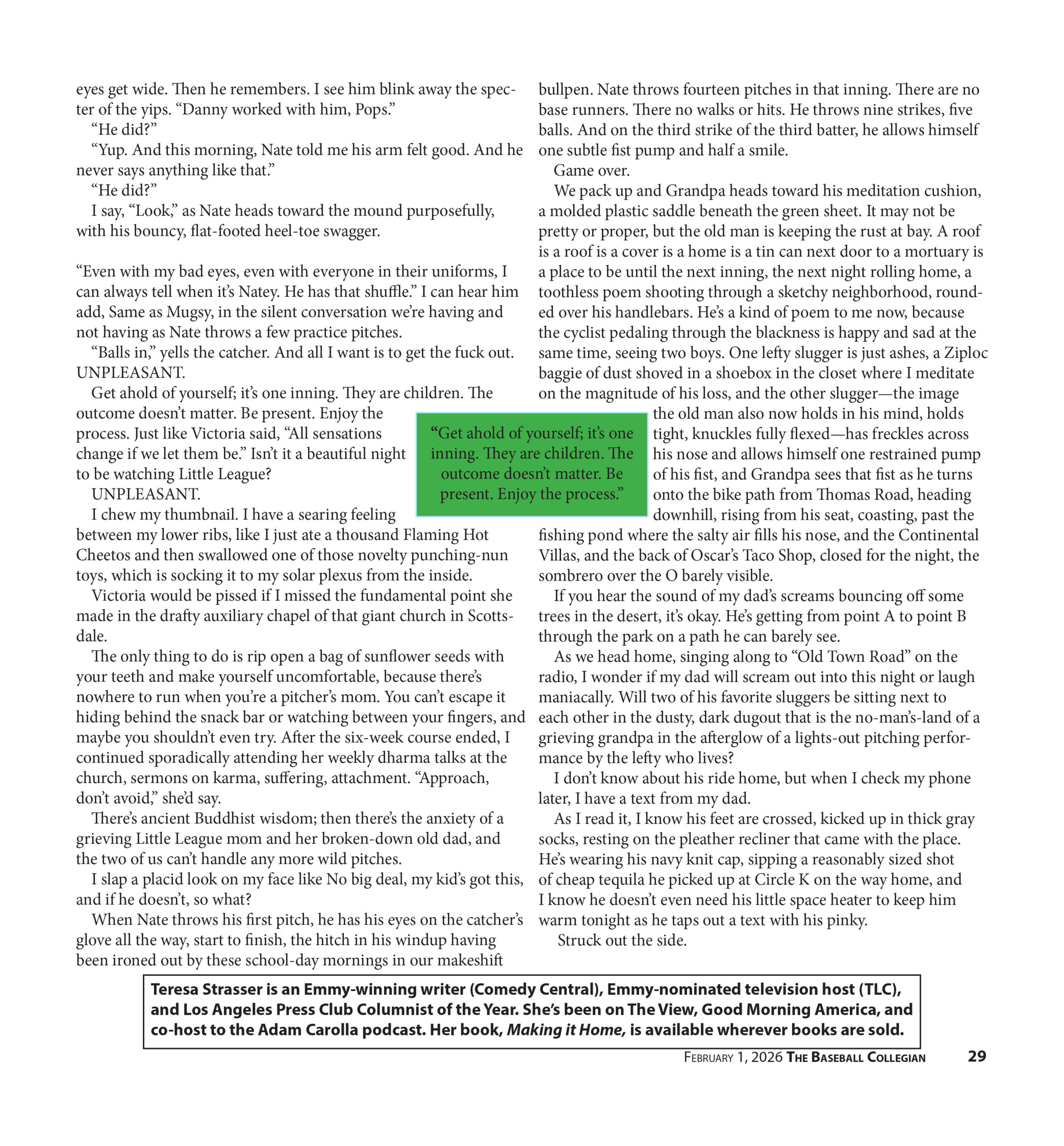
A second excerpt from the book Making it Home: Life Lessons from a Season of Little League, by Teresa Strasser, an Emmy-winning writer (Comedy Central), Emmy- nominated television host (TLC), and Los Angeles Press Club Columnist of the Year. She’s been on The View, Good Morning America, and co-host to the Adam Carolla podcast. Her book, Making it Home, is about her journey through loss and healing through a season of Little League Baseball. It is available wherever books are sold.
 Nate’s been pitching in the yard before school. Along the side of our house, a wooden fence separates us from our neighbor, leaving a narrow lane between the house and the fence. My husband measures out the correct distance—forty-six feet for Little League Minors—puts down a plastic mat for a makeshift home plate, another for the pitcher’s mound, and then he squats behind the plate to receive each pitch as it comes down the pike, calling balls or strikes against an imaginary batter.
This morning, Nate stops. “Hey, Dad?
“When I look at you the whole time during my delivery, I throw more strikes.”
“What have you been looking at?” asks his dad, who has missed this one small detail in the bevy of body movements that make up a pitch.
Nate slows down his motion, reenacting it. A left-hander’s body faces first base—in this case, the side of our house—before initiating delivery. He holds the ball in his left hand, cradling it like a baby held low. He turns his head to look at his dad, his body still facing imaginary first base. He cranks up his right knee. His hands separate, the gloved hand going toward his target, his dad’s catcher’s mitt. His ball hand stretches back as his body weight moves forward. He draws his elbow back, like an archer, and then flashes the ball to the batter as his front foot lands. His throwing arm comes forward, trailing his leg by just a fraction of a second, flinging the ball toward the strike zone, arcing forward in a rainbow. After the ball is released, his left leg comes all the way around, parallel to the other, so his hips, shoulders, head, everything, are facing forward, squared off, ready to field a ball.
“I’ve been looking at first.”
“Oh no,” says his dad. “You should always be looking at the catcher. Keep your eyes on the target no matter what your body is doing.”
Coach says that’s pretty much an ironclad rule when it comes to Little League pitching. Maybe it’s even true for major leaguers.
Fernando Valenzuela was a notable exception. He would look up for a moment during his windup, a very unorthodox delivery that somehow worked for him. I only know this because my brother had a poster of Valenzuela Scotch-taped to his bedroom wall. The left-handed Dodger from Mexico looked pudgy and jovial, his lead leg lifted all the way to his elbow, gathering himself to hurl his other-worldly screwball toward the plate, eyes lifted toward the heavens.
Nate holds his gaze steady toward his dad’s glove.
They go through a few more counts against invisible opponents, some balls, but mostly strikes.
“You just struck out two batters,” Daniel says, in the measured tone of a guy temperamentally suited to being a Little League dad.
Things are looking up for Nate in the bullpen that is the narrow patch of dirt along our fence, but irrational exuberance is not his coach’s style, nor is taking his eye off the ticking clock on a school day. “One more, Dad. One more,” Nate begs. But it’s time for breakfast, and Coach rises from his squat, removes his glove.
“My arm feels good today,” Nate tells me over oatmeal, in a rare tell-Mom-a-thing-I-feel moment. My breath catches in my sternum for a second.
I look sidelong at Daniel, who is rinsing a dish at the sink. He raises his eyebrows, tilts his head to the side, but doesn’t look up. “Yup,” he says, nodding and rinsing. “Looking good.”
 Nate isn’t a leadoff hitter, doesn’t quite have the wheels, but tonight Coach is mixing things up. Despite his recent mishaps at the plate, Nate is just as likely to put the ball in play as anyone else. Before stepping into the box, he takes a practice swing, and I know he’s working to keep the bat nice and level, like his dad taught him. He steps into his stance, taps the bat on the plate, swings the bat all the way around, toward the pitcher and over his head in a circle, taps the plate with the bat again, and then rocks back and forth until his weight is centered, his cleats parallel.
The first pitch is a ball. He doesn’t swing. Good eye.
On the second pitch, he gets under it, makes contact, and launches the ball into the air toward center field. There’s a very particular sound when the sweet spot of an aluminum bat hits the leather, cork, and rubber that make up a baseball. “You hear that?” my dad says when Nate hits it square. “I love that sound.” It’s a sharp thwack, something you take in more like echolocation than hearing, the bat flexing and vibrating, the acoustics of two solid objects connecting in exactly the right place.
But this isn’t that sound. It’s dull and flat. It’s a hollow, three-quarter echo of that sound.
“DROP. DROP. DROP.” We can will the ball to drop; if we chant, in unison, the ball will drop. Maybe we shouldn’t, because it’s embarrassing, but we can’t help ourselves. I clutch my jade necklace for luck, because I know I can help this weak hit somehow land where a fielder isn’t. The moment I hear the sound, the aluminum hitting the ball, sending it out, I know that I control how fast and how far it travels and whether it finds a spot to drop. In that fraction of a second, when I clutch the pendant hanging on a chain around my neck, I believe in God, I believe in angels, I believe dead people are angels looking out for me, I believe in the indescribable embrace of Jesus and his love-light, I believe my dead mom, who never cared about baseball, is taking a pause from some heavenly game of bridge to see to it that this goes right for me. Forget letting be. Forget the here and now, my toes, the dirt, the earth. Forget meditating in my closet, letting life unfold, accepting and being present. I’m as far away as I can be, in the phony afterlife of cheap figurines and basic-cable mediums, chugging a bottomless cup of crave. In that slice of time, between contact and landing, I set aside all the things I secretly know to be true: that when you’re dead, you’re dead; maybe when people think of you there’s some sort of momentary reawakening of your essential being in the atmosphere, but basically you’re gone, nighty night and shalom; and angels are just nice people who are repairing cleft palates in war-torn countries or working at food banks here on Earth, not prancing around looking like Stevie Nicks in the afterlife, wearing feathers and wings. But for this pause in the space-time continuum, angels are dead ancestors on puffy clouds listening to actual harp music. My mom is peering down over her bridge hand, through the clouds, aware that Nathaniel James has just made contact with a baseball and things might not go his way, so of course she has the power to bend the wind, or the Earth, or the left fielder’s arm. My brother is up there, hearty and whole. He doesn’t have cancer and he doesn’t have the yips, but he does have divine superpowers. For the thin sliver of time when the outcome is up in the air, I’d swear angels exist. I’d pay to have my aura photographed and my palm read. When it’s time to control the world for my kid, I’m one hundred percent that bitch.
DAMN.
Caught by the third baseman, who smugly returns it to the pitcher. I knew heaven was bullshit.“Oh for one,” I whisper to my dad.
“What was that?” he says to me out of the side of his mouth. We both keep facing the game, faking it, acting like we actually care about the next batter.
“This is a disaster, Dad. His timing is way off. Still.”
“Disaster,” Dad repeats, talking like a trailer-park ventriloquist, mouth barely moving. He takes off his knit cap, holds it gently in his lap, looks at the traffic on Camelback Road, swigs his Diet Pepsi.
We are holding out hope for his next at bat.
 The first two innings were so painfully slow, they ate up most of the time. By our calculations, Nate will get only one more turn at bat.
When Nate steps up to the plate, he takes an overeager big hack at the first pitch, which is so high, it’s at his eyeline. He swings so hard he turns himself around, like a screw going into the ground. He collects himself, looks toward his coach. “Wait for your pitch. Lay off the high stuff,” says Coach Daniel casually, spitting sunflower seeds into the dirt. On the next pitch, Nate is way out in front. Down two strikes in the count, he keeps his eye on the ball and doesn’t swing at a high one. But the ump calls it a strike, and he goes down looking.
“Oh for two,” mutters my dad. We shake our heads, roll our eyes. We sit in silence. And more silence.
“I lost my son to cancer, but this is the worst thing that’s ever happened,” he murmurs. This is a green-sheet joke, dark and wrong and something only we could understand as not true and absolutely true. He lets out a huge guffaw when he sees the words register on my face, dabs his eyes with his blue bandana. Then the reality hits us. It’s just not fucking funny. No majestic line drive to discuss the next day. No clever base running where Nate comes out the victor. No sweet sound of a shot coming off Nate’s red aluminum USA Baseball–sanctioned bat for us to hear in our heads as our heads hit our pillows, for us to parse the next day on the phone as we review the game. Nothing good. Fortunately I can cheer my dad up by sharing my inside information, conspiratorially, as Nate hits the dugout, registering no emotion on his young face but hanging his head low as he removes his helmet, shakes out his hair, and checks his outfield assignment on a clipboard hanging from a nail by the door.
“Dad, Coach promised Nate an inning on the mound tonight, because friends from his school are on Team Turquoise.” My dad’s eyes get wide. Then he remembers. I see him blink away the specter of the yips. “Danny worked with him, Pops.”
“He did?”
“Yup. And this morning, Nate told me his arm felt good. And he never says anything like that.”
“He did?”
I say, “Look,” as Nate heads toward the mound purposefully, with his bouncy, flat-footed heel-toe swagger.
“Even with my bad eyes, even with everyone in their uniforms, I can always tell when it’s Natey. He has that shuffle.” I can hear him add, Same as Mugsy, in the silent conversation we’re having and not having as Nate throws a few practice pitches.
“Balls in,” yells the catcher. And all I want is to get the fuck out. UNPLEASANT.
Get ahold of yourself; it’s one inning. They are children. The outcome doesn’t matter. Be present. Enjoy the process. Just like Victoria said, “All sensations change if we let them be.” Isn’t it a beautiful night to be watching Little League?
UNPLEASANT.
I chew my thumbnail. I have a searing feeling between my lower ribs, like I just ate a thousand Flaming Hot Cheetos and then swallowed one of those novelty punching-nun toys, which is socking it to my solar plexus from the inside.
Victoria would be pissed if I missed the fundamental point she made in the drafty auxiliary chapel of that giant church in Scottsdale.
The only thing to do is rip open a bag of sunflower seeds with your teeth and make yourself uncomfortable, because there’s nowhere to run when you’re a pitcher’s mom. You can’t escape it hiding behind the snack bar or watching between your fingers, and maybe you shouldn’t even try. After the six-week course ended, I continued sporadically attending her weekly dharma talks at the church, sermons on karma, suffering, attachment. “Approach, don’t avoid,” she’d say.
There’s ancient Buddhist wisdom; then there’s the anxiety of a grieving Little League mom and her broken-down old dad, and the two of us can’t handle any more wild pitches.
I slap a placid look on my face like No big deal, my kid’s got this, and if he doesn’t, so what?
When Nate throws his first pitch, he has his eyes on the catcher’s glove all the way, start to finish, the hitch in his windup having been ironed out by these school-day mornings in our makeshift bullpen. Nate throws fourteen pitches in that inning. There are no base runners. There no walks or hits. He throws nine strikes, five balls. And on the third strike of the third batter, he allows himself one subtle fist pump and half a smile.
Game over.
We pack up and Grandpa heads toward his meditation cushion, a molded plastic saddle beneath the green sheet. It may not be pretty or proper, but the old man is keeping the rust at bay. A roof is a roof is a cover is a home is a tin can next door to a mortuary is a place to be until the next inning, the next night rolling home, a toothless poem shooting through a sketchy neighborhood, rounded over his handlebars. He’s a kind of poem to me now, because the cyclist pedaling through the blackness is happy and sad at the same time, seeing two boys. One lefty slugger is just ashes, a Ziploc baggie of dust shoved in a shoebox in the closet where I meditate on the magnitude of his loss, and the other slugger—the image the old man also now holds in his mind, holds tight, knuckles fully flexed—has freckles across his nose and allows himself one restrained pump of his fist, and Grandpa sees that fist as he turns onto the bike path from Thomas Road, heading downhill, rising from his seat, coasting, past the fishing pond where the salty air fills his nose, and the Continental Villas, and the back of Oscar’s Taco Shop, closed for the night, the sombrero over the O barely visible.
If you hear the sound of my dad’s screams bouncing off some trees in the desert, it’s okay. He’s getting from point A to point B through the park on a path he can barely see.
As we head home, singing along to “Old Town Road” on the radio, I wonder if my dad will scream out into this night or laugh maniacally. Will two of his favorite sluggers be sitting next to each other in the dusty, dark dugout that is the no-man’s-land of a grieving grandpa in the afterglow of a lights-out pitching performance by the lefty who lives?
I don’t know about his ride home, but when I check my phone later, I have a text from my dad.
As I read it, I know his feet are crossed, kicked up in thick gray socks, resting on the pleather recliner that came with the place. He’s wearing his navy knit cap, sipping a reasonably sized shot of cheap tequila he picked up at Circle K on the way home, and I know he doesn’t even need his little space heater to keep him warm tonight as he taps out a text with his pinky.
Struck out the side.
