
Jeff Smith has coached catchers for over 25 years as a professional manager and coach. He has over 1,000 wins as a minor league manager, as well as serving as catching coach with the Minnesota Twins under manager Paul Molitor. He is currently the catching coordinator for the Tampa Bay Rays.
Jeff played for Stetson University, as well as three summers for the Orleans Cardinals in the Cape Cod League. He was drafted by the Minnesota Twins and spent nine years playing in the Twins, Red Sox and Rangers systems.
Want to learn more from Jeff?
Access over 150 teaching clips through Jeff’s courses.
Jeff is also available for individual video analysis. espinosa-online.com/online-private-lessons/
Collegian What are some of the most important physical movements that a catcher has to do? I know you have to throw well, block well, receive well, but what are their movements that make a good catcher?
Jeff Smith I’m going to preface this as a player that played 10 years in the minor leagues, a guy that’s instructed for over 25 years, and a guy that’s been with the Twins as a major league and minor league catching instructor and for three years now in Tampa as a catching coordinator. I have been through three complete generational cycles in catching. When I started, it was drop the glove pre-pitch, and then it went to a quarter turn, and now it’s all the way to the ground. All of them are pretty much very similar in a sense of staying underneath the ball. We’re still relaxing the wrist. We’re still getting to a spot with a goal of beating the ball to the spot. For movement patterns, you can start with hip mobility, which is still a very, very important thing. Hamstring and back flexibility go in to mobility. Also, having good strength and movements in the left wrist and left arm. And when you have those movements, then you get to the advanced stage of making good quality movements as fast as possible.
Collegian Isn’t it almost overwhelming how pro catchers are able to withstand the velocity?
Jeff Smith Yes. I think it amazes us catching instructors too, because we’re seeing catchers pocket balls, have the strength to make moves, have the strength to stop balls, have the strength to bring balls left, right, up, down – not at 80 miles an hour, but at pitches going 100 miles an hour, or sliders that are going 92, or split fingers that are going 91, or high fastballs with 20+ inches of carry. You must really give so much credit to these catchers. Their eyesight, their recognition, their strength, and most of all, just the work ethic of catchers these days. Every catcher wants to be able to slow the game down. And you slow down the game enough to do this with 100 mile-an-hour pitches with over and over repetition. You want to be the one that catches the bullpens, as every time you catch pitches of high velocity, you’re slowing things down. And eventually, that 100 is going to keep going slower and slower with your eyesight. It’s a special breed for sure.
Collegian We’re talking athleticism, but I’m also curious about practicing these skills. What do you need to do daily?
Jeff Smith For drills, it’s kind of like you’re doing ball handling in basketball. It’s like infielders doing repetitions every day. It’s not one of these things where you’re just going to do two or three days a week and do it for an hour. You will get better a lot faster if you do 15-30 minutes daily where you touch receiving, you touch throwing, you touch blocking. Spend 15-30 minutes a day at your craft, you will get better at something. It involves some strength training of your left arm, forearm, wrist and shoulder. It may involve quickness. But what it really comes back to is just learning how to pocket the ball and catch the ball correctly with movement and velocities. And that’s kind of where it all starts. But the more someone trains daily at a smaller amount of time is always going to outweigh just once or twice a week with long periods of time. Because your eyes have to match your hands.
 Collegian A tricky thing is how to do daily catching drills without beating your body down every day.
Jeff Smith Catchers are a special fraternity. And it just becomes part of your daily life. You want it, your mind wants it, your body wants it, and it just makes you so much better. Even if you’re just doing receiving daily, even if you’re just doing it and adding a little throw, a little whatever, you’re going to be feeling confident. When you get back there and you want to slow down the game, feeling confident is where it all starts. And the only way to feel confidence really is to feel good. There’s a lot of repetition and feeling good at what you do, and it’s just that daily routine of 15-30 minutes that is going to make that difference. And you could do it on both knees, on the left knee, on the right. You could do it in traditional stance, you can do it on a bucket. There’s all different ways that catchers catch. The more your eyes sync up with that glove and the ball, the better you’re going to be in the long run.
Collegian A hard thing I found in coaching was how to get catchers practice reps on game day. In pro baseball, they’re playing every day. When do they practice? How long? What do they do? What’s a good plan?
Jeff Smith For our routines, we’re doing receiving, throwing, blocking routines just the same thing as shortstops getting ground balls – it’s no different. If you’re not starting, you might do it during BP or right before BP. The starting catcher is going to do his routine right before he catches his first pitch in the bullpen. If a fan wants to see a pro catcher work, the best time is 45 minutes before the game starts. In the bullpen, you will see all kinds of different routines, anywhere from hip mobility to stretching to some type of receiving drills, then blocking drills and then some footwork and exchange drills. Then he’s ready to catch for that night, but also keeping him sharp all season long.
Collegian Do you have any go-to drills that you would put into that little session?
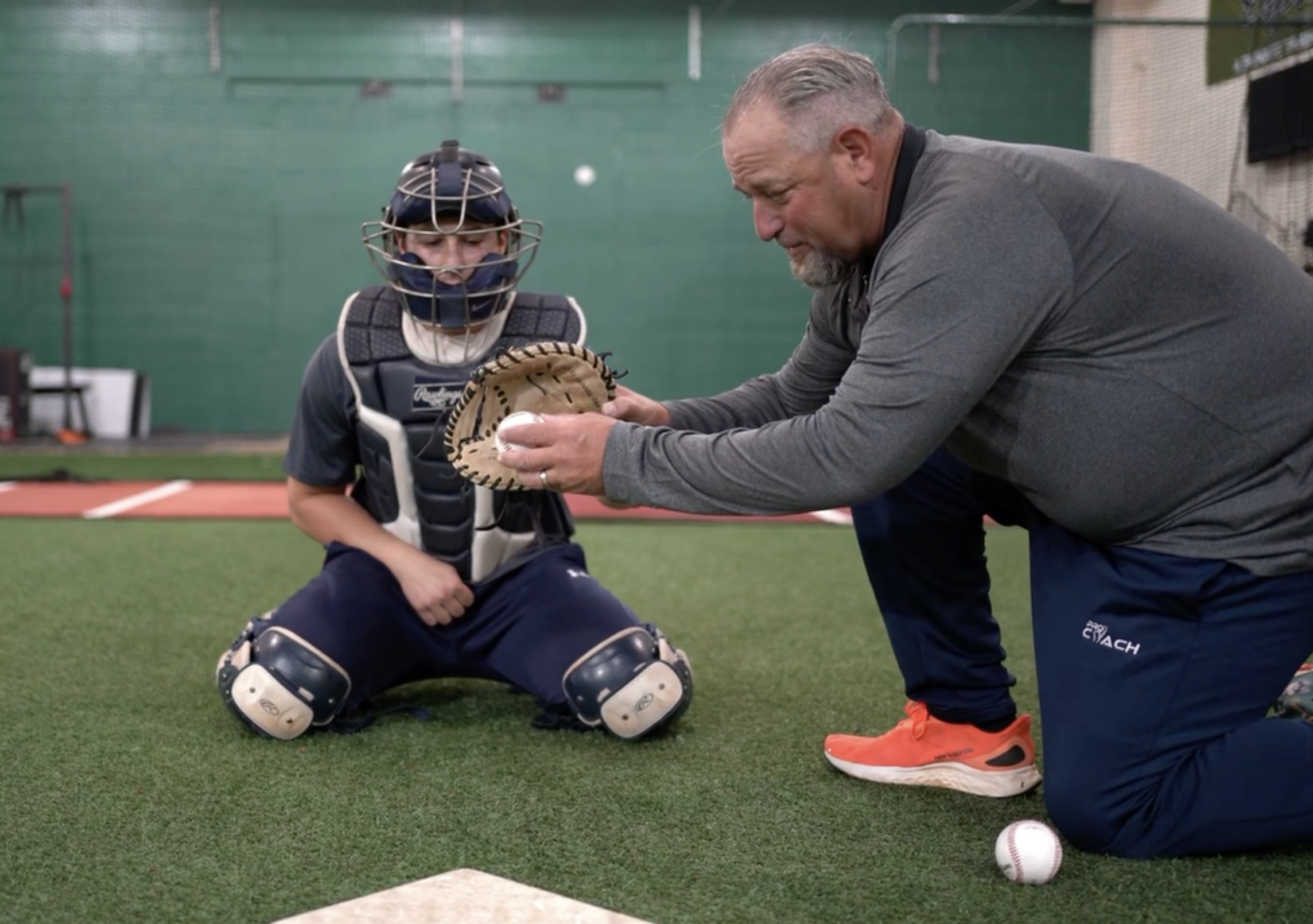
Jeff Smith In general, it all starts with getting your hands ready. It could be catching plyo balls and sticking it. It could be something with a heavy glove. It could be something barehand with baseballs or light balls to get your hands and eyes going. You let your hand work underneath the baseball, then you go right to your glove, maybe with some fastballs, maybe some bounce drills. The biggest thing before you start making your moves in all four sectors is to feel the ball hit the pocket a bunch. Then you go to your left or right knee down or if you’re a kickstand guy, whatever stances you’re going to use, and work your four zones. Then guys like to feel the ball off the chest protector a little bit on some blocks. You like to see ball spin and and do some recognition drills. Is it in the air? Is it going in the dirt? And then at the end, how it feels from side to side with that and then go to some transfers. Get the hand on the baseball. Go from your glove to your hand, and end up with a little footwork, and then you’re ready to go. Because I think one thing that everybody forgets, the first ball receiving, the first block you make, the first throw you make, may dictate that whole game. And if you’re not ready… Maybe the most important thing to do is to prepare you for that first time.
 Collegian I would always tell my guys to create a daily routine that they need to own every day. But in the rush of game day, it would often get lost and not done enough.
Jeff Smith Right. There are so many things that partners do without a coach. I’m a huge believer in the most valuable and best players are the ones that do things when no coach is watching. You go to a college game and there’s four catchers in the bullpen with no coach, doing drills back and forth. They’re doing stuff together. So I think the process of getting better is really important.
Collegian It’s kind of becoming more and more realized how profound catching is. It requires such an athleticism and it’s where the action is – Home plate.
Jeff Smith There’s no place where you are so involved in the action, every single play. And there’s also probably no position on the field where you can make such a difference in a pitcher’s career in development, too. You’re developing yourself, but just the difference you can make on your teammate’s career is so cool to do too. There’s so many good things.
Collegian Let’s talk about receiving. What are your thoughts about knee on the ground receiving?
Jeff Smith Looking back at my career as a catcher coach, when it first started, I was obviously a traditional guy. It was knees out, or knees in for big guys so they can get down. Anybody that’s done it a long time, it took them a little time to understand and believe and see what we’re going to do with it. But once you understood the knee down, you just saw the value of it. And it took all of us a different time period to understand that. Anybody that says catchers go knee down to save hips and knees – that is a false statement. because you are more intense. Maybe some of the pressure is no longer on your left knee, right knee, but maybe the pressure is added on your lower back or lower on different parts of your body. But the intensity level is just as much. Basically, when you go down to a knee, you do have a lot more freedom on your left elbow and ability to use your glove. A lot of time in a traditional stance, their elbow might get stuck with their left knee. When you put a left knee down, the knee is out of place. So a lot of times now, your glove has full freedom of the strike zone. And No. 2, your eye level is in the strike zone a lot more. It does keep you a lot quieter. And No. 3, it gives the umpire a very clear, clean look at the strike zone.
Collegian With blocking on one knee, is it harder to block balls to the side when the knee is down?
Jeff Smith I’ve actually seen guys block better with left and right knee down. And there’s a few reasons why it’s comparable or better. A lot of times, everybody will notice the one block that gets away. The catcher might have just blocked 10 balls, but it might be the one crazy pitch that gets away. And it’s always blamed on the knee down. We all get it as catching instructors. But the good thing on left knee/right knee is blocking all starts with recognition, being engaged, and anticipation. But when your left knee or right knee is down and your glove is on the ground, you are in a position already close to the ground where you can slide left or right and you don’t have to drive your knees down. You are very close. And your decision making between the block and the catch, becomes easier for you. And that’s what you really want – to make your decision-making process between the catch and the block as easy as possible.
Collegian You mentioned starting with the glove at the bottom of the zone. What is the main purpose of that?
Jeff Smith I talked earlier about seeing all three generational cycles of catching that I’ve been through for pre-pitch. Relax the hand down, quarter turn, and now, glove to the ground. All are in the same concept of staying underneath the baseball because we want to keep our thumb underneath the ball – we never want the glove to go down or have that perception. We want to always bring the lowest balls up into the zone. And when you talk pitch framing, it’s kind of a lost concept. It’s not always about gaining strikes. The main purpose of pitch framing is not losing any strikes. It’s not gaining the strikes. Catchers cannot afford to lose strikes. Whatever we can gain, that’s a bonus.
Collegian I like that perspective shift. What I haven’t been able to solve in my mind is the concept that while having your glove down is really good for the low pitch, it seems bad for the high pitch.
Jeff Smith You’ll see a lot of guys do it a little different. Some guys like to start all the way down on the high pitch. Some guys just start at the bottom of the strike zone. Some guys keep it at their chest or belly button where the pitch is going to be. A guy may not always go to the same spot down if they’re calling a high pitch, so there are some variances based on pitch location.
Collegian My teams threw a lot of high fastballs on purpose, and it felt like it was just a long way to go.
Jeff Smith Right. And a lot of teams in Major League Baseball throw a lot of high fastballs. Some guys keep their posture where they have quick enough hands to do that. It’s kind of a preference. And it’s also based on a pitcher’s command too. In high school or college or coming up, guys command might be scattered all over the place. You just don’t know where it’s going to go.
Collegian Framing has changed so much. It used to be about being ultra still and letting it come to you. Now it seems like a 180-degree reversal. We used to make fun of people that would take pitches out of the zone and snatch them in the zone. Is this helping or hurting?
Jeff Smith So look at it as a kind of perspective as a whole. The concept of framing has not changed on a philosophy level. Our job as catchers is to make sure all strikes stay strikes. And No. 2 is to hopefully make sure we do the best we can to get pitches that are close. Maybe we can have an influence on that. Whether you were a catcher with little movement or doing what framing has become now, all catchers are just applying an opposite force to the way the ball is going. And so I don’t look at it as major movements. I don’t like moving the ball all the time. I like to look at it as applying an opposite force to where the ball is going. That’s kind of where it all starts. Guys are teaching it from 12U all the way up. When guys first went to knee-down and glove down to the ground, it was a change for pitchers too, in terms of what they see with their eyes. But now guys are getting it. No one even notices it anymore. If a pitcher doesn’t like that, you have to say, let’s talk about it and be comfortable. Because that’s our job as a catcher – to make that guy as comfortable as possible.
Collegian I heard Bobby Valentine in a clinic say that he went to Japan to coach, and all the catchers were using their glove to block instead of their bodies. I haven’t heard anyone else say something like that before. But he started to come around on that idea.
Jeff Smith It’s funny because what Bobby said right there is a lot more true today than it’s probably ever been. Really. But that does not mean that you are blocking without your body. It just means that when you’re in a knee-down stance, you may not have the same range as you might in a traditional stance. You’re always going to go after the block first. However, once it gets outside of your range, you are basically in a catching world where you’re going to be doing either a pick or a paddle, and that is keeping it in front. Like Bobby Valentine said, you are going to be keeping your glove face pretty much open and now it becomes an extension of your blocking body.
Collegian That explains the concept.
Jeff Smith Catches are amazing at it. What really is the definition of a block? It’s not hitting your chest protector, it’s not hitting your glove. The true definition of a block is not letting the runner advance 90 feet. That is the true definition of a block.
Collegian How can a catcher practice leadership or develop leadership?
Jeff Smith It’s such a skill. We spend a lot of time on leadership. And there are a lot of different ways to lead. There are quiet leaders, vocal leaders, different kinds. But No. 1, I think of the work ethic. Doing things the right way is the start of leadership. And No. 2 is wanting to make your pitchers better and wanting them to be as successful as possible. And also, having the complete confidence of managers, your coaches, and your team. That is just from all the preparation and work that you do basically over time that gets noticed. You are the person that is involved in everything. So if you are underprepared, if you are not willing to make your pitcher better, that leadership aspect is going to be something you’re going to need to work on. But if you’re the guy that’s always over-prepared, always wanting to make your pitchers better, always wanting to have a work ethic, then that quiet leadership comes out and then your personality kind of intermixes with that part.
