
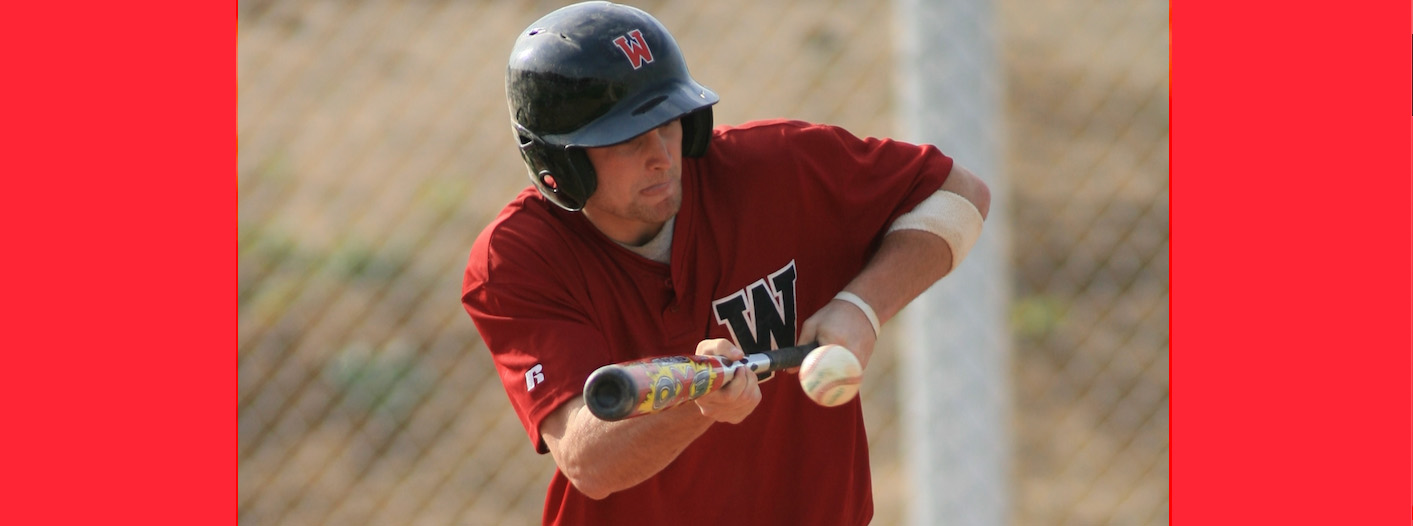
Can we maybe look at bunting a little differently?
Is standard bunting technique really as successful as it should be?
Is standard bunting technique safe for our players?
Something is going on here. Even bad hitters with no power don’t want to bunt for hits. When they do, they are often popped up, fouled off, or go to the pitcher.
Too often, bunting is thought of as a referendum on being a team player. It’s seen as easy – “Just get it down!” It’s seen as an act of will and desire.
No – this is about technique and safety.
We all know about the demise of the bunt. Maybe it’s better that there are less bunts today, because players don’t even realize until it’s too late that their technique is putting them in extreme harm’s way. This exposure might be an even more important reason to look at bunting differently.
If you never knew anything about bunting, would we actually follow any of the precepts of standard bunting technique?
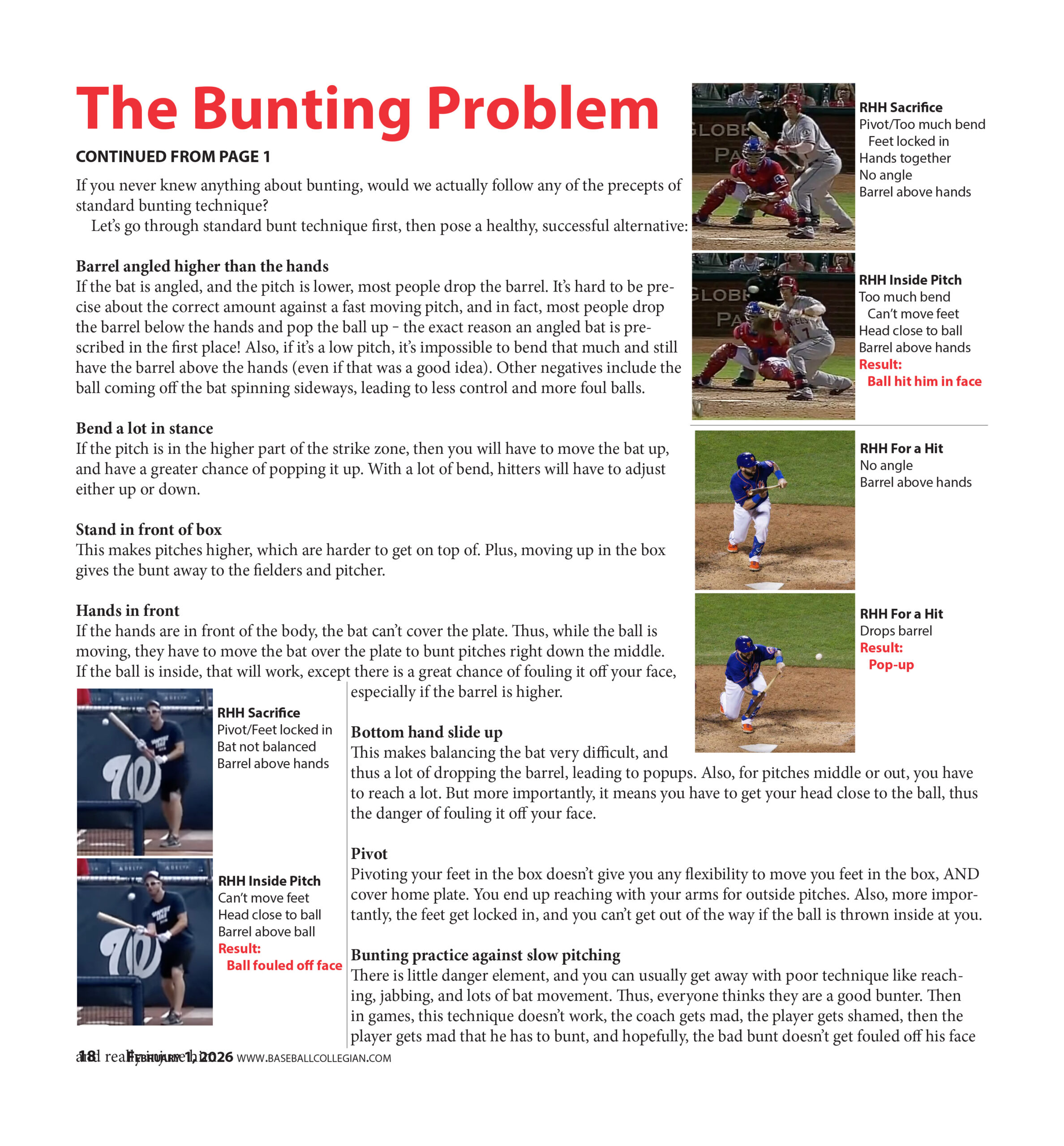 Let’s go through standard bunt technique first, then pose a healthy, successful alternative:
Barrel angled higher than the hands
If the bat is angled, and the pitch is lower, most people drop the barrel. It’s hard to be precise about the correct amount against a fast moving pitch, and in fact, most people drop the barrel below the hands and pop the ball up ‒ the exact reason an angled bat is prescribed in the first place! Also, if it’s a low pitch, it’s impossible to bend that much and still have the barrel above the hands (even if that was a good idea). Other negatives include the ball coming off the bat spinning sideways, leading to less control and more foul balls.
Bend a lot in stance
If the pitch is in the higher part of the strike zone, then you will have to move the bat up, and have a greater chance of popping it up. With a lot of bend, hitters will have to adjust either up or down.
Stand in front of box
This makes pitches higher, which are harder to get on top of. Plus, moving up in the box gives the bunt away to the fielders and pitcher.
Hands in front
If the hands are in front of the body, the bat can’t cover the plate. Thus, while the ball is moving, they have to move the bat over the plate to bunt pitches right down the middle. If the ball is inside, that will work, except there is a great chance of fouling it off your face, especially if the barrel is higher.
Bottom hand slide up
This makes balancing the bat very difficult, and thus a lot of dropping the barrel, leading to popups. Also, for pitches middle or out, you have to reach a lot. But more importantly, it means you have to get your head close to the ball, thus the danger of fouling it off your face.
Pivot
Pivoting your feet in the box doesn’t give you any flexibility to move you feet in the box, AND cover home plate. You end up reaching with your arms for outside pitches. Also, more importantly, the feet get locked in, and you can’t get out of the way if the ball is thrown inside at you.
Bunting practice against slow pitching
There is little danger element, and you can usually get away with poor technique like reaching, jabbing, and lots of bat movement. Thus, everyone thinks they are a good bunter. Then in games, this technique doesn’t work, the coach gets mad, the player gets shamed, then the player gets mad that he has to bunt, and hopefully, the bad bunt doesn’t get fouled off his face and really injure him.
 Fixing the Bunting Problem
Correct bunting technique has to feel safe and actually be safe. That is absolutely the No. 1 most important thing. This is almost a matter of ethics, in putting players in a position to not get injured. If you don’t feel safe, how can you possibly do it successfully? Thankfully, the safest technique is also the most successful technique, allowing players to be more consistent, and thus be more confident to bunt.
Thus, here is an alternative to the standard bunting model – a slightly different technique that has been tested and performed successfully for many years at the college level.
Note: This is for right-handed hitters on sacrifice bunts to third base. The same concept applies to all other bunts, except on bunts for hits where the right-handed hitter has a closed stance instead of an open stance.
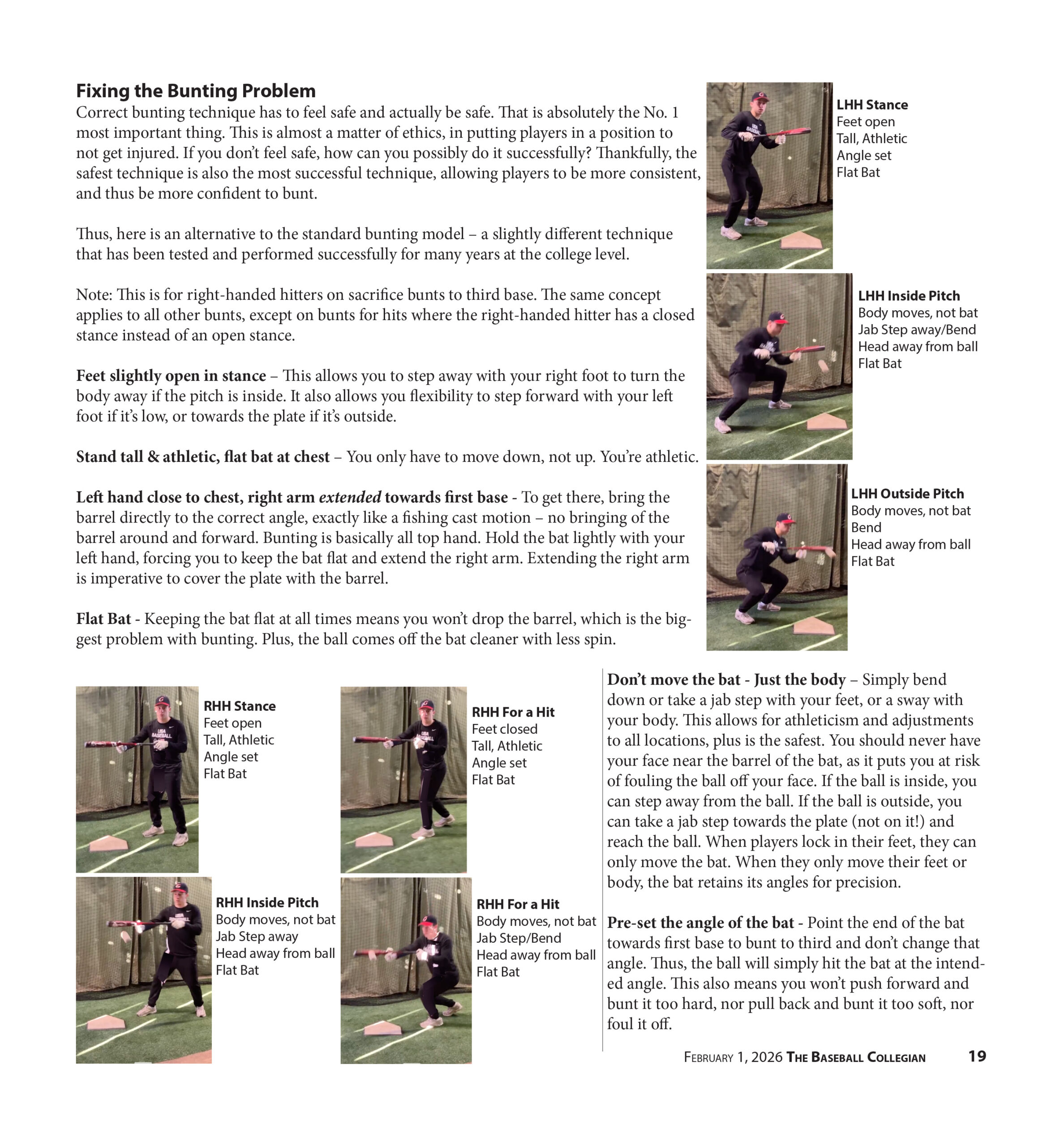
Feet slightly open in stance – This allows you to step away with your right foot to turn the body away if the pitch is inside. It also allows you flexibility to step forward with your left foot if it’s low, or towards the plate if it’s outside.
Stand tall & athletic, flat bat at chest – You only have to move down, not up. You’re athletic.
Left hand close to chest, right arm extended towards first base – To get there, bring the barrel directly to the correct angle, exactly like a fishing cast motion – no bringing of the barrel around and forward. Bunting is basically all top hand. Hold the bat lightly with your left hand, forcing you to keep the bat flat and extend the right arm. Extending the right arm is imperative to cover the plate with the barrel.
Flat Bat – Keeping the bat flat at all times means you won’t drop the barrel, which is the biggest problem with bunting. Plus, the ball comes off the bat cleaner with less spin.
Don’t move the bat – Just the body – Simply bend down or take a jab step with your feet, or a sway with your body. This allows for athleticism and adjustments to all locations, plus is the safest. You should never have your face near the barrel of the bat, as it puts you at risk of fouling the ball off your face. If the ball is inside, you can step away from the ball. If the ball is outside, you can take a jab step towards the plate (not on it!) and reach the ball. When players lock in their feet, they can only move the bat. When they only move their feet or body, the bat retains its angles for precision.
Pre-set the angle of the bat – Point the end of the bat towards first base to bunt to third and don’t change that angle. Thus, the ball will simply hit the bat at the intended angle. This also means you won’t push forward and bunt it too hard, nor pull back and bunt it too soft, nor foul it off.
Other Bunting Notes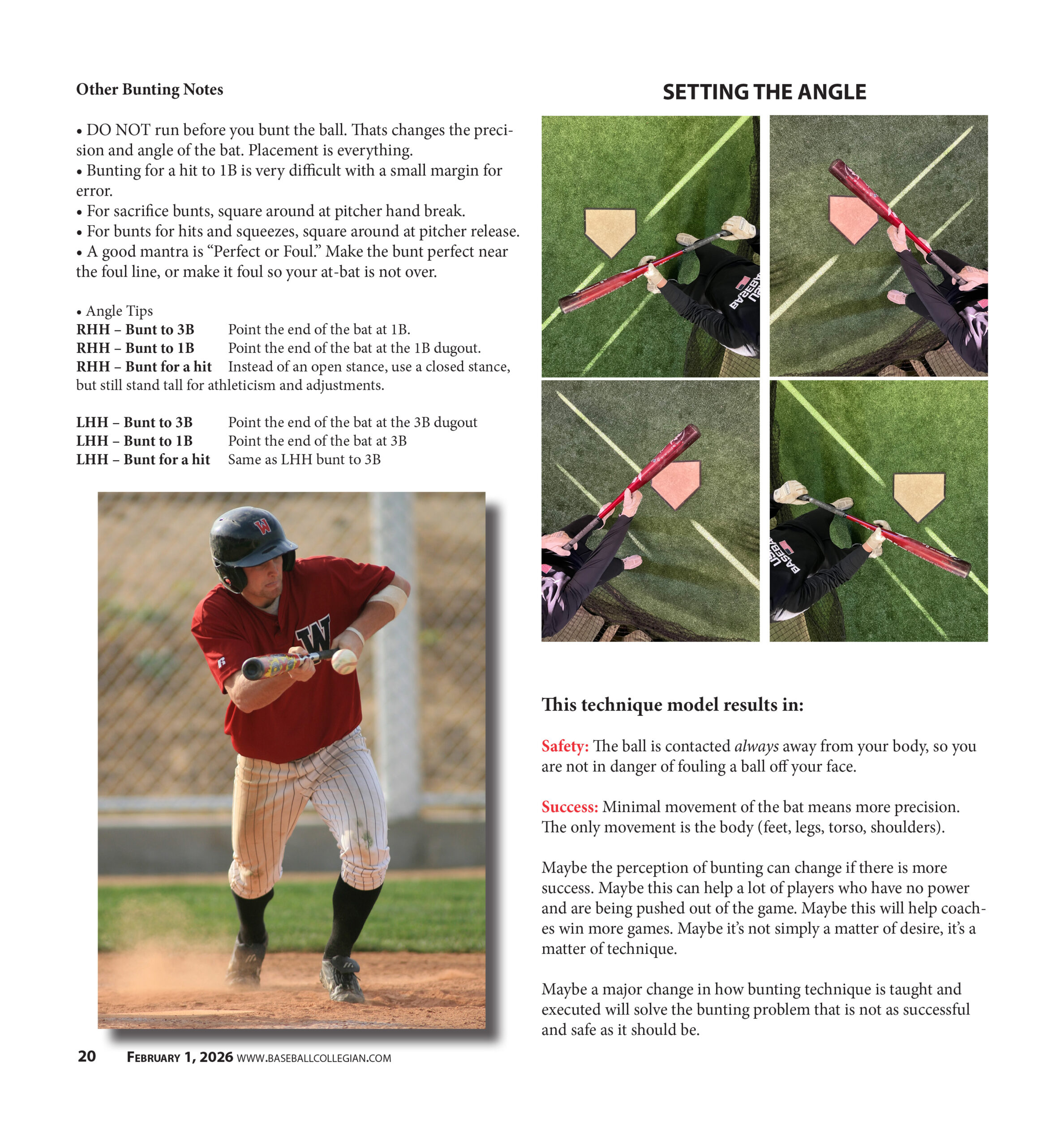
• DO NOT run before you bunt the ball. Thats changes the precision and angle of the bat. Placement is everything.
• Bunting for a hit to 1B is very difficult with a small margin for error.
• For sacrifice bunts, square around at pitcher hand break.
• For bunts for hits and squeezes, square around at pitcher release.
• A good mantra is “Perfect or Foul.” Make the bunt perfect near the foul line, or make it foul so your at-bat is not over.
• Angle Tips
RHH – Bunt to 3B Point the end of the bat at 1B.
RHH – Bunt to 1B Point the end of the bat at the 1B dugout.
RHH – Bunt for a hit Instead of an open stance, use a closed stance, but still stand tall for athleticism and adjustments.
LHH – Bunt to 3B Point the end of the bat at the 3B dugout
LHH – Bunt to 1B Point the end of the bat at 3B
LHH – Bunt for a hit Same as LHH bunt to 3B
This technique model results in:
Safety: The ball is contacted always away from your body, so you are not in danger of fouling a ball off your face.
Success: Minimal movement of the bat means more precision. The only movement is the body (feet, legs, torso, shoulders).
Maybe the perception of bunting can change if there is more success. Maybe this can help a lot of players who have no power and are being pushed out of the game. Maybe this will help coaches win more games. Maybe it’s not simply a matter of desire, it’s a matter of technique.
Maybe a major change in how bunting technique is taught and executed will solve the bunting problem that is not as successful and safe as it should be.
