
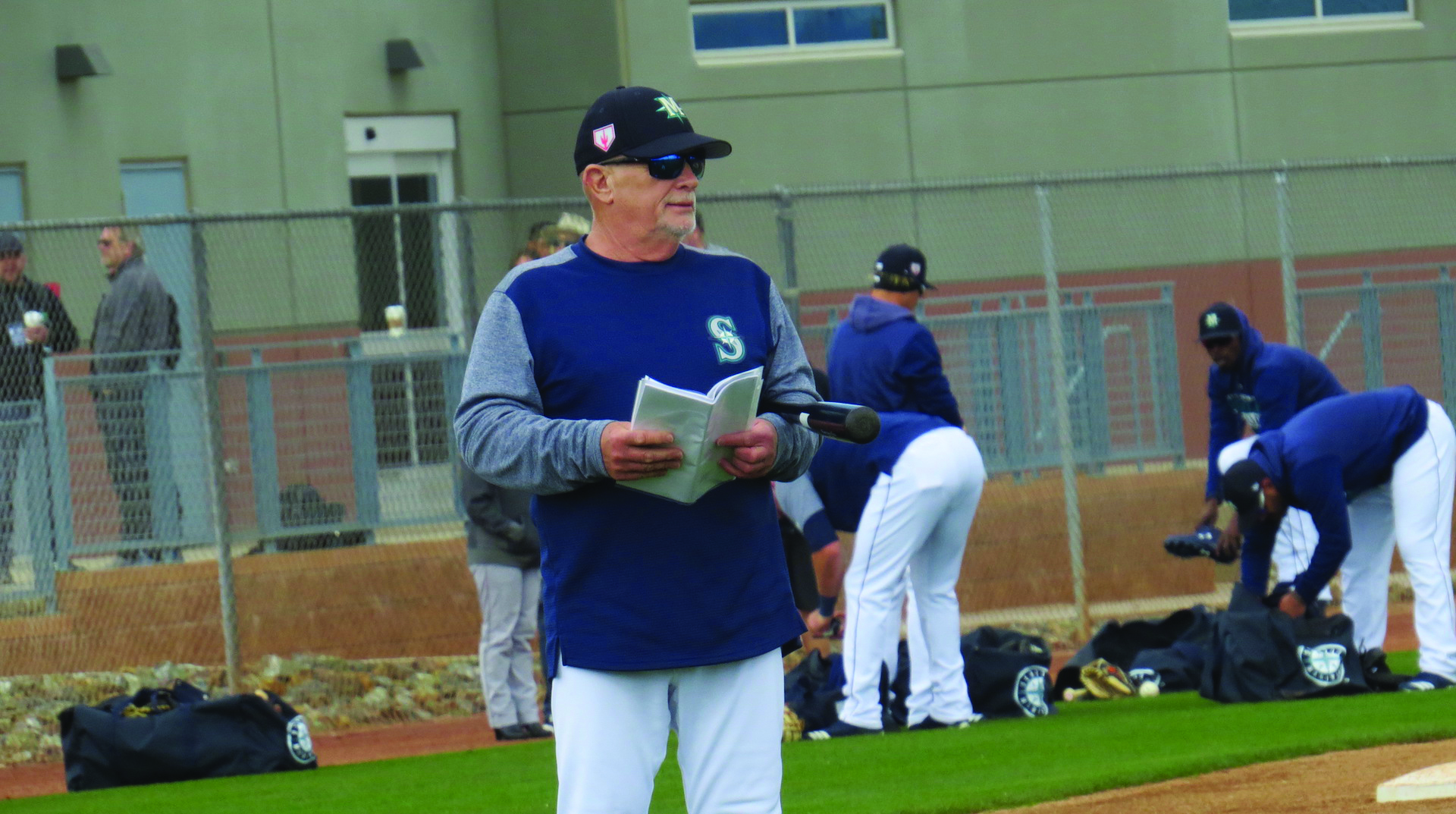
Perry Hill just completed his 38th season coaching in professional baseball. He has spent the last six seasons as the infield coach with the Seattle Mariners. Before that, he coached infielders with Detroit, Montreal, Texas, Pittsburgh & Florida/Miami.
He has become revered for his coaching of infielders, and in addition to coaching 10 Gold Glove winners and winning a World Series in 2003 with Florida, his teams have led the majors in fielding numerous times, and are always near the top.
He created his 6 F’s model of fielding (feet, field, funnel, footwork, fire and follow) playing in the Mexican Leagues back in 1976. During our interview, he used this lens to talk in-depth on the foundations of becoming a great fielder.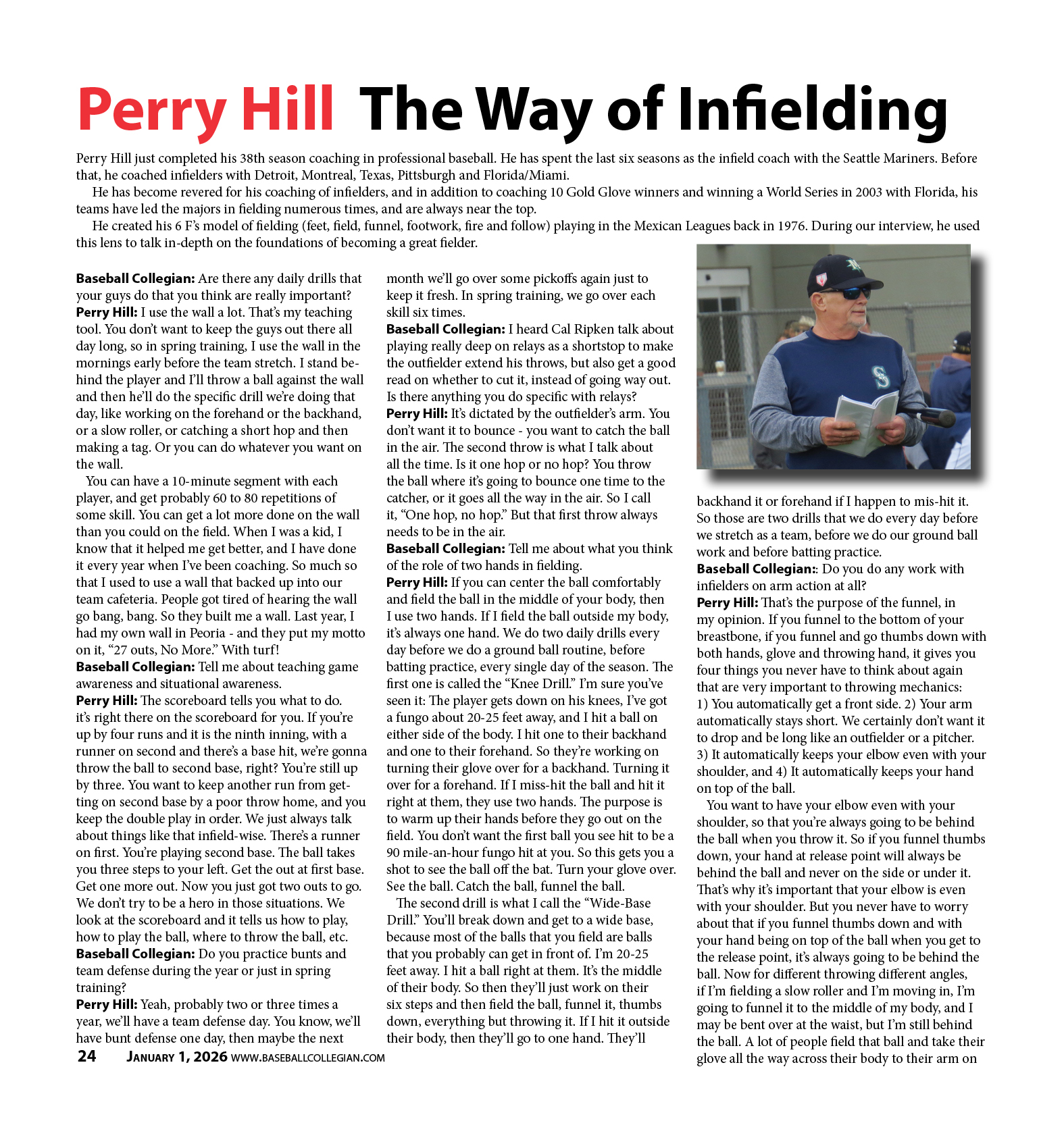
Baseball Collegian: Are there any daily drills that your guys do that you think are really important?
Perry Hill: I use the wall a lot. That’s my teaching tool. You don’t want to keep the guys out there all day long, so in spring training, I use the wall in the mornings early before the team stretch. I stand behind the player and I’ll throw a ball against the wall and then he’ll do the specific drill we’re doing that day, like working on the forehand or the backhand, or a slow roller, or catching a short hop and then making a tag. Or you can do whatever you want on the wall.
You can have a 10-minute segment with each player, and get probably 60 to 80 repetitions of some skill. You can get a lot more done on the wall than you could on the field. When I was a kid, I know that it helped me get better, and I have done it every year when I’ve been coaching. So much so that I used to use a wall that backed up into our team cafeteria. People got tired of hearing the wall go bang, bang. So they built me a wall. Last year, I had my own wall in Peoria – and they put my motto on it, “27 outs, No More.” With turf!
Baseball Collegian: Tell me about teaching game awareness and situational awareness.
Perry Hill: The scoreboard tells you what to do. it’s right there on the scoreboard for you. If you’re up by four runs and it is the ninth inning, with a runner on second and there’s a base hit, we’re gonna throw the ball to second base, right? You’re still up by three. You want to keep another run from getting on second base by a poor throw home, and you keep the double play in order. We just always talk about things like that infield-wise. There’s a runner on first. You’re playing second base. The ball takes you three steps to your left. Get the out at first base. Get one more out. Now you just got two outs to go. We don’t try to be a hero in those situations. We look at the scoreboard and it tells us how to play, how to play the ball, where to throw the ball, etc.
Baseball Collegian: Do you practice bunts and team defense during the year or just in spring training?
Perry Hill: Yeah, probably two or three times a year, we’ll have a team defense day. You know, we’ll have bunt defense one day, then maybe the next month we’ll go over some pickoffs again just to keep it fresh. In spring training, we go over each skill six times.
Baseball Collegian: I heard Cal Ripken talk about playing really deep on relays as a shortstop to make the outfielder extend his throws, but also get a good read on whether to cut it, instead of going way out. Is there anything you do specific with relays?
Perry Hill: It’s dictated by the outfielder’s arm. You don’t want it to bounce – you want to catch the ball in the air. The second throw is what I talk about all the time. Is it one hop or no hop? You throw the ball where it’s going to bounce one time to the catcher, or it goes all the way in the air. So I call it, “One hop, no hop.” But that first throw always needs to be in the air.
Bas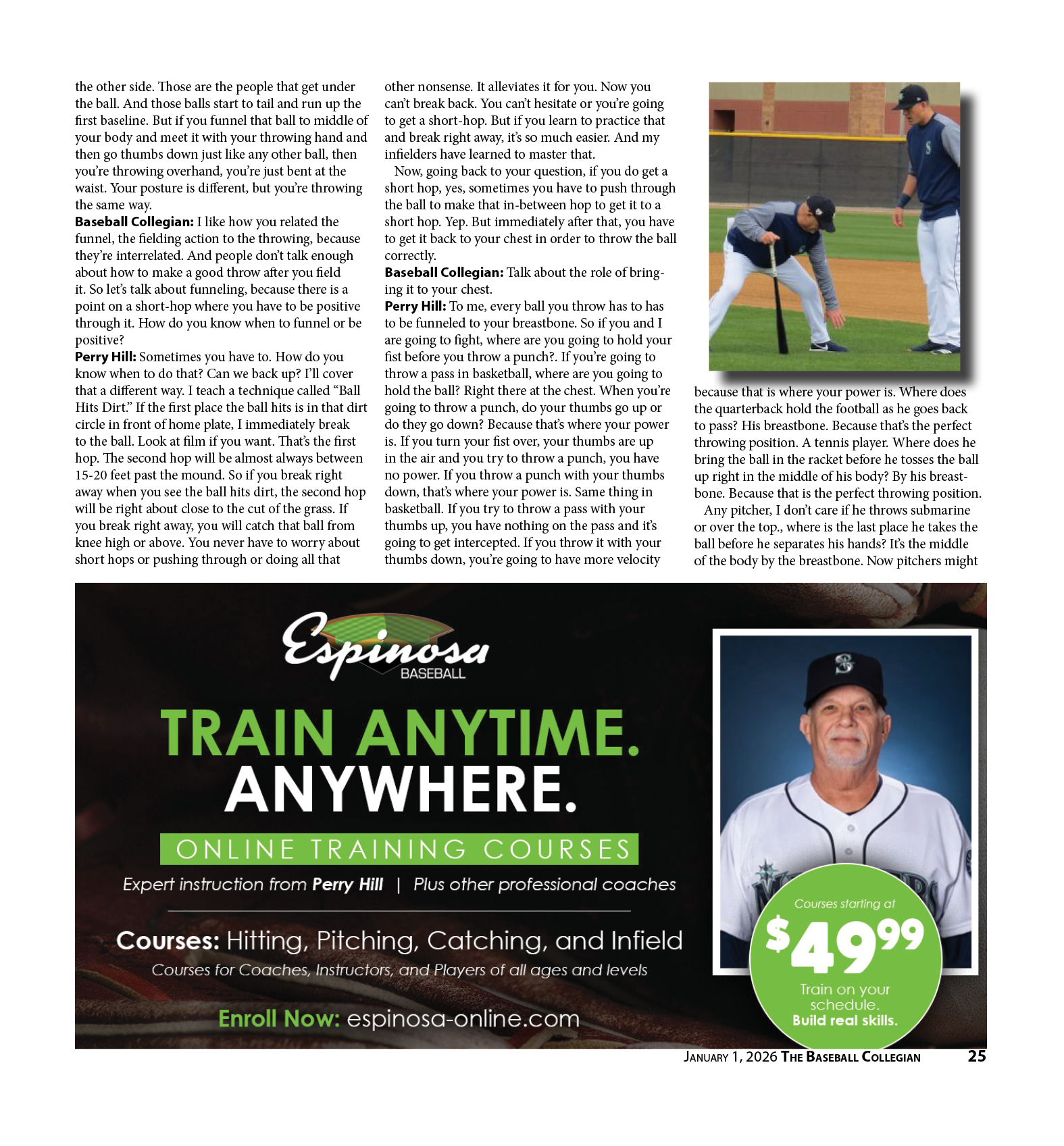 eball Collegian: Tell me about what you think of the role of two hands in fielding.
Perry Hill: If you can center the ball comfortably and field the ball in the middle of your body, then I use two hands. If I field the ball outside my body, it’s always one hand. We do two daily drills every day before we do a ground ball routine, before batting practice, every single day of the season. The first one is called the “Knee Drill.” I’m sure you’ve seen it: The player gets down on his knees, I’ve got a fungo about 20-25 feet away, and I hit a ball on either side of the body. I hit one to their backhand and one to their forehand. So they’re working on turning their glove over for a backhand. Turning it over for a forehand. If I miss-hit the ball and hit it right at them, they use two hands. The purpose is to warm up their hands before they go out on the field. You don’t want the first ball you see hit to be a 90 mile-an-hour fungo hit at you. So this gets you a shot to see the ball off the bat. Turn your glove over. See the ball. Catch the ball, funnel the ball.
The second drill is what I call the “Wide-Base Drill.” You’ll break down and get to a wide base, because most of the balls that you field are balls that you probably can get in front of. I’m 20-25 feet away. I hit a ball right at them. It’s the middle of their body. So then they’ll just work on their six steps and then field the ball, funnel it, thumbs down, everything but throwing it. If I hit it outside their body, then they’ll go to one hand. They’ll backhand it or forehand if I happen to mis-hit it. So those are two drills that we do every day before we stretch as a team, before we do our ground ball work and before batting practice.
Baseball Collegian:: Do you do any work with infielders on arm action at all?
Perry Hill: That’s the purpose of the funnel, in my opinion. If you funnel to the bottom of your breastbone, if you funnel and go thumbs down with both hands, glove and throwing hand, it gives you four things you never have to think about again that are very important to throwing mechanics: 1) You automatically get a front side. 2) Your arm automatically stays short. We certainly don’t want it to drop and be long like an outfielder or a pitcher. 3) It automatically keeps your elbow even with your shoulder, and 4) It automatically keeps your hand on top of the ball.
You want to have your elbow even with your shoulder, so that you’re always going to be behind the ball when you throw it. So if you funnel thumbs down, your hand at release point will always be behind the ball and never on the side or under it. That’s why it’s important that your elbow is even with your shoulder. But you never have to worry about that if you funnel thumbs down and with your hand being on top of the ball when you get to the release point, it’s always going to be behind the ball. Now for different throwing different angles, if I’m fielding a slow roller and I’m moving in, I’m going to funnel it to the middle of my body, and I may be bent over at the waist, but I’m still behind the ball. A lot of people field that ball and take their glove all the way across their body to their arm on the other side. Those are the people that get under the ball. And those balls start to tail and run up the first baseline. But if you funnel that ball to middle of your body and meet it with your throwing hand and then go thumbs down just like any other ball, then you’re throwing overhand, you’re just bent at the waist. Your posture is different, but you’re throwing the same way.
Baseball Collegian: I like how you related the funnel, the fielding action to the throwing, because they’re interrelated. And people don’t talk enough about how to make a good throw after you field it. So let’s talk about funneling, because there is a point on a short-hop where you have to be positive through it. How do you know when to funnel or be positive?
Perry Hill: Sometimes you have to. How do you know when to do that? Can we back up? I’ll cover that a different way. I teach a technique called “Ball Hits Dirt.” If the first place the ball hits is in that dirt circle in front of home plate, I immediately break to the ball. Look at film if you want. That’s the first hop. The second hop will be almost always between 15-20 feet past the mound. So if you break right away when you see the ball hits dirt, the second hop will be right about close to the cut of the grass. If you break right away, you will catch that ball from knee high or above. You never have to worry about short hops or pushing through or doing all that other nonsense. It alleviates it for you. Now you can’t break back. You can’t hesitate or you’re going to get a short-hop. But if you learn to practice that and break right away, it’s so much easier. And my infielders have learned to master that.
Now, going back to your question, if you do get a short hop, yes, sometimes you have to push through the ball to make that in-between hop to get it to a short hop. Yep. But immediately after that, you have to get it back to your chest in order to throw the ball correctly.
Baseball Collegian: Talk about the role of bringing it to your chest.
Perry Hill: To me, every ball you throw has to has to be funneled to your breastbone. So if you and I are going to fight, where are you going to hold your fist before you throw a punch?. If you’re going to throw a pass in basketball, where are you going to hold the ball? Right there at the chest. When you’re going to throw a punch, do your thumbs go up or do they go down? Because that’s where your power is. If you turn your fist over, your thumbs are up in the air and you try to throw a punch, you have no power. If you throw a punch with your thumbs down, that’s where your power is. Same thing in basketball. If you try to throw a pass with your thumbs up, you have nothing on the pass and it’s going to get intercepted. If you throw it with your thumbs down, you’re going to have more velocity because that is where your power is. Where does the quarterback hold the football as he goes back to pass? His breastbone. Because that’s the perfect throwing position. A tennis player. Where does he bring the ball in the racket before he tosses the ball up right in the middle of his body? By his breastbone. Because that is the perfect throwing position.
Any pitcher, I don’t care if he throws submarine or over the top., where is the last place he takes the ball before he separates his hands? It’s the middle of the body by the breastbone. Now pitchers might sometimes might break with thumbs on the side or thumbs under because they want the ball to move and dart because they don’t want the hitter to hit it. We, on the other hand, want to throw the ball straight. So we’re always thumbs down because that’s where you get the more direct line on throws. Every sport. You know when you’re bowling, where you hold the ball as you go bowling? It’s most every sport holds the ball in the middle of their body.
Baseball Collegian: What do you think about stepping behind with your right foot before throwing?
Perry Hill: I hate it. Tell me where your left shoulder goes. It rotates to the right, and when your left shoulder moves, even an inch or two, that means your arm has to move to compensate for that. Now, instead of being behind the ball where your power is, you’re a little bit on the side of the ball. And if you have any kind of arm strength, you’re going to get a tailing action or a sinking action with your throw because you’re not lined up to your target. I talk about it this way: If you were my coach and I was taking a secondary lead at first base and I put my left foot behind my right foot, would you correct me? Yes. Why? Because it rotates your shoulders too much. So if that’s bad, then why wouldn’t it be bad throwing? So that’s what I teach. Replacing your feet when you’re throwing: Your right foot goes where your left foot is, but at the same time your left foot is moving towards your target. And you get what I call the two D’s: Distance and Direction. If you cross your feet on a secondary lead, you’re not getting the two D’s, right? So, when I see a coach correct somebody because they’re taking an improper secondary lead, and then I don’t see him correcting that when they throw, I’m thinking that this guy needs to stop and figure it out. I use the word “replace” because “shuffle” may imply that they can just move their feet any way they want. I catch the ball, I replace my feet.
Baseball Collegian: I want to talk about fly balls because I see these infielders in the majors in loud stadiums sprinting after balls with no fear. I don’t see them calling it at full speed while running to the outfield with their back to home plate. How is the right of way communication handled on those?
Perry Hill: Things are being said. You just can’t tell. So the infielder goes until he hears the outfielder. The outfielder has priority. Anytime the outfielder calls it, the infielder peels off immediately.
Baseball Collegian: So the infielder is not necessarily calling it, though.
Perry Hill: No. When going out toward the outfield, he calls the ball only if he can actually stop.
Baseball Collegian: What is the difference between a great major league infielder and a poor major league infielder, because overall, they’re all amazing fielders, right? But what is the distinction between the guy that you don’t think is that good, and the guy that’s good enough to play every day? It seems so subtle.
Perry Hill: No plays are routine. A ground ball could hit a spike mark and take a little bitty hop and screw the whole thing up. So nothing’s routine in my opinion. I call it, “Making the plays in the box.” In other words, I look four or five steps each way, then I look six or seven in, and then I just close it. I make it a box. Make those plays in that box. Pitchers can go deeper into games, you don’t tax your bullpen with extra pitches, and it makes the game flow faster. If you make a play outside the box, hallelujah, great. But for me, a great infielder is the guy that makes those plays in that box every single time. Those are outs. That’s the consistent type of infielder that I want. You’ll see a lot of guys that bobble the ground ball right at them, but make the great play up the middle, spin and throw a guy out at first. Well, how many times does that play happen compared to a ground ball that’s two steps from you? I spend my time on plays in the box. If you make the plays in the box, you’re going to win a lot of games. They’re the hardest plays to make: the plays in the box. If you talk about it every day and you stress it every day, the player sees that you think it’s important, and it becomes important to them. There are a lot of coaches that don’t talk about things until they happen. So the players are automatically thinking, “Well, we never do this or we never talk about it or we never practice this. So it must not be very important.” So it becomes less important to them. I tried to keep everything in front of the player. You got to make the plays in the box. You got to turn this double play. I constantly talk about it. The player knows it’s important, so therefore it becomes important to them because they know if he doesn’t, they’re not going to play for me. A lot of things are not talked about until it goes wrong. Prevention is worth a pound of cure.
Baseball Collegian: Have you seen many players who’ve really transformed themselves from a bad infielder and then made themselves into good infielders.
Perry Hill: So I couldn’t even begin to give you a list. There are so many. It’s not because of me. It’s because of our philosophy. Talking about things every day that are important. Don’t let anything slide. There are some days that my players hate me, and sometimes they go two or three days without talking to me, because I do not let anything slide. We take every ground ball before the game as if it’s the seventh game in the World Series because you practice how you play. You can’t practice half-speed and expect to play full speed. So there’s intensity to the ground ball routine that we do every day. And I let them know about it.
Baseball Collegian: So for the pre-pitch ready position, what do you have your guys do?
Perry Hill: I like to do the same thing a tennis player does. The guy’s getting ready to serve you the ball, you’re kind of swaying or standing there. You take a tiny step forward, and once that racket starts to move forward, that’s when you separate your feet and land on the balls of your feet. That’s the same thing in baseball. Peripherally, I’m looking at the pitcher. And when he makes his first move, whether he’s in the stretch or the wind up, I slightly bend my back. If you go to a major league game, when you see the pitcher take his first initial move, you’ll see four infielders slightly bend their back at the same time. Because you don’t want to be so upright, you want to be in an athletic position. So this helps you makes it a habit. Once the pitcher’s arm goes back, once it starts to go forward, I take a small step with my right foot and then I separate my feet. The timing puts the ball right in front of home plate. So now when the ball hits the bat, my feet are hitting the ground and I’m actually moving when the ball is hit. So I’m going to be quicker to the ball than the guy who’s just flat-footed and not moving.
Players might come from another organization and do something else, but as long as he lands on the balls of his feet when the ball is right in front of home plate, I have no problem with it. But if he does something too early where he is flat-footed when the ball gets to home plate, then I’ll introduce him to this method, because once the pitcher makes his first move, there’s always constant movement with the infielder. Sir Isaac Newton said that an object in motion stays in motion And they’ll say, “Who’s Sir Isaac Newton?” That leads me right into the discussion about how you’re quicker when you’re moving than when you’re not. But you gotta know how to outsmart these guys sometimes, you know? I use every tool I can.
