Pitchers who throw strikes. Who don’t walk anyone. Who throw three pitches for strikes. Who throw hard. Who have a lot of movement. Who are good defenders. Who have a strong mental game.
These are the guys we want our pitchers to be. These are the goals we give our pitchers and when they don’t perform well, we pick out one or more of these to have them work on.
But is that what is really going on? Is that what leads to success? We’ve all seen all kinds of pitchers who just get outs. Pitchers who could really only throw one pitch for strikes, but had successful seasons. Pitchers who walk a bunch, but pitch well. Pitchers who have middling velocity and have successful seasons (indeed, there is a minimum velocity needed, which is defined as the slowest pitcher at that level of play). And pitchers who can’t throw a breaking pitch to save their lives, or pitchers who are bad athletes, yet still pitch well.
Conversely, there are pitchers who throw three pitches for strikes, but have poor seasons. And pitchers who don’t walk anyone who have poor seasons. And pitchers with outstanding velocity who can’t get anyone out. And pitchers with incredible movement on their pitches, and pitchers who are incredible athletes, who pitch poorly.
Thus, a study was born on what are the variables that are found most often in successful seasons by pitchers.
The study started with an analysis of the season success of 119 pitchers who threw 57,000 pitches. A successful season was defined as a low ERA or low WHIP, or low hits allowed per nine. A regression analysis was run to look at some quantifiable variables – strike percentages, velocity ranges, hits, walks, movement, and atheticism – to see what were the common skills that pitchers had in successful seasons.
The result was an interesting discovery: Pitchers who had success at just two variables had excellent seasons. The pitchers who didn’t have success at these two aspects did not have good seasons.
The Variables
The two variables are this: Pitchers having an overpowering pitch; and then throwing it for the correct amount of strikes.
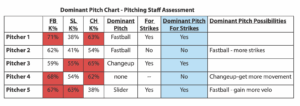
An overpowering pitch, what we call a “Dominant Pitch,” is defined as a pitch that is hard to hit, even if it’s thrown right down the middle. Here are examples of overpowing pitches:
A fastball with high velocity (HS-85+, DIII-87+, D1-91+, MLB 96+)
A fastball that moves a lot
An offspeed pitch that moves a lot
Any pitch that has exceptional command in the strike zone
A pitch that tunnels with other pitches
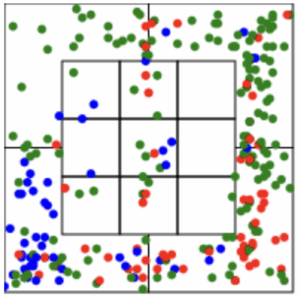 The correct amount of strikes is what we call reaching the “Threshold.”
The thresholds are:
Fastball: 67%+ for strikes
Curveball/Slider: 55% for strikes
Changeup: 60% for strikes.
Discovery
What was found that if pitchers simply had One Dominant pitch at Threshold (thrown for the correct amount of strikes), then they had a great season.
On one level, this is confounding. What about the need for three pitches for strikes? What about velocity? What about movement? What about holding runners?
These two variables, when put together, combine versions of all the traditional thoughts on successful pitchers, but also clarify exactly how to execute it. Of course, if you don’t have a single good pitch but throw all of them for strikes, you will give up a lot of hits. Of course, if you have great velo or movement, but don’t throw any pitches for strikes, you will walk a lot of people. On the flip side, if you have a dominant pitch that you also throw for strikes, it will be very hard to hit, regardless of the count, situation, umpire, or hitter.
What about the guys whose dominant pitch gets hit because they can’t throw another pitch for strikes? I contend that it is not really a dominant pitch. There are certainly examples of MLB pitchers who throw one pitch and still dominate.
What about the observed problem of needing a second pitch to balance off their other pitch? This is true, but the need for that second pitch to also be exceptional, or even thrown for strikes, doesn’t appear to be necessary. You do need to show a pitch at a different speed to keep hitters honest by changing their timing, and it helps to tunnel with your dominant pitch (fastball up, offspeed down). Still, it’s all in service of that dominant pitch.
Thus, an action plan for successful pitchers can be formulated:
• Pitchers must seek out a Dominant Pitch (a pitch that’s hard to hit).
• Pitchers must figure out how to throw it at Threshold (the correct % of strikes).
• Show other pitches certainly, but in a simplified version, throw it in the opposite location as their dominant pitch, even if it’s not a strike (missing by a lot does not keep hitters honest).
• If you have one dominant pitch at Threshold, then go find another. That pitcher will be really dominant.
• This simple scoreboard can be used by coaches quickly mid-game to see if the pitcher should stay in or not.